

Legislative decision designs architecture, not just a response
Every legislative decision creates a legislative architecture, even when this is not explicitly recognized.
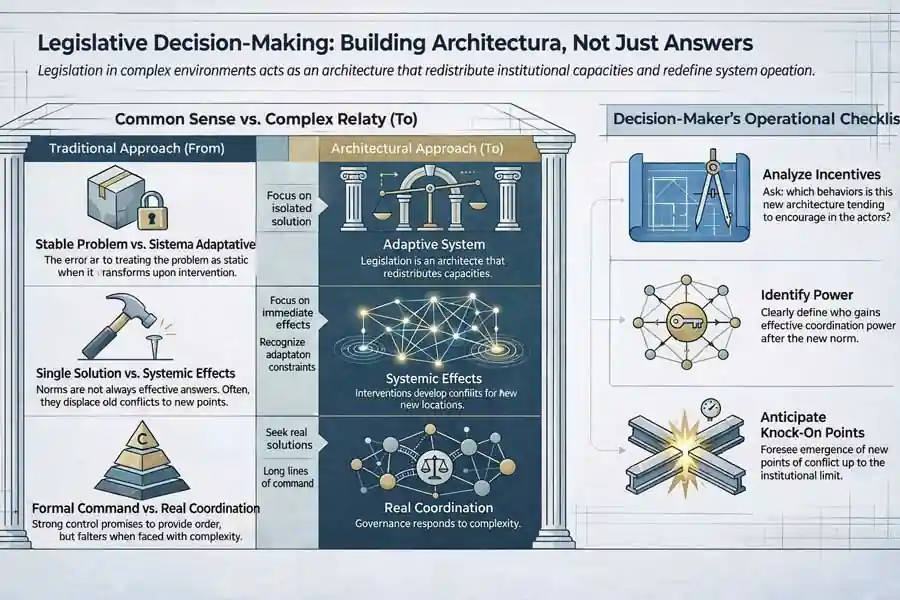
Laws do not merely authorize conduct. They organize incentives, distribute power, define coordination centers, and also produce zones of institutional conflict.
In complex problems, this architectural dimension ceases to be a detail and becomes the very core of the decision. One does not decide only “what to do,” but also how the institutional system will operate after the norm.
The recurrent error in legislative action lies not in the lack of technical information. It lies in the implicit assumption that legislative decision-making consists of choosing the best available response to a stable problem. In complex environments, the problem transforms as the response is applied.
Violence, organized crime, surveillance technology, and federative coordination are not isolated themes. They are fields in which every normative decision reorganizes the behavior of the actors involved. The legislative architecture becomes part of the system it intends to orient.
The central point is simple and uncomfortable:
no neutral legislative decision exists in complex problems.
Every norm:
- redistributes institutional capacities
- incentivizes adaptation strategies
- displaces conflicts to new points in the system
Ignoring this does not make the decision more objective. It only makes it blind to its own effects.
The most common error
Legislative common sense still operates under three fragile assumptions:
- the problem is stable
- the correct solution exists
- implementation will follow the original design
These assumptions frequently fail in complex problems. When they fail, the state responds with more norms, more centralization, or more technology, reinforcing cycles of decisional frustration.
What changes when architecture is assumed
When the decider assumes that every legislative decision designs legislative architecture, the focus shifts:
- from isolated solutions to systemic effects
- from formal command to real coordination
- from the promise of control to responsible management
This does not weaken state action. It makes the decision more conscious of its limits.
Section 1 – Operational Checklist
Before any legislative decision, ask:
- What behaviors this architecture tends to incentivize
- Who gains coordination power after the norm
- Where new points of institutional friction arise
- Who learns and adapts faster to the new arrangement
Summary
Legislative decision, in complex problems, is not a punctual choice. It is a design of legislative architecture that reorganizes incentives, powers, and conflicts. Ignoring this dimension does not simplify the decision. It only pushes the cost further down the line.
Visual Summary
Complex problems do not eliminate decision; they impose criteria
Recognizing complex problems does not authorize decisional paralysis.
It authorizes criteria.
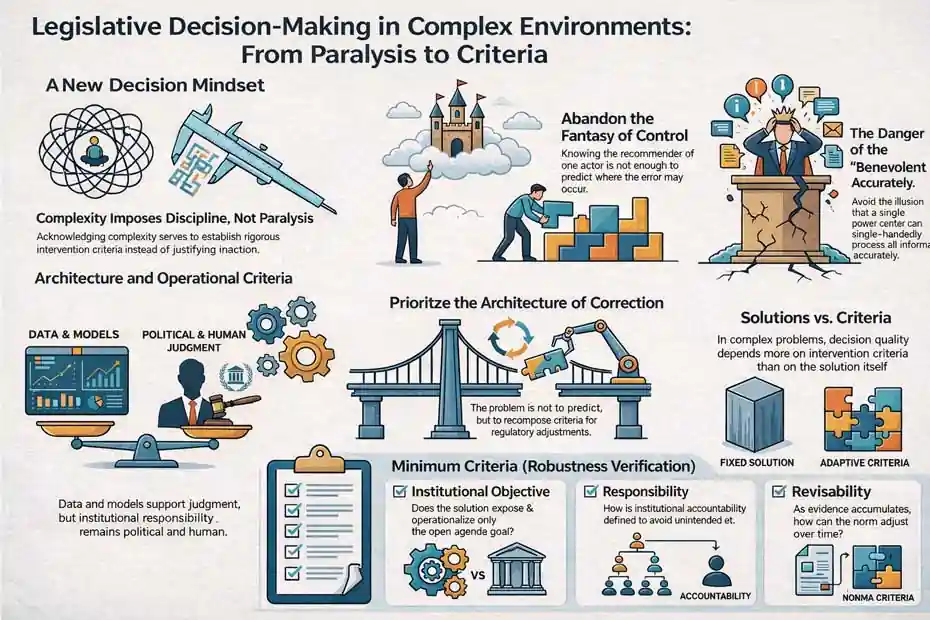
A recurrent and unproductive use of the complexity idea is treating it as a justification for indecision. The role of complexity, here, is different: to impose discipline on the legislative decision, not to dissolve it.
Deciding in complex environments requires abandoning the fantasy of total control and adopting explicit intervention criteria. It is not about predicting everything. It is about recognizing where error may occur and who responds institutionally for it.
The problem is not missing the prediction.
The problem is missing an architecture for correction.
The limit of technique
Technology, data, and models are relevant support to the legislative decision. But they do not replace political judgment. When the decider transfers integral responsibility to the technical apparatus, they create two simultaneous risks:
- decisional opacity
- dilution of institutional responsibility
Technique orients. The legislative decision remains political, human, and accountable.
Criteria more relevant than solutions
In complex problems, the quality of the legislative decision depends less on the chosen solution and more on the criteria that orient its application and review.
Minimum criteria:
- clear institutional objective
- explicit responsibilities
- separation between technical support and political decision
- real possibility for normative review
Without these elements, legislative architecture crystallizes and begins to produce unforeseen effects.
Section 2 – Operational Checklist
When structuring a legislative decision, verify:
- Is the objective operational or merely rhetorical
- Who answers for unintended effects
- How the norm can be adjusted without an institutional crisis
- Where technical role ends and political decision begins
Summary
Complex problems do not eliminate the legislative decision. They require clear criteria, defined responsibility, and the capacity for correction. Technique orients but does not decide. Confusing these planes generates institutional error, not just technical error.
Visual Summary
Legislative architecture governs risk; it does not promise control
The promise of total control is seductive.
And almost always false in complex problems.
In public security, technology, and state coordination, normative discourse frequently sells predictability and anticipation. In practice, what is delivered is decisional noise, institutional overlap, and a false sense of mastery.
Governing well is not about eliminating risk.
It is about orienting the legislative decision to coexist with risk without losing legitimacy.
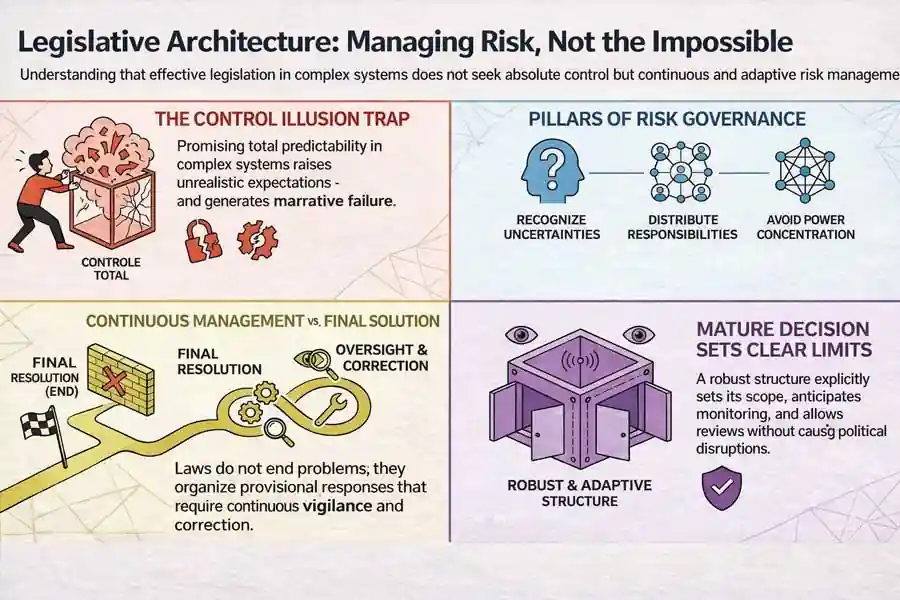
This requires abandoning the logic of the definitive solution and adopting the logic of continuous effect management. Legislative architecture does not close problems. It organizes provisional responses under permanent vigilance.
The political cost of the illusion of control
Promising absolute control produces two recurrent effects:
- it raises expectations that the system cannot fulfill
- it delegitimizes the legislative decision when reality imposes itself
When the norm ignores limits, failure becomes narrative before it is even empirical.
The role of mature legislative architecture
A legislative architecture oriented toward risk governance:
- recognizes uncertainty
- distributes responsibility
- creates space for correction
- avoids excessive concentration of decisional power
This does not weaken the state. It reduces systemic risk.
Section 3 – Operational Checklist
A legislative decision oriented toward risk governance must:
- explicate limits of use and scope
- foresee institutional monitoring
- allow for review without political rupture
- avoid excessive dependence on a single decisional center
Visual Summary
Summary
Legislative architecture does not promise total control in complex problems. It governs risk with criteria, responsibility, and the possibility for correction. Mature legislative decisions recognize limits before they impose themselves chaotically.
Final considerations
This text offers no ready-made solution.
It offers a responsible mode of orienting legislative decisions in complex problems.
Legislative architecture, when treated with seriousness, ceases to be an academic abstraction and becomes a minimum condition for acting without producing further institutional disorder.
Those who decide will continue to err.
The difference lies in erring with architecture or erring in the dark.
This is the central role of Track 3 at [S] Lab.