

Violence, Organization, and Organized Crime: Three Levels, Recurring Errors
Analytical Framework
Violence and organized crime often appear associated in public and institutional debate, but they operate at distinct analytical levels. Confusing these levels generates fragile diagnoses and predictable responses. For real decisions in public safety, it is necessary to separate layers before intervening.
At [S] Lab, the reading starts from an operational progression:
violence → organization of violence → organized crime
This distinction orients the entire analysis that follows.
📌 How to use this page?
🧭 Decision-oriented reading guide
The content of this pillar is presented as an analytical map of violence and organized crime.
It does not require linear reading.
- Use the tabs to navigate through distinct levels of the problem
- Read only the topics that seem relevant
- Treat each section as a framework, not a final answer
- Deep dives are indicated throughout the journey
Here, the objective is not to accumulate information, but to guide you through the content.
Violence
Relational and Decisional Phenomenon
Violence is not reduced to visible damage or extreme events. It emerges from situated human decisions, oriented by cultural, institutional, and relational contexts. Understanding it requires going beyond the immediate result.
The analysis of violence is structured into five dimensions.
The Five Dimensions of Violence
Conceptual base proposed by Dr. Sergio Senna
- 🧠 Desires and Decisions
Violence stems from choices, even under fear, pressure, or restriction.
- 👤 Agents and Patients
There is always one who exerts and one who suffers, even when roles alternate.
- ⚖️ Asymmetry
Differences in power, information, resources, or risk sustain the violent relationship.
- 📜 Disrespect for Norms and Rules
The rupture can be legal, moral, or symbolic, formal or informal.
- 🔥 Potential to Cause Harm
Harm can be physical, psychological, social, or institutional.
Violence is not defined solely by the effect.
It is defined by the structure of the relationship that produces it.
Organization of Violence
Limited Coordination
Not all organized violence constitutes organized crime.
The organization of violence involves:
- minimal coordination between actors
- informal rules of engagement
- basic functional division
- restricted relational predictability
Here, order emerges, but it remains unstable, fragmented, and easily dismantled.
Organized Crime
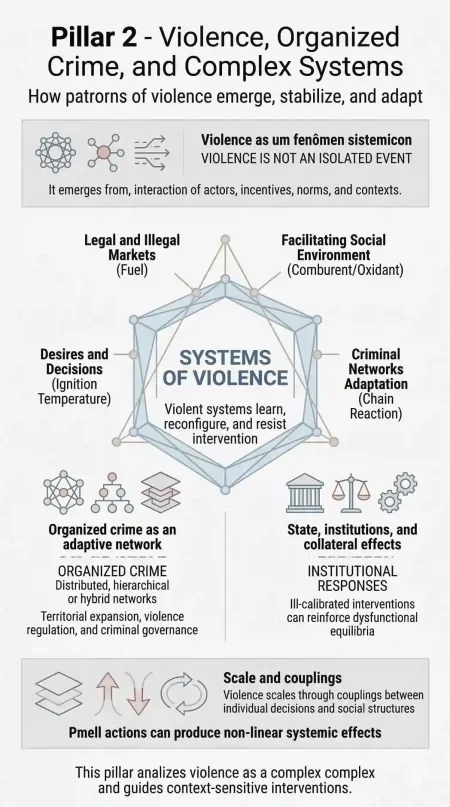
Adaptive System with Agency
Organized crime arises when violence becomes part of a system of actors with agency, capable of exploiting asymmetries continuously and strategically.
In organized crime:
- violence is a management instrument, not an impulse
- illicit markets ensure continuity
- territory organizes flows, protection, and control
- individual losses do not eliminate core functions
The central indicator of organized crime is not the intensity of violence,
but the capacity for structural preservation after repression.
Critical Implication for Managers
Strategic Retreat
Organized crime does not thrive only where the State is absent.
It strengthens where there are:
- persistent informational asymmetries
- decisional fragmentation
- institutional predictability
- political discontinuity
These conditions allow organized crime to learn, adapt, and recompose itself.
Recurring Framework Error
Operational Alert
Confusing violence with organized crime produces:
- symptom-oriented policies
- intense operations with short-term effects
- reinforcement of the asymmetries exploited by organized crime
Linear responses do not dismantle non-linear phenomena.
➜ Why does this distinction matter?
Decision Orientation
Separating violence, organization of violence, and organized crime changes the way we diagnose, plan, and intervene in public safety. From this progression, organized crime will be analyzed in the next sections as an adaptive system, rather than an episodic enemy.
Identify Critical Points:
Click on the tabs
We recommend that you navigate through the tabs in numerical order.
1. What do you find here?
General Analytical Map
How to read this page
This section organizes the analysis of violence and organized crime based on a systemic framework.
It was not designed for mandatory linear reading. Each tab deepens a distinct level of the diagnosis, but all start from the same analytical model.
Before moving forward, understand the logic.
Structure of the Analysis
Conceptual Progression
The page follows a clear progression:
violence → organization of violence → organized crime → institutional decision
Each tab answers a different strategic question. None works in isolation.
What each tab delivers
Criminal Framing Error
Where diagnoses fail
Presents the Tetrahedron of Criminal Organizations as an original diagnostic method.
Shows why partial readings of organized crime produce fragile and repetitive responses.
Read this if you want to understand why well-intentioned strategies fail.
Adaptive Organized Crime
Learning and Resilience
Analyzes organized crime as an adaptive system.
Explores agency, replacement of actors, adversarial adaptation, and the strategic use of violence.
Read this if you want to understand why isolated repression does not destabilize systems.
Markets and Territory
Where the system sustains itself
Examines the coupling between organized crime, illicit markets, and territorial control.
Shows how predictability and informal regulation sustain the system’s continuity.
Read this if you want to understand where the problem truly anchors itself.
Governance and Real Coordination
Real Limits of the State
Discusses centralization, polycentrism, and institutional coordination.
Explains why more command does not guarantee more control when facing organized crime.
Read this if you want to understand the institutional limits of state responses.
Strategies Under Constraint
Deciding Without Illusions
Presents possible strategies for confronting organized crime, with explicit costs, risks, and side effects.
It does not offer magic solutions. It offers criteria.
Read this if you want to understand how to decide better in imperfect scenarios.
How to use this page
Practical Orientation
- Sequential reading offers an integrated view
- Selective reading meets specific demands
- The initial framework is common to all tabs
2. The TCO Tetrahedron
The Tetrahedron of Criminal Organizations
🧭 Analytical model to read organized crime as a system
The Tetrahedron of Criminal Organizations is an original analytical model developed by Dr. Sergio Senna to understand why organized crime persists, adapts, and recomposes, even after intense repressive actions.
It starts from a simple premise:
👉 organized crime is not sustained by a single factor, but by the recursive interdependence among four structural dimensions.
Without looking at the whole, every intervention acts only upon symptoms.
🗣️ Read and Comment:
- After a major operation you followed, what truly changed: people, territories, or just the official discourse?
- Have you ever seen a drop in violence accompanied by the strengthening of organized crime? Where and how did it happen?
- What kind of state response do you think most taught organized crime how to adapt?
The Four Faces of the Tetrahedron
📌 None works in isolation
The model identifies four dimensions that reinforce each other:
- 🧠 Agency and Decision
Capacity to decide, replace actors, learn from losses, and preserve core functions.
- 💰 Economy and Illicit Markets
Financial flows that ensure continuity, adherence, protection, and adaptive capacity.
- 🌍 Territory and Relational Control
Informal regulation of space, local predictability, and reduction of operational uncertainty.
- ⚖️ Institutional Environment
Legal, normative, informational, and temporal asymmetries exploited by the system.
Each face sustains the others.
Attacking only one displaces the problem, it does not dismantle it.
Recursive Interdependence
![2026-The_transnational_criminal_organizations_tetrahedron_understanding_TCO_sustainability_through_recursive_interdependence-[s]-lab](https://ibralc.com.br/en/wp-content/uploads/2026/01/2026-The_transnational_criminal_organizations_tetrahedron_understanding_TCO_sustainability_through_recursive_interdependence-s-lab.webp)
The point that is often ignored
When the State pressures one dimension:
- the system compensates through the others
- it learns from the pattern of intervention
- it adjusts markets, routes, actors, or levels of violence
Therefore, successful short-term operations frequently produce:
- structural recomposition
- territorial migration
- criminal innovation
The Tetrahedron shows where the system absorbs impact and where it loses capacity.
Recurring Reading Error
Why policies fail even with good data
Most strategies fail because they:
- treat organized crime as a hierarchy
- confuse leadership with function
- focus on visible violence and ignore sustainability
- act on events, not on structures
The Tetrahedron corrects this bias by forcing a simultaneous reading of the four dimensions.
What is this model for?
Practical Function
The Tetrahedron:
- organizes the progression between dimensions
- explains why isolated repression fails
- grounds the reading of adaptation, territory, and governance
- avoids intuitive and fragile solutions
The next tabs deepen each face, without losing sight of the whole.
The Tetrahedron does not promise control.
It reduces strategic error.
3. Crime Learns!
Systemic Criminal Resilience
⚙️ Learning, Replacement, and Structural Preservation
The Analytical Starting Point
What changes when adaptation is understood
Organized crime does not only react to state action.
It learns, tests limits, and reorganizes functions in the face of incentives, pressures, and opportunities.
This adaptive trait explains why:
- major operations generate short-term effects
- relevant arrests do not produce collapse
- localized drops in violence do not signify structural weakening
Here, the common error is confusing visible impact with systemic effect.
Read and Comment:
- In your reality, is organized crime sustained more by territorial control or by economic flows that cross the territory?
- Have you witnessed an operation that dismantled a visible point but preserved the market?
- What kind of local predictability do you believe most favors the continuity of organized crime?
Adaptation is Not Improvisation
Recurring Process
In organized crime, adaptation involves:
- redistribution of functions
- rapid replacement of exposed actors
- adjustment of routes and markets
- recalibration of the use of violence
- continuous exploitation of institutional asymmetries
None of this depends on rigid central command.
It depends on distributed learning.
Distributed Agency and Resilience
Why the system does not collapse
Organized crime operates with distributed agency.
Relevant decisions do not concentrate on a single vulnerable point.
Practical consequences:
- human losses do not eliminate functions
- leaders are replaceable
- cells learn from others’ mistakes
- selective repression generates relocation, not dissolution
The resilience of organized crime is not in hierarchy,
it is in the preservation of critical functions.
Violence as a Strategic Variable
Regulation, Not Impulse
Violence in organized crime is regulated, not spontaneous.
It tends to:
- rise when there is dispute, internal discipline, or signaling of power
- fall when it threatens markets, attracts state attention, or breaks agreements
Reduction in homicides, in isolation, does not indicate the de-structuring of organized crime.
It may indicate only a tactical adjustment.
Asymmetry as an Adaptive Advantage
Where the system buys time
The adaptive capacity of organized crime is anchored in asymmetries:
- local information in real-time
- higher tolerance for risk
- decisional continuity
- use of practices forbidden to the State
- exploitation of institutional predictability
While the State decides under political cycles, organized crime decides under the logic of survival and profit.
The Recurring Response Error
Pressure Without Continuity
Strategies that ignore adaptation tend to:
- generate territorial displacement
- strengthen other faces of the Tetrahedron
- accelerate criminal innovation
- increase institutional costs
Pressure without adaptive reading trains the adversary.
Why does this content matter?
Link to the next sections
Understanding organized crime as an adaptive system prepares the reader for two central questions:
- where the system anchors itself materially
- how the State can coordinate responses without reinforcing asymmetries
These questions structure the next tabs.
4. Territory, Economy, and Flows
Markets and Territory
Where organized crime sustains itself
Starting Point
Organized crime does not float
Organized crime is not maintained only by violence or adaptation.
It needs a material base and relational predictability.
This base is formed in the coupling between illicit markets and territory.
Without this coupling, the system loses scale, continuity, and coordination.
Read and Comment:
- Where have you seen centralization improve results and where has it clearly worsened the response to organized crime?
- In practice, does the polycentrism you know coordinate or fragment actions? Why?
- What is currently the greatest real obstacle to institutional coordination in your experience?
Illicit Markets
Flows before actors
In organized crime, markets come before people.
They ensure:
- continuous liquidity
- incentive for adherence
- funding for adaptation
- capacity for corruption and protection
The common error is focusing on the visible illegal product and ignoring:
- logistics chains
- associated services
- money laundering and reinvestment
- articulation with licit economies
Where there is a stable market, organized crime finds a base to reorganize.
Territory
Organizer of Predictability
Territory, for organized crime, is not just physical space.
It is a structure of relational control.
In the territory, crime:
- regulates conflicts
- controls circulation
- protects flows
- imposes informal norms
- reduces operational uncertainty
Territory is not just armed domain.
It is the capacity to make the environment predictable.
Market–Territory Coupling
The core of sustainability
Organized crime stabilizes when:
- markets need territorial protection
- the territory depends on market income
- violence becomes regulated
- the relationship with the population becomes functional
This coupling creates mutual dependence and hinders external intervention.
Relationship with Local Populations
Functionality, Not Legitimacy
Organized crime does not need explicit support.
It needs:
- silence
- predictability
- selective cooperation
- functional neutrality
This is obtained through:
- provision of illegal services
- mediation of conflicts
- calibrated coercion
- exploitation of state failures
Confusing this with “legitimacy” is a serious analytical error.
Recurring Intervention Error
Attacking the Visible
Interventions focused only on:
- points of sale
- local leadership
- episodic territorial operations
tend to:
- displace markets
- fragment temporarily
- reinforce other territories
- preserve the organized crime system
Without breaking the market–territory coupling, the effect is short-lived.
Why is this tab central?
Connection with Governance
Understanding markets and territory prepares the reader for the next decisive question:
If crime organizes markets and regulates territories,
how does the State coordinate responses without reinforcing asymmetries?
This is the question of the next tab.
5. Governance and Real Coordination
Governance and Real Coordination
State coordination in the face of organized crime
Starting Point
More power is not more control
Facing organized crime, the intuitive response of the State is usually the centralization of command. The promise is efficiency and unity. The recurring result is the loss of territorial sensitivity, decisional delay, and exploitable predictability.
The central problem is not a lack of state authority.
It is the design of coordination, which is frequently incompatible with an adaptive phenomenon.
Read and Comment:
- What strategy have you seen that seemed effective in the short term, but generated serious side effects later?
- Which institutional cost is most often ignored when deciding to confront organized crime?
- If you had to sustain a single strategy for two years, which would be the hardest to maintain and why?
Excessive Centralization
When command becomes a bottleneck
Excessively centralized arrangements tend to:
- lengthen decision chains
- uniformize responses for distinct realities
- reduce local operational autonomy
- produce predictable patterns
In the short term, they appear to have control.
In the medium term, they favor the adaptation of organized crime.
Polycentrism: A Disputed Concept
Necessary Conceptual Alert
Polycentric governance is not a single or consensual concept.
It has been used in different countries with diverse political meanings, not always compatible with the protection of rights, state coordination, or efficacy in confronting organized crime.
In the project’s annexes, it is clear that:
- polycentrism is not synonymous with unrestricted decentralization
- it is not equivalent to outsourcing responsibilities
- it does not imply state withdrawal
- nor does it legitimize informal power arrangements
The [S] Lab proposal does not adhere to political uses of polycentrism that:
- dilute state responsibility
- fragment authority without coordination
- transfer costs to more fragile entities
- naturalize territorial asymmetries
Polycentrism as a Functional Necessity
Not Ideology, but Arrangement
In the context of organized crime, polycentrism is treated as an operational necessity, not a normative value.
When well-designed, polycentrism allows for:
- multiple coordinated decision centers
- relative autonomy with clear responsibility
- reduction of informational asymmetries
- territorially sensitive responses
- lower predictability for the adversary
Without explicit coordination, however, polycentrism fails.
Coordination is the Central Problem
And it is usually neglected
Organized crime coordinates because it:
- decides fast
- preserves functions even under loss
- tolerates internal conflict
- learns from error
The State fails when it:
- confuses command with coordination
- treats cooperation as an exception
- penalizes information sharing
- changes priorities with each political cycle
Coordination requires institutional architecture, not discourse.
Real Risks of Poorly Designed Polycentrism
Recurring Blind Spot
Without proper vigilance and design, polycentric arrangements can:
- generate institutional fiefdoms
- expand local capture
- reinforce territorial asymmetries
- hinder accountability
These risks do not invalidate polycentrism.
They reinforce the need for continuous control, monitoring, and correction.
Strategic Implication
Without Illusions
Facing organized crime, governing is not about seeking total control.
It is about managing complexity, reducing adversarial advantages, and preserving state adaptive capacity.
Polycentrism is not a political solution.
It is a demanding arrangement that fails when treated as a slogan.
Final Transition
For the last tab
Once the limits of governance are understood, the decisive question remains:
What is possible to do, in practice, without reinforcing the asymmetries that sustain organized crime?
This is the question of the next tab.
6. Strategies Under Constraint
Strategies Under Constraint — TAB 6
Deciding in the face of organized crime without illusions
Starting Point
Strategy is not ideal, it is possible
In confronting organized crime, the relevant question is not “what should be done,” but what is possible to do without reinforcing the asymmetries that sustain the system.
Strategy, here, does not mean final victory.
It means managing losses, side effects, and institutional continuity.
Read and Comment:
- What was the most difficult decision you ever saw taken (or avoided) out of fear of side effects?
- In practice, what usually carries more weight: what is possible to do or what is politically acceptable?
- Have you ever participated in a strategy that seemed correct on paper but unfeasible in the real context?
The Error of Origin
Confusing Intention with Effect
Most strategies fail because they:
- confuse repression with dismantling
- measure success by immediate impact
- ignore adversarial adaptation
- disregard institutional costs
Good intentions do not neutralize perverse systemic effects.
Minimum Principles of Realistic Action
Criteria, Not Recipes
In the face of organized crime, viable strategies tend to combine:
- selective pressure, not diffuse
- continuity, not episodic actions
- attack on functions, not just people
- reduction of flows, not just visible events
- sufficient coordination, not total control
Each choice implies a cost. Not choosing does as well.
Attacking Critical Functions
Where the system feels it
In organized crime, functions matter more than names.
The most effective pressures bear upon:
- financing and liquidity
- logistics and circulation
- communication and trust
- territorial protection
- coordination capacity
Arresting individuals without compromising functions trains the system.
Violence as an Ambiguous Indicator
Beware of Easy Metrics
Drops or spikes in violence can indicate:
- tactical adjustment
- internal dispute
- territorial reorganization
- side effect of repression
Violence is not a sufficient metric of strategic success against organized crime.
Costs and Side Effects
Nothing is Neutral
Every strategy produces:
- territorial displacement
- criminal adaptation
- institutional tensions
- impact on local populations
Responsible strategy anticipates these effects.
Neglecting them is an implicit decision.
What Recursively Does Not Work
Known Patterns of Failure
- operations without continuity
- centralization without coordination
- symbolic goals disconnected from the system
- universal solutions for distinct contexts
- promises of rapid elimination of organized crime
These patterns repeat because they seem decisive, but they are not.
Final Decision Criterion
What to evaluate before acting
A strategy is defensible when it:
- reduces adaptive advantages of organized crime
- does not expand institutional asymmetries
- preserves state capacity over time
- accepts limits without paralysis
Strategy is not about beating the system.
It is about not losing capacity in the face of it.
Closing — Violence and Organized Crime as a Systemic Problem
What remains after reading
The analysis developed on this page starts from a simple and uncomfortable premise: violence and organized crime are not isolated problems, nor reducible to a single factor. They emerge from human decisions, structural asymmetries, illicit markets, informally regulated territories, and institutional arrangements operating at their limits.
Separating these elements throughout the tabs was not about fragmenting the phenomenon, but about making it intelligible. When treated as an indistinct block, they produce intuitive responses. When analyzed as a system, they reveal where public decisions fail, where crime learns, and where the State becomes predictable.
Organized crime does not sustain itself only through violence. It persists because it:
- learns faster than the State adjusts its responses
- exploits informational, temporal, and normative asymmetries
- anchors itself in predictable markets and territories
- operates in networks capable of replacing actors without losing functions
- faces institutional architectures designed for simpler problems
Ignoring any of these dimensions does not eliminate the problem; it only displaces it.
The Role of this Pillar at [S] Lab
Do not offer easy solutions
This pillar does not promise total control, nor does it present universal formulas. It exists to correct naive readings and provide minimum criteria for less fragile decisions in public safety.
The central contribution is not in saying what to do, but in showing:
- what recursively does not work
- where well-intentioned responses produce perverse effects
- why the insistence on linear models sustains the problem
Without this foundation, any strategy becomes a gamble.
Connection with the Other Pillars
Necessary Progression
The systemic reading of violence and organized crime does not stand alone.
- Without applied psychology, one cannot understand decision, adherence, fear, and silence
- Without persuasion and influence, one cannot comprehend manipulation, coercion, and cooperation
- Without complexity and method, one cannot decide in non-linear environments
Each pillar of [S] Lab answers a part of the same problem.
Next Cognitive Step
It is not about deepening, but shifting the perspective
If this page shifted your way of reading organized crime, the next step is not to seek more data, but to learn to decide under uncertainty, conflict, and adversarial adaptation.
This is what the next pillar addresses.
Enclosure
Violence and organized crime will not be resolved by intensity, rhetoric, or excessive centralization. They require rigorous reading, imperfect coordination, and decisions conscious of their own limits.
This is the commitment of [S] Lab.
For those who wish to deepen:
Click on the tabs
Navigate through the tabs to read the latest studies from [S] Lab.
Organized Crime
PIRES, Sergio Fernandes Senna. The transnational criminal organizations tetrahedron: understanding TCO sustainability through recursive interdependence. Studies in Multidisciplinary Review, 6, 2025b, e13147. DOI: https://doi.org/10.55034/smrv6n1-001. Available at: https://www.researchgate.net/publication/387836275. Accessed on: Jan 13, 2026
PIRES, Sergio Fernandes Senna. The transnational criminal organizations tetrahedron: understanding TCO sustainability through recursive interdependence. Studies in Multidisciplinary Review, 6, 2025b, e13147. DOI: https://doi.org/10.55034/smrv6n1-001. Available at: https://www.researchgate.net/publication/387836275. Accessed on: Jan 13, 2026
Polycentrism
PIRES, Sergio Fernandes Senna. Quando a centralização produz menos controle: complexidade e governança policêntrica na segurança pública. Contemporânea, 6, 1, 2025b, p. 1-40. DOI: https://doi.org/10.56083/RCV6N1-088. Available at: https://www.researchgate.net/publication/400029126. Accessed on: Jan 13, 2026
PIRES, Sergio Fernandes Senna. The transnational criminal organizations tetrahedron: understanding TCO sustainability through recursive interdependence. Studies in Multidisciplinary Review, 6, 2025b, e13147. DOI: https://doi.org/10.55034/smrv6n1-001. Available at: https://www.researchgate.net/publication/387836275. Accessed on: Jan 13, 2026
Complexity
PIRES, Sergio Fernandes Senna. Quando a especialização encontra a complexidade: inovação legislativa para um mundo em transformação. In: MEDRADO, V. (Org.). Estado, direitos e transformação social: reflexõesinterdisciplinares: Volume 2, 2025c, p. 129-150. DOI: https://doi.org/10.48021/978-65-270-7631-5-C5. Available at: https://www.researchgate.net/publication/393210327. Accessed on: Dec 19, 2025
PIRES, Sergio Fernandes Senna. Do caos à ordem adaptativa: como a teoria dos sistemas complexos pode (re)orientar o enfrentamento da violência? In: Humanidades e Ciências Sociais Aplicadas: reflexões e propostas: Volume 5. 2025. p. 359-390. DOI: https://doi.org/10.48021/978-65-270-7629-2-C17. Available at: https://www.researchgate.net/publication/393225851. Accessed on: Dec 19, 2025.