

Understanding crime as a system helps explain why many public security responses produce immediate impact but few lasting results. In the previous article, we started from a simple idea: the current public security scenario is not inevitable. It results, in large part, from how we interpret the problem and how we decide in response to it. When criminality is seen only as a sequence of incidents, arrests, seizures, and operations, institutions tend to repeat familiar responses, even when those responses fail to reduce the recomposition capacity of criminal networks.
The next step is to deepen this perspective. The Crime That Learns cannot be understood only as a set of dangerous actors or violent events. It combines illicit markets, adaptive networks, favorable social and institutional environments, and human decisions guided by fear, profit, belonging, loyalty, opportunity, or survival. The better we understand this system, the less likely we are to reinforce, without noticing, the very problem we intend to weaken.
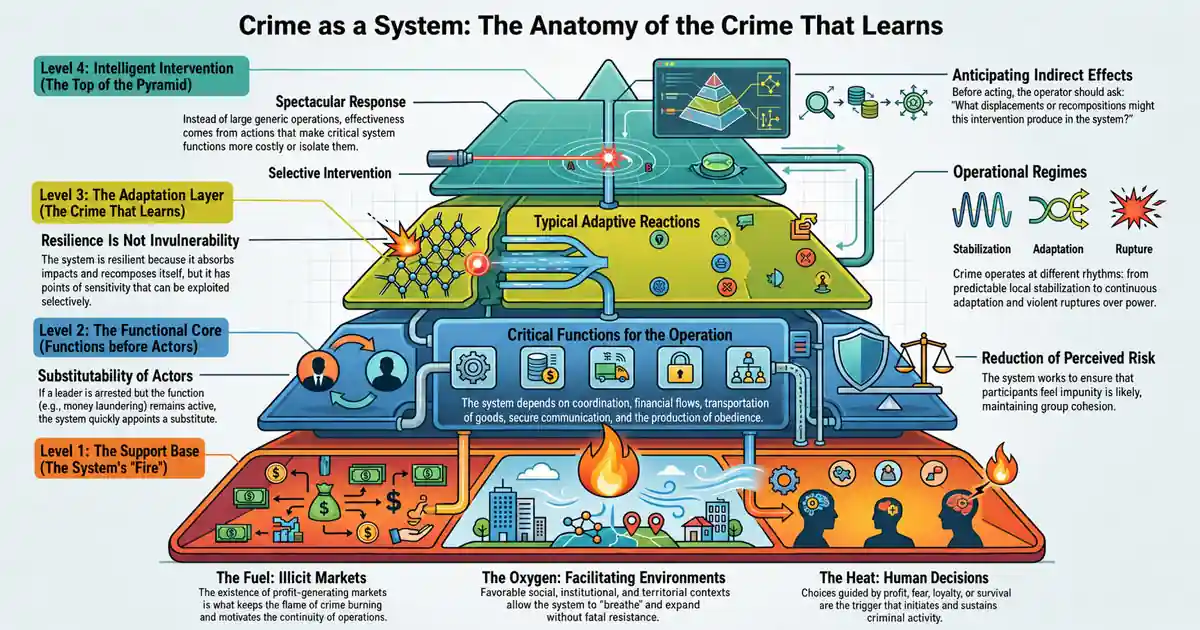
Crime as a System Is Not an Abstraction
Speaking of an adaptive system may sound distant from the daily routine of public security. However, the idea is quite concrete. An adaptive system reacts to interventions, learns from obstacles, reorganizes functions, and finds new ways to keep operating.
In everyday practice, this appears when a trafficking route changes after an operation, when an arrested leader is replaced by another actor, when a faction changes its communication method, when an illicit activity moves to another territory, or when repression in one point strengthens another point in the network.
For this reason, observing crime as a system helps public officials ask a decisive question before acting: what indirect effects can this intervention produce? This question does not prevent action. On the contrary, it improves its quality. It allows decision-makers to anticipate displacement, recomposition, and adaptive responses that, if ignored, may turn an immediate victory into another chapter of repetition.
Functions Before Actors
One important shift is to look at functions before looking only at individuals. Arresting a relevant actor may be necessary. However, if the function that person performed remains active, the system tends to replace that actor. Someone continues to finance, transport, intimidate, recruit, communicate, launder money, or negotiate protection.
This distinction opens a practical possibility. It is not necessary to dismantle everything at once to produce relevant effects. Often, the most intelligent intervention is to identify where a critical function remains active and how it can be interrupted, made more costly, isolated, or made less attractive.
Instead of asking only “who is the boss?”, we can ask: who performs the coordination function? Who connects market and territory? Who guarantees financial flow? Who produces obedience? Who reduces the perceived risk for participants? This shift reduces dependence on spectacular responses and expands the capacity for selective intervention.
Resilience Does Not Mean Invulnerability
The resilience of criminal organizations often creates a sense of impotence. The system seems to resist everything: arrests, seizures, operations, legal changes, and internal disputes. But resilience does not mean invulnerability. It means the capacity to absorb impacts and recompose.
This difference is fundamental. A resilient system may still have points of sensitivity. It may depend on specific routes, financial flows, communication channels, local alliances, institutional tolerances, intimidation practices, or expectations of impunity. Once these points are understood, public action can become less diffuse and more selective.
The metaphor of fire helps visualize this logic. For fire to continue, flame is not enough. It requires fuel, oxygen, heat, and a chain reaction. In organized crime, illicit markets function as fuel; facilitating environments function as oxygen; human decisions function as heat; and adaptive networks sustain the chain reaction. Attacking only one dimension may reduce the intensity of the problem for some time, but it rarely eliminates its capacity for recomposition.
The Crime That Learns and Operational Regimes
Another gain from this perspective is that it reduces the feeling of chaos. Violence often appears explosive, irrational, and unpredictable. In part, it does involve uncertainty. But uncertainty does not mean the absence of patterns.
Territorial disputes, exemplary executions, attacks against rivals, intimidation of residents, reactions to police operations, and internal conflicts may reveal operational regimes. In some contexts, there is local stabilization, with greater predictability in routes, markets, and relationships. In others, continuous adaptation predominates, with rapid changes in functions, strategies, and displacement. There are also situations of episodic rupture, marked by violent disputes, fragmented leadership, and territorial instability.
Recognizing these regimes does not automatically solve the problem, but it improves decision-making. The decision-maker stops reacting only to the most recent event and begins asking what kind of dynamic is actually being confronted. This reading makes decisions less impulsive, less predictable, and more compatible with the real functioning of the system.
A New Basis for Intervention
Understanding The Crime That Learns as crime as a system does not mean abandoning operations, arrests, intelligence, financial enforcement, or territorial presence. It means reorganizing how these resources are interpreted, combined, and sequenced.
When crime is no longer seen as a set of isolated events, more intelligent and less costly possibilities of intervention begin to appear. The focus moves beyond the intensity of the response and starts to include precision, timing, coordination with other actions, and the likely effects of intervention on the system.
This is the realistic promise of this framework. It does not offer a simple solution to a complex problem. It expands the capacity to read the situation before deciding. The better we understand markets, networks, environments, and human decisions, the greater the chance of acting on sensitive points, reducing recomposition, and avoiding the risk that public intervention may strengthen what it seeks to weaken.
Yet understanding the structure is still not enough. The next step is to understand how this system learns and reacts to our own actions. This is where the notion of criminal learning becomes decisive for public security.
Regards
Sergio Senna