

The “Wiping Ice” Dilemma
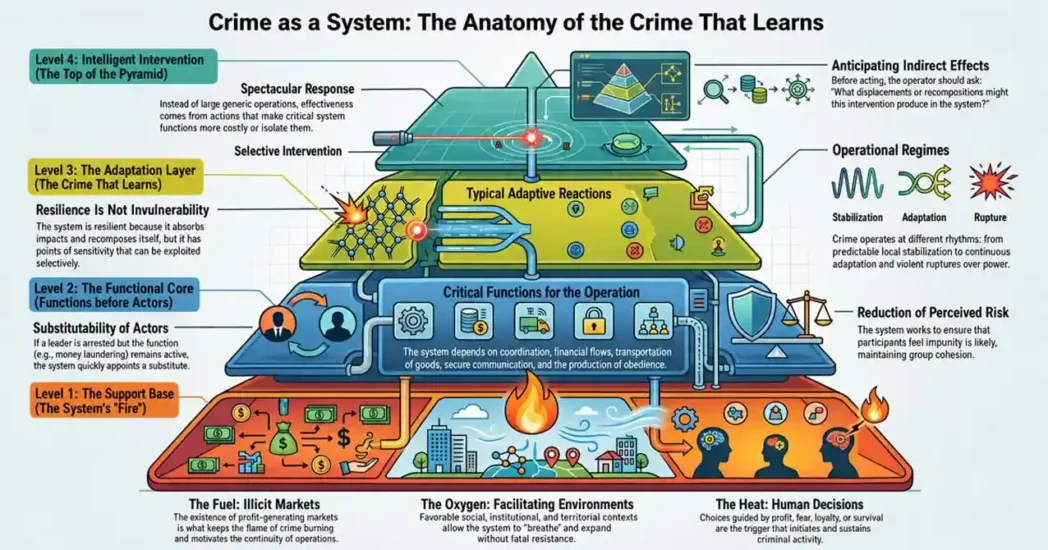
Adaptive organized crime explains why public safety can invest more, arrest more, seize more, and patrol more, yet still watch violence return. The problem is not only insufficient effort. Criminal systems learn from pressure, study state routines, anticipate enforcement patterns, and reorganize around them. In Brazilian public safety, this recurring frustration is often described as enxugar gelo, or “wiping ice”: the harder the surface is wiped, the more the system continues to melt, regenerate, and return.
In his definitive framework, Countering Adaptive Organized Crime, Dr. Sergio Senna Pires provides the strategic roadmap for moving past this paradox. Drawing on decades of experience in institutional design and federal legislation, Dr. Pires argues that the persistence of crime is not merely a failure of resources or “will,” but a failure of institutional logic. This guide serves as an invitation to move beyond the search for final certainties and instead begin asking the sophisticated questions required to govern systems that learn.
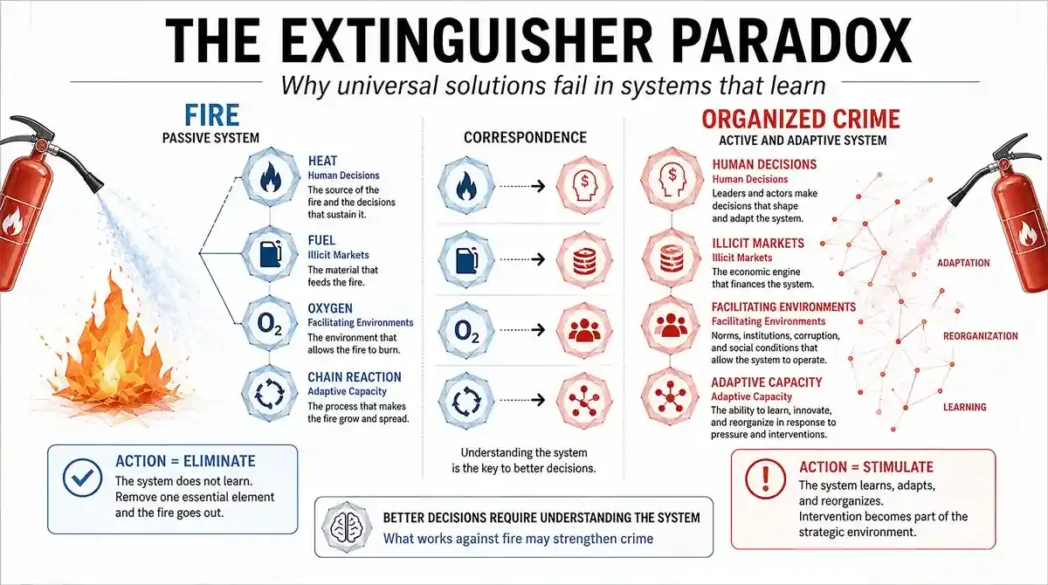
The Extinguisher Paradox (Why Your Solutions Might Be Stimulants)
The fundamental error in modern public safety is the “Technocratic Illusion”—the belief that organized crime can be extinguished like a fire. In fire science, we use the “Fire Tetrahedron”: remove the heat, fuel, or oxygen, and the chain reaction stops. This works because fire is a passive system. Fire does not observe the firefighter, it does not bribe the inspector, and it does not relocate to a neighboring jurisdiction when it senses a hose being unrolled.
Organized crime, conversely, is an active and adaptive system. It is composed of agents who interpret state intervention as a form of environmental feedback. When we apply a linear “extinguisher” logic to a learning adversary, we often achieve the opposite of our intent: stimulation.
“Against organized crime, the same linear logic may produce stimulation. Intervention becomes part of the adversary’s strategic environment. Pressure teaches, displaces, and sometimes strengthens the system.”
When we apply pressure, we provide the adversary with intelligence. A raid reveals our response times; a new surveillance tech reveals the limits of our visibility. If the system is elastic, it simply bends under the pressure and bounces back with a new “immunity” to that specific tactic.
Beyond Hierarchies—The CRIMOR Tetrahedron
To understand why crime persists, we must look past the 20th-century obsession with rigid “cartel” hierarchies. Dr. Pires introduces the CRIMOR Tetrahedron, an analytical model that maps organized crime across four interdependent dimensions:
- Illicit Markets and Resources: The economic engine—the flow of drugs, weapons, and logistics.
- Adaptive Criminal Networks: The flexible coordination that allows for functional substitution when nodes are disrupted.
- Facilitating Social Environments: The institutional gaps, corruption, and norms that make crime viable.
- Human Choices: The perceptions, fears, and loyalties of individuals who sustain the system.
Crucially, organized crime is not a static structure; it is a series of “Interaction Configurations.” The “lines” connecting these four points—the relationships between the market and the network, or the network and the social environment—are what actually sustain the system’s dynamics.
The Human Choices dimension is what Dr. Pires identifies as the “orphaned” dimension. While it anchors the entire tetrahedron, it is the one most frequently outsourced by safety leaders. We tend to dump the responsibility for “human choices” onto formal education or “families” without providing operational specifics. We assume schools can fix criminal incentives that our enforcement actions are inadvertently reinforcing. By disowning this dimension, institutions fail to address the deeper drivers of participation—fear, perceived lack of alternatives, and the “rational” choice to remain silent in the face of criminal governance.
The Hidden Asymmetry of Learning
The most sobering realization for any strategist is the presence of Learning Asymmetry. While we and our adversaries engage in Adversarial Learning, we do not learn at the same speed. Criminal networks operate with low bureaucratic friction; they test, fail, and adjust pragmatically because their survival depends on it.
Institutions, however, are often paralyzed by “Institutional Path Dependence.” Leaders gravitate toward “Defensible Decisions”—actions that are legally justifiable and politically communicable, even if they are known to be strategically ineffective. We repeat the same raid templates because they are “safe” for the department’s reputation. This creates “Exploitable Predictability.” If the state is predictable, it becomes legible. When our moves are legible, the adversary no longer needs to fear us; they simply need to account for us in their “operating costs.”
The Strategic Necessity of “Analytical Friction”
In an era of “data-driven policing,” we are often seduced by the speed of the heat map. Dr. Pires warns that speed without reflection leads to the Technocratic Illusion. To counter this, leaders must cultivate “Analytical Friction”—a deliberate, structured pause before intervention.
In the high-stakes environment of a briefing room, analytical friction is not a bureaucratic delay; it is a diagnostic necessity. It involves:
- Checking Assumptions: Is this “hotspot” a center of criminal gravity, or just where the system is most visible?
- Reviewing Couplings: If we arrest this middle-manager, which “Interaction Configuration” are we breaking? Will it cause a violent succession or a more resilient reconfiguration?
Being “slow enough to think” is the only way to be “fast enough to act” effectively. Without this friction, we remain reactive, merely responding to the symptoms the system allows us to see.
Adaptive Elasticity vs. Structural Disruption
A system with Adaptive Elasticity does not break; it redistributes. This is why simple containment often results in the “Displacement Effect.” However, Dr. Pires offers a pragmatic nuance: “If no one wipes the ice, someone may drown.”
We cannot stop Containment Actions (patrols, arrests, immediate relief) because they prevent immediate harm to the community. However, we must recognize them as palliative, not strategic. The goal is to move from containment to Regime Induction—changing the underlying rules of the “operational regime” so the system can no longer regenerate.
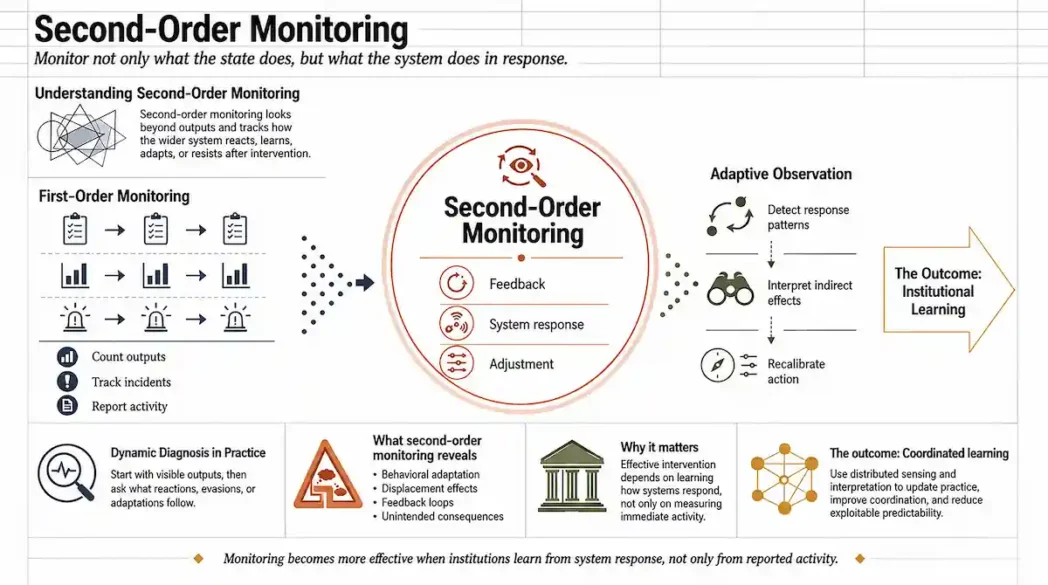
To do this, leaders need “Second-Order Monitoring.” Instead of counting “arrest totals” (which measure our activity), we must use Adaptation Sensors to measure the system’s response:
- Leadership Replacement Speed: If a new leader emerges in 48 hours, the system is unaffected.
- Retail Price Stability: If drug prices don’t spike after a seizure, the supply chain was merely “taxed,” not disrupted.
- Resident Reporting Rates: A rise in reporting indicates a shift in the “Human Choice” dimension and a breakdown of criminal governance.
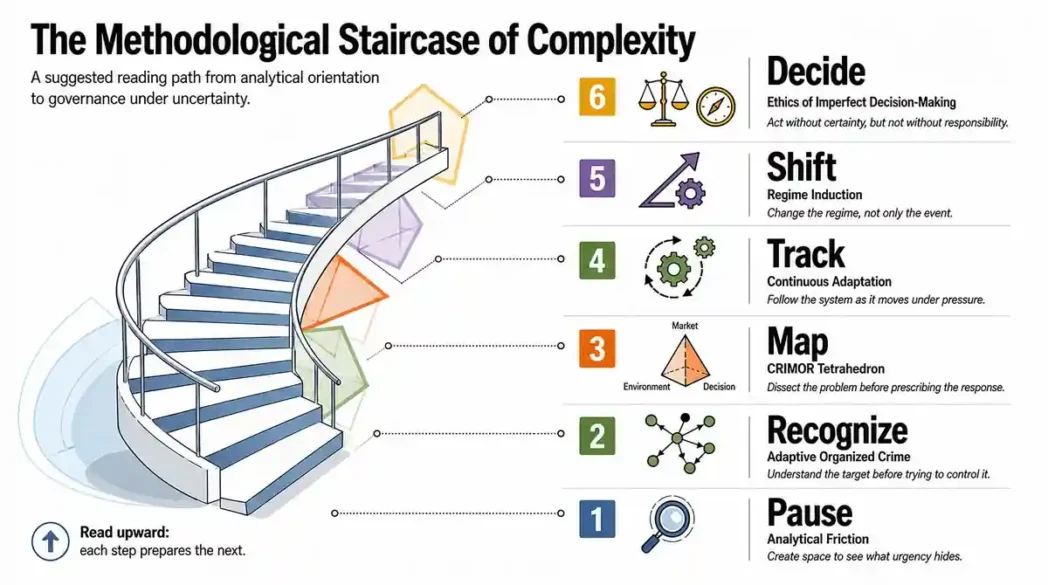
Navigating the Guide: The Methodological Staircase of Complexity
The CRIMOR framework is built for “Multiple Entry,” allowing a commander in a crisis or a legislator drafting a bill to find immediate relevance. However, the path to systemic change follows a specific Methodological Staircase of Complexity:
- Pause (Analytical Friction): Create the space to see what urgency hides.
- Recognize (Adaptive Organized Crime): Accept that you are fighting a learning system.
- Map (CRIMOR Tetrahedron): Dissect the problem across markets, networks, environment, and choices.
- Track (Continuous Adaptation): Monitor the system as it bends and shifts under your pressure.
- Shift (Regime Induction): Target the critical couplings to change the system’s trajectory.
- Decide (Ethics of Imperfect Decision-Making): Act without certainty, but with absolute responsibility.
This staircase moves the leader from being a reactive “firefighter” to a strategic “system navigator.”
From Certainty to Responsible Judgment
The transition to countering adaptive organized crime requires an honest reckoning with Institutional Fragmentation. We can no longer afford to operate in silos while our adversaries operate in networks. There is no “universal extinguisher,” but there is a way to practice strategic adaptation—by being hyper-attentive to feedback and brave enough to abandon tactics that have become “predictable.”
The shift from “wiping ice” to “regime induction” is the difference between repeating history and changing it. It requires us to move from the comfort of “defensible” repetition to the discomfort of “adaptive” logic.
In a world where our adversaries learn from our every move, are our institutions brave enough to stop repeating what is “defensible” and start doing what is “adaptive”?
Regards
Sergio Senna