

The CRIMOR Tetrahedron is the central analytical model of Countering Adaptive Organized Crime. It helps explain why organized crime cannot be understood through one factor alone. It is not only a criminal network, not only an illicit market, not only a failure of the state, and not only a set of individual decisions. Organized crime becomes more resilient when these dimensions connect and reinforce one another over time.
The first article in this series introduced analytical friction as the pause needed before action. The second article explained why adaptive organized crime learns from repeated state intervention. This third article follows the next step in the Methodological Staircase of Complexity: Map. Once we recognize that the target learns, we need a model that helps us see what exactly is interacting.
This matters because many public safety strategies still focus on isolated targets. A police operation may arrest a leader. A new law may increase punishment. A financial investigation may block one account. A territorial intervention may remove visible dealers from a specific area. Each of these actions can be useful. But none of them is enough if the system that sustains the criminal function remains active. The CRIMOR Tetrahedron offers one practical way to map that system.
The Four Dimensions of the System
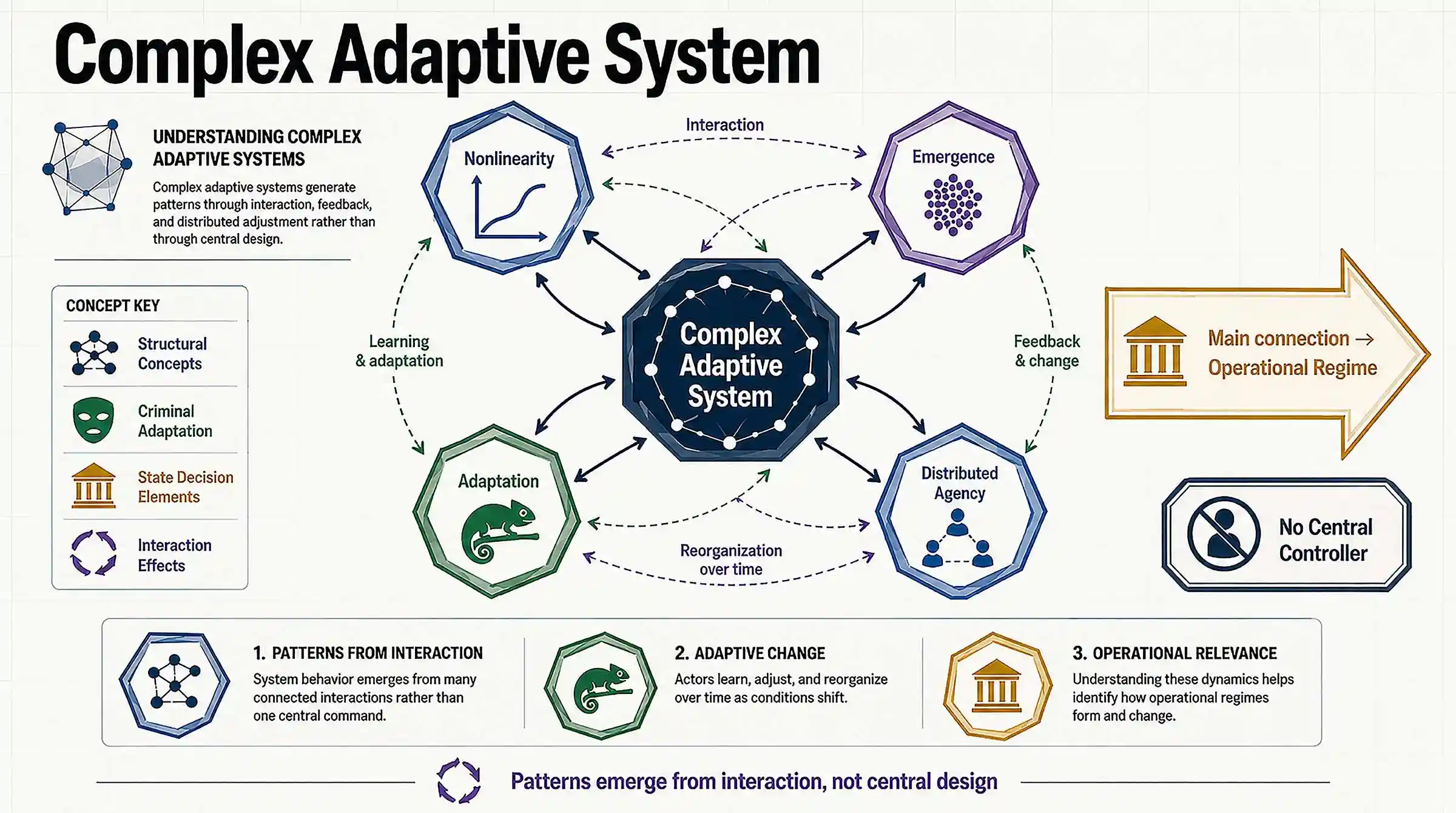
The model organizes analysis around four interdependent dimensions.
The first dimension is illicit markets and resources. These include drugs, weapons, stolen goods, illegal services, money laundering, territorial income, protection payments, logistics, and other flows that make criminal activity profitable. Without resources, criminal networks lose part of their capacity to recruit, corrupt, intimidate, and adapt.
The second dimension is adaptive criminal networks. These are the relationships that allow criminal actors to coordinate, replace people, shift routes, protect information, and preserve functions after disruption. A network may lose a leader and continue operating because other actors can absorb the role, redistribute tasks, or activate alternative pathways.
The third dimension is the enabling social and institutional environment. Organized crime depends on more than criminals. It also depends on conditions that allow illicit activity to remain viable: fear, silence, corruption, weak regulation, fragmented governance, distrust of public institutions, slow response, tolerated illegal commerce, and gaps between agencies.
The fourth dimension is human motivations and decision-making. People decide whether to participate, buy, sell, report, remain silent, cooperate, tolerate, resist, or look away. These decisions may be shaped by fear, loyalty, profit, dependency, opportunity, coercion, belonging, distrust, or lack of alternatives.
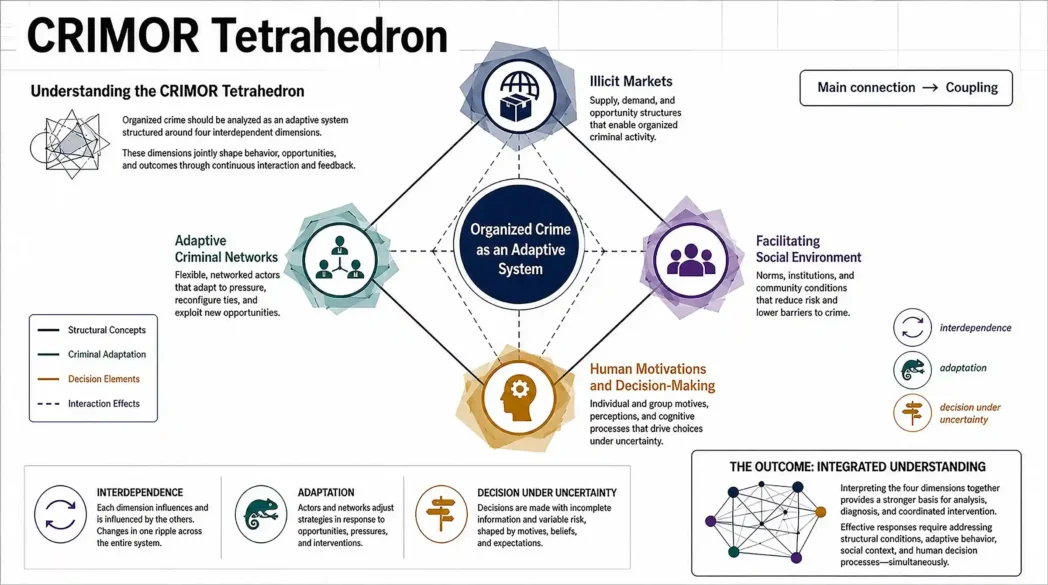
The tetrahedron matters because none of these dimensions explains organized crime alone. A market without a network may not scale. A network without resources may weaken. A hostile social environment may block criminal stabilization. Human decisions may interrupt or reproduce the system.
Why the Human Decision Dimension Is the Base
One of the most original claims in Countering Adaptive Organized Crime is that human motivations and decision-making form the base of the CRIMOR Tetrahedron. Markets do not operate by themselves. Networks do not adapt by themselves. Institutions do not fail or succeed in the abstract. People decide, tolerate, cooperate, resist, ignore, protect, report, consume, recruit, enforce, or remain silent.
This dimension is also the easiest one to disown. Police agencies may treat it as a matter for schools or social policy. Schools may treat it as a family or community problem. Families may experience it as beyond their capacity. Communities may remain silent out of fear. As a result, the dimension that anchors the system can become institutionally orphaned.
That is why the model gives human decisions a central role. Organized crime persists not only because it has money, weapons, networks, or territory but also because it is adaptable. It persists because enough people, in different positions, continue making decisions that reproduce the system under fear, coercion, loyalty, opportunity, profit, distrust, or lack of alternatives.
This point is difficult because no institution can solve it alone. A police agency cannot transform family bonds, community trust, school trajectories, economic dependency, fear, loyalty, addiction, and local expectations by itself. But if these decisions are left outside the security framework, the state may keep attacking visible structures while the human base of regeneration remains intact. The CRIMOR Tetrahedron keeps this uncomfortable dimension inside the analysis.
Why Coupling Changes the Question
The most important idea behind the model is not the list of dimensions. It is the connection among them. This connection is called coupling.
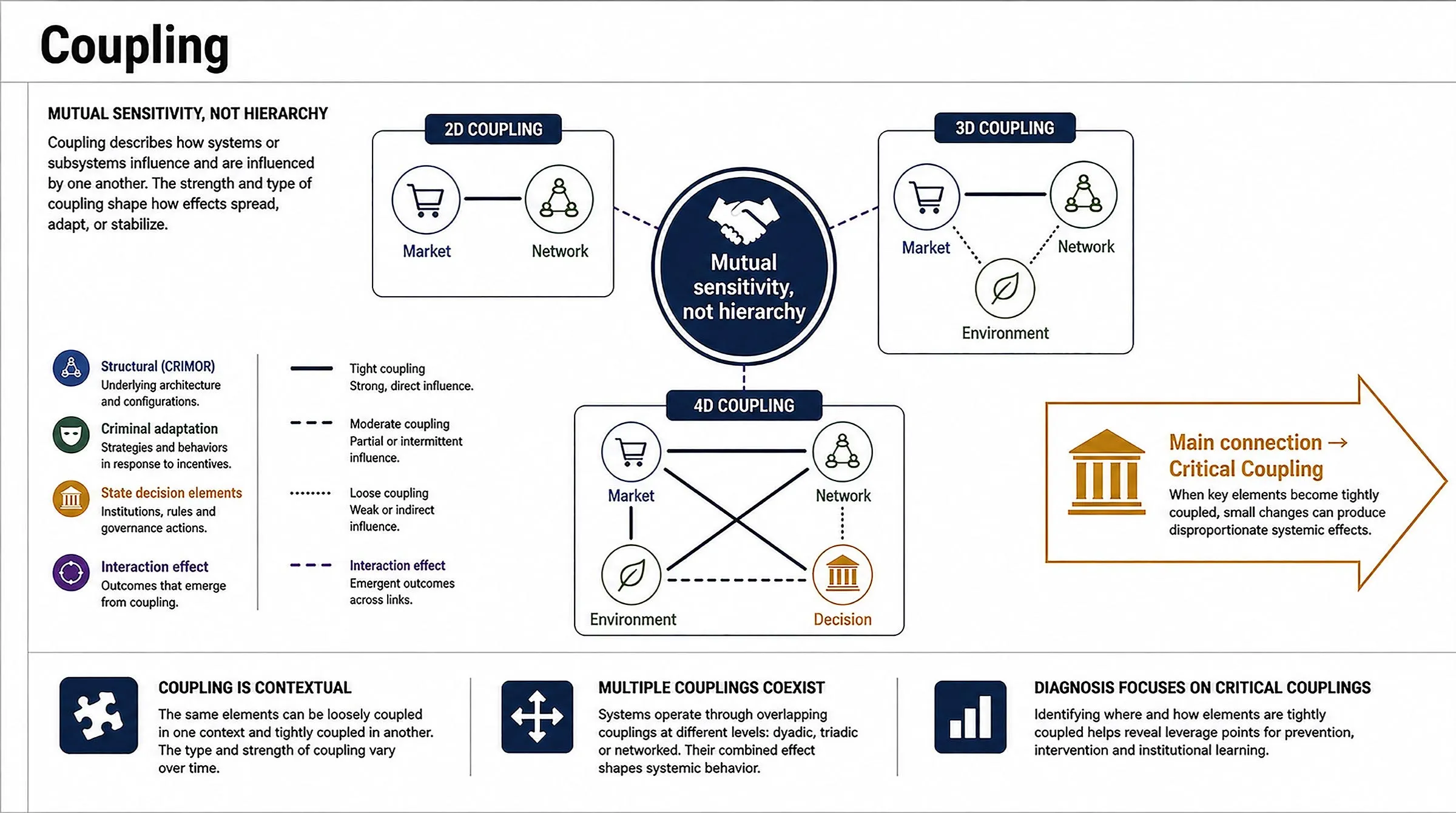
A coupling exists when a change in one part of the system produces an adjusted response in another. If police disrupt a drug route, the market may respond through scarcity, price changes, or substitution. If a leader is arrested, the network may reorganize. If residents lose trust in the state, human decisions may shift toward silence. If enforcement becomes predictable, the criminal network may transform state action into operational information.
This changes the public safety question. Instead of asking only “Which target should we attack?”, decision-makers should ask how the dimensions are connected, which coupling allows the system to survive, where pressure will travel after intervention, whether the action will disrupt a function or merely move it, and whether the adversary will learn from the response.
A strategy that ignores coupling may produce short-term visibility but little systemic change. A strategy that understands coupling can identify more sensitive points of intervention. The most important coupling may involve money and protection, prison communication and street coordination, illicit markets and tolerated resale channels, or fear and silence inside a community.
That leads to the next article in this series. If organized crime persists through connected dimensions, then not every visible target is a strategic target. The next step is to understand critical coupling and leverage points: the places where intervention can change the system instead of merely disturbing its surface.
Regards
Sergio Senna
Take a look at this book:
See at Amazon: https://www.amazon.com/Countering-Adaptive-Organized-Crime-strategic-ebook/dp/B0GX3CSSGF/
This post is also available in pt_BR.