

Human decisions in adaptive organized crime are the hardest part of the problem to govern. Punishment is necessary. The state must set limits, protect victims, incapacitate dangerous actors, and reaffirm that criminal conduct has consequences. But punishment is not enough when the system persists through desire, fear, addiction, loyalty, profit, silence, distrust, dependency, and perceived lack of alternatives.
For centuries, societies have punished crime. They have created prisons, penalties, police forces, courts, surveillance systems, moral campaigns, and legal reforms. Yet drug markets continue. Fraud continues. Lies, cheating, corruption, extortion, illegal commerce, and everyday tolerance of small illegal advantages continue. This does not mean punishment is useless. It means punishment reaches only part of the decision field.
Adaptive organized crime survives because it is not sustained by offenders alone. It is sustained by many decisions made by many people in different positions: those who sell, buy, transport, protect, consume, ignore, tolerate, report, resist, cooperate, remain silent, or look away. The human dimension activates the system.
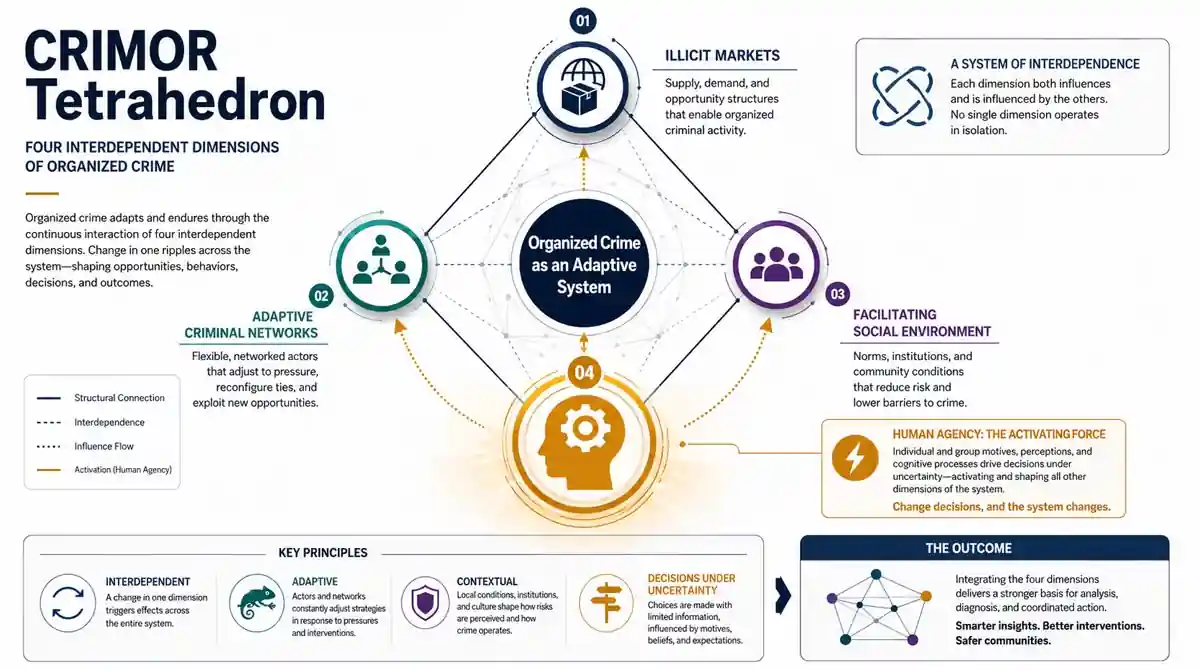
The Hardest Dimension to Govern
In the CRIMOR Tetrahedron, organized crime is analyzed through four dimensions: illicit markets and resources, adaptive criminal networks, enabling social and institutional environments, and human motivations and decision-making. The fourth dimension is the most difficult because nobody fully owns it.
Security agencies may say that motivations belong to education, family, or social policy. Schools may say that family and community shape behavior before students arrive. Families may feel powerless against terror, poverty, addiction, peer pressure, digital influence, or fear. Communities may remain silent because cooperation with the state feels dangerous. Each institution sees part of the problem, but no institution can govern the whole human decision field alone.
This is why the dimension becomes institutionally orphaned. Everyone knows it matters, but no one knows exactly what to do with it.
Yet markets do not operate by themselves. Networks do not recruit by themselves. Territories do not remain silent by themselves. People decide. A young person accepts or refuses a role. A user buys or seeks help. A merchant pays or reports extortion. A resident speaks or remains silent. A public official confronts, tolerates, delays, leaks, or looks away. These decisions are not made in a vacuum. They are shaped by risk, belief, opportunity, fear, loyalty, pressure, and expectations.
The difficulty is not that people are simply good or bad. The difficulty is that people make decisions inside configurations. A person may cooperate when protection is credible and remain silent when cooperation is dangerous. A public official may act courageously in one setting and defensively in another. A young person may refuse criminal recruitment when alternatives are real and accept it when belonging, income, and status seem unavailable elsewhere. Responsibility remains, but context changes the decision field.
Why Punishment Changes Costs but Not Always Decisions
Punishment can change the cost of a decision. It can deter some people, incapacitate others, and signal that a boundary has been crossed. But many decisions that sustain organized crime do not respond only to legal costs.
Drug use is a clear example. A user may know the law, the health risk, and the social cost. Yet addiction, suffering, habit, availability, peer networks, homelessness, trauma, or lack of treatment may keep the decision field intact. Punishment may increase fear, but it does not necessarily reduce demand, stabilize housing, rebuild trust, or create access to care.
Fraud and cheating show the same problem in another form. A person may lie in a document, buy stolen goods, evade rules, pay a bribe, or justify a small illegal advantage because “everyone does it,” because the price is lower, because the system feels unfair, or because the risk seems low. The decision is not only legal. It is moral, social, economic, and practical.
Silence under criminal governance follows a similar logic. A resident may refuse to report not because they support crime, but because reporting appears dangerous and useless. If the state cannot protect the person after cooperation, punishment of the offender alone does not change the resident’s next decision. Fear remains coupled to silence.
This is the central point: punishment may affect behavior, but it often fails to break the couplings that make behavior repeat.
Human Couplings: Where Strategy Must Begin
A human coupling exists when a decision is linked to another part of the system in a way that helps organized crime persist. Desire couples with illicit markets. Fear couples with silence. Addiction couples with demand. Distrust couples with noncooperation. Loyalty couples with criminal networks. Opportunity couples with rationalization. Institutional pressure couples with defensible decisions.
These couplings are hard to disrupt because they are not located in one person. They are spread across relationships. A drug market survives because users continue to need or desire the product, sellers continue to find profit, networks continue to supply, and institutions fail to provide alternatives that change the decision field. An extortion system survives because merchants pay, residents fear, police may not protect enough, and the criminal group remains credible.
This is also why the state itself must be included in the analysis. Street-level bureaucracy shows that public policy becomes real through frontline decisions. Police officers, prison staff, inspectors, prosecutors, teachers, health workers, and social workers do not merely execute abstract rules. They decide under pressure, scarcity, fear, uncertainty, loyalty, workload, and risk of blame.
A police officer may follow a predictable routine because it is safer to justify. A social worker may avoid a case because there is no protection network. A school may not report recruitment signs because nothing happens afterward. A prosecutor may focus on a visible case because deeper structures are harder to prove. These are also human decisions in organized crime’s environment.
In other words, the human dimension is not only “on the criminal side.” It is also inside the state, the community, the market, the family, and the institutions that respond. If strategy ignores this, it may punish one actor while leaving the wider decision field untouched.
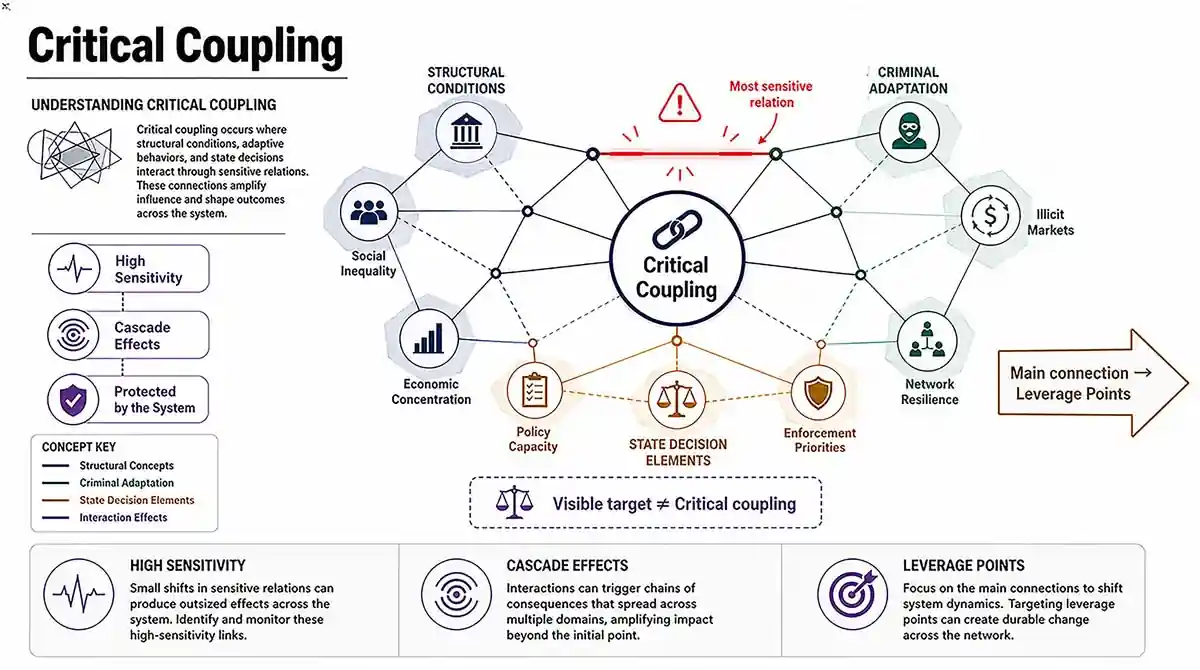
[Insert Figure 2 here: Coupling / Critical Coupling]
Beyond Punishment Alone
A better strategy does not abandon punishment. It places punishment inside a broader effort to change decision conditions. The question becomes, “What must change so that people decide differently?”
That may require credible protection for those who report, not only appeals to courage. It may require treatment and housing for drug users, not only police displacement. It may require disrupting resale markets for stolen goods, not only arresting thieves. It may require reducing institutional fragmentation, not only blaming frontline agents. It may require making lawful cooperation safer, faster, and more credible than criminal accommodation.
Public safety also needs human adaptation sensors. Institutions should monitor not only arrests, seizures, and reported crimes, but also fear, trust, silence, reporting willingness, recruitment patterns, family vulnerability, extortion compliance, and perceived alternatives. These indicators are difficult, but they reveal whether the human base of the system is changing. The deepest challenge of adaptive organized crime is not only to punish wrongdoing but also to prevent it. It is to alter the configurations in which wrongdoing becomes desirable, tolerable, profitable, safe, necessary, or easier than resistance. That is why punishment is necessary but not enough. The system persists through decisions. Strategy must begin where those decisions are made.