

Adaptive organized crime does not survive only because governments lack resources, laws, technology, or courage. It survives because criminal systems observe state action, learn from repeated interventions, and reorganize under pressure. A police operation may arrest leaders, seize drugs, or disrupt a visible market. A new law may increase penalties or expand investigative powers. Yet, after the first impact, the criminal system may shift routes, replace actors, reduce visibility, change communication patterns, or move into another territory. What looks like pressure from the state may become information for the adversary.
The first article in this series introduced analytical friction: the deliberate pause that helps public safety leaders think before acting in systems that learn. This second article follows the next step in the Methodological Staircase of Complexity: Recognize. Before trying to control the target, we need to understand what kind of target we are facing.
This is the central challenge addressed in Countering Adaptive Organized Crime. Organized crime should not be treated as a fixed object waiting to be dismantled by one decisive action. It behaves more like a complex adaptive system: many actors, incentives, markets, territories, institutional gaps, and human decisions interact over time. No single person controls the whole system, but the system still learns. It learns through trial and error, imitation, survival, and practical adjustment.
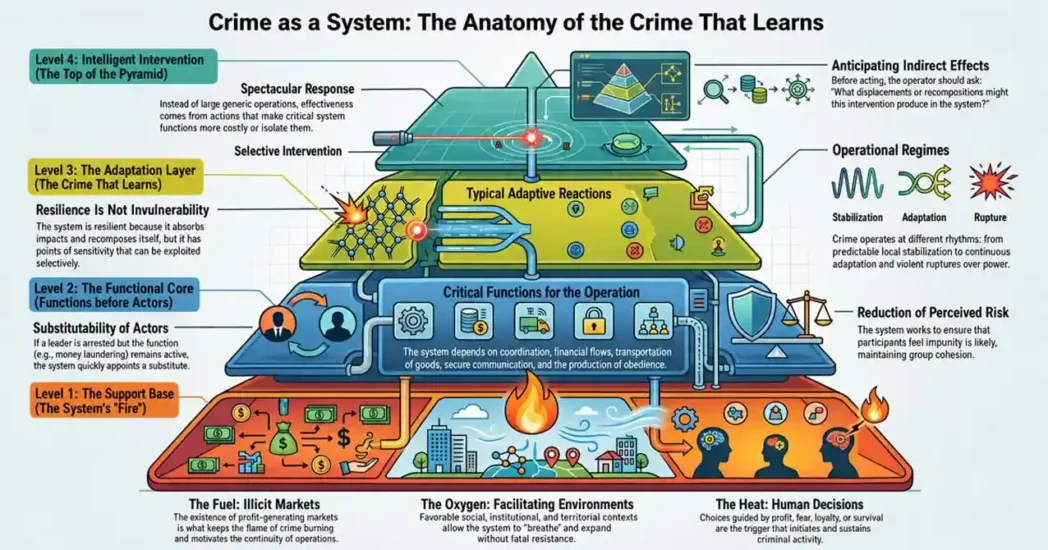
[Insert Figure 1 here: Complex Adaptive System]
From Criminal Structure to Adaptive System
Traditional public debate often imagines organized crime as a hierarchy. There is a leader, a chain of command, a territory, and a set of criminal activities. This image is sometimes accurate, but it is incomplete. Many criminal systems preserve their functions even after leaders are removed. They can replace people, distribute tasks, create redundancies, and shift operations.
A complex adaptive system is not defined only by its parts. It is defined by interaction. Illicit markets create money and incentives. Criminal networks coordinate logistics, protection, communication, and violence. Social and institutional environments may provide silence, fear, corruption, tolerance, or gaps in enforcement. Human beings make decisions under pressure, loyalty, fear, need, opportunity, and perceived lack of alternatives.
This human dimension matters from the beginning. Markets do not sell by themselves. Networks do not recruit by themselves. Territories do not remain silent by themselves. People decide, fear, tolerate, cooperate, consume, protect, resist, or look away. If public security ignores those decisions, it may attack visible structures while leaving the system’s conditions of regeneration intact.
When these dimensions interact, organized crime becomes more than a list of offenders. It becomes a pattern that can regenerate.
This is why some interventions produce visible results without lasting change. Arrests may rise while the network remains functional. Seizures may increase while prices remain stable. A violent territory may calm down for a few weeks and later return to the same pattern. The state acted, but the system absorbed the pressure.
The Extinguisher Paradox
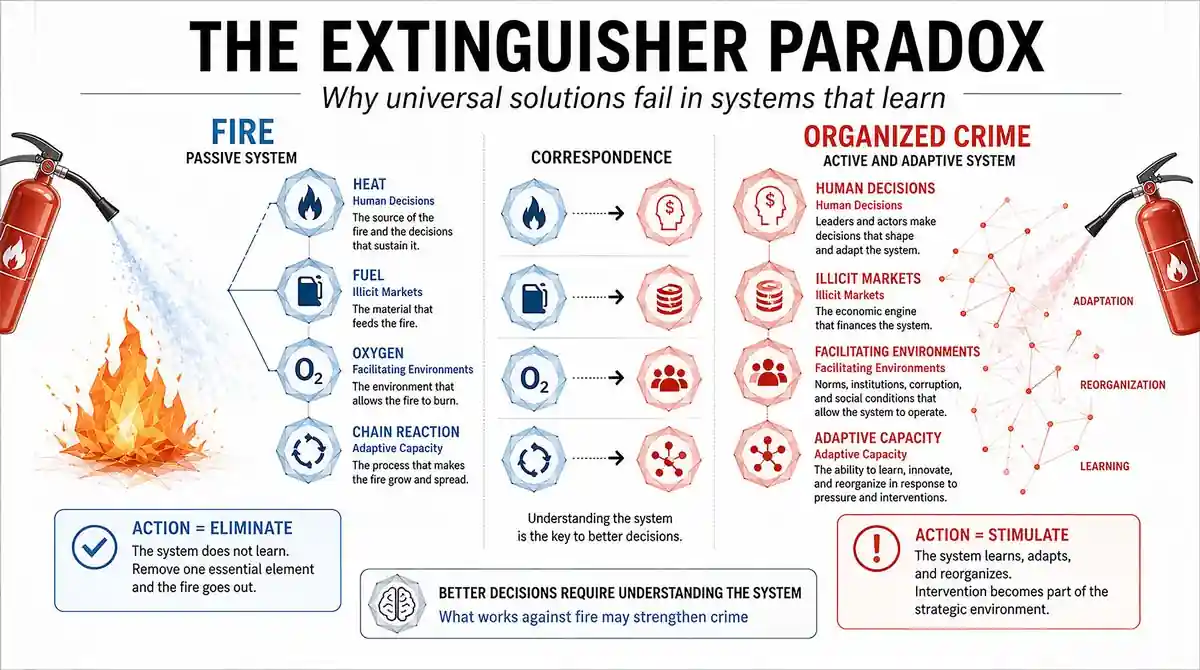
One of the original ideas developed in Countering Adaptive Organized Crime is the extinguisher paradox. Against fire, removing one essential element can eliminate the system. Fire does not observe the firefighter. It does not learn from previous attempts. It does not relocate, replace functions, bribe an inspector, or change its strategy under pressure.
Organized crime is different. It is not a passive fire waiting to be extinguished. It observes the state, tests responses, and reorganizes. An operation may remove a leader, but the network may preserve the function. A law may close one gap, but criminal actors may search for another. A territorial intervention may reduce visible activity, but the market may move, hide, or fragment.
That is the paradox: a linear intervention that works against a passive system may stimulate adaptation in an adversarial system. The lesson is not that the state should avoid action. The lesson is that action must be designed with learning, displacement, recomposition, and human decision thresholds in mind.
To understand this pattern, the next step is the CRIMOR Tetrahedron, a model that maps the four dimensions of adaptive organized crime and shows how they interact. After that, we will examine critical coupling, the point where intervention can affect the system instead of only disturbing its surface.
What the State Unintentionally Teaches
Criminal systems learn especially well when state action becomes repetitive. If operations occur at similar times, in similar places, against similar targets, the adversary begins to anticipate them. If agencies do not coordinate, criminals learn where jurisdictional gaps are. If investigations always focus on visible actors and rarely reach financial flows, the system protects its deeper functions.
This is not a reason for arbitrary or unlawful action. Democratic institutions must remain predictable in the right sense: laws, rights, procedures, and accountability must be stable. The problem is operational predictability that becomes exploitable. Criminal actors should not be able to easily read the timing, limits, routines, and blind spots of public action.
The first lesson, then, is simple but demanding: fighting organized crime requires more than force. It requires learning. Public institutions need feedback, memory, variation, coordination, and the capacity to recognize when a criminal system has changed.
If organized crime learns from the state, the state must learn from what happens after it acts. That is where the next step begins: understanding the model that helps map the system. In the next article, we will introduce the CRIMOR Tetrahedron and the idea of coupling.