

Centralized enforcement can look like the obvious answer when criminal networks cross jurisdictions, exploit uneven institutional capacity, and move faster than public agencies can coordinate.
The logic is easy to understand. If the problem is dispersed, someone should concentrate on command. If agencies do not communicate well, someone should impose order. If criminal networks operate across cities, counties, states, prisons, ports, financial systems, and digital platforms, someone should see the whole picture.
That intuition is not wrong. It is incomplete.
Federal coordination is often necessary. The problem begins when centralized enforcement becomes rigid command and weakens the capacities public safety institutions need most against adaptive criminal networks: local intelligence, operational feedback, distributed agency, institutional learning, and the ability to adjust when the adversary adapts.
This article follows the vocabulary developed in Countering Adaptive Organized Crime (Pires, 2026), especially the concepts of adaptive criminal networks, learning asymmetry, exploitable predictability, managed predictability, distributed agency, critical couplings, and adaptive capacity.
Why centralized enforcement looks efficient
Centralized enforcement looks efficient because it simplifies responsibility. One authority sets priorities. One strategy is announced. One command structure appears to organize action.
That matters in a crisis. Public pressure rises. Political leaders need to show a response. Agencies need direction. Communities want visible action.
But enforcement alone is not the whole public safety response.
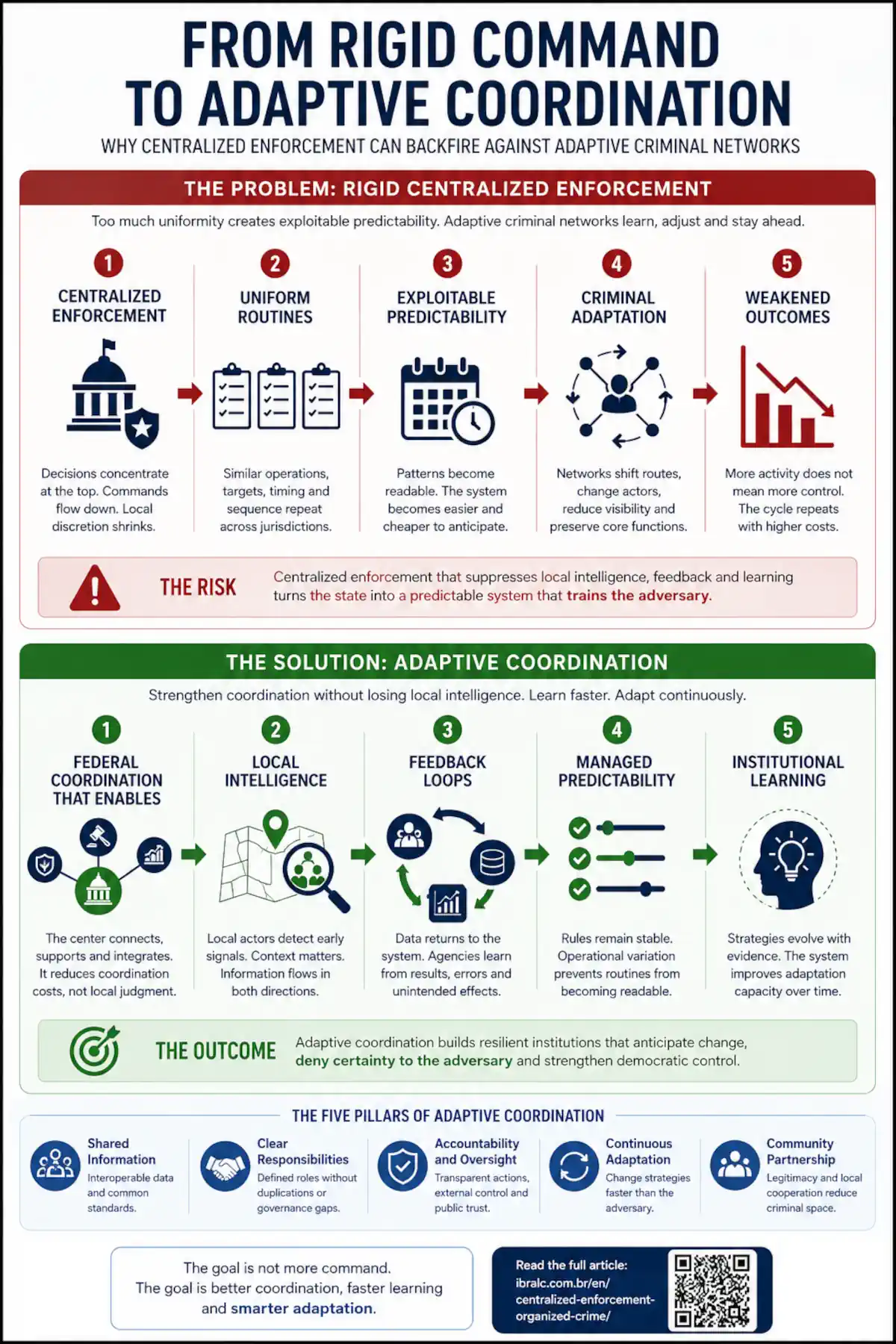
Against adaptive criminal networks, command, intelligence, corrections, local information, feedback, and institutional learning must work together. If centralized enforcement suppresses those capacities, the state may gain formal alignment while losing adaptive control.
Adaptive criminal networks observe public action. They learn enforcement routines, investigative patterns, inspection cycles, institutional limits, interagency gaps, prosecutorial priorities, and correctional vulnerabilities. When public action becomes too uniform, it can also become too readable.
More command may produce more formal alignment. It may also produce exploitable predictability.
The central question is not only who commands. The better question is how information circulates, who learns from it, and how fast strategy changes when criminal networks adapt.
What centralized command can miss
A central authority may see the national map. That matters.
But it may miss the texture of place.
Some of the most important signals appear first at the local level: a patrol officer notices a change in street routines; a correctional officer detects a shift in communication; a municipal inspector sees extortion behind a local business pattern; a school observes absenteeism in an area under threat; a health worker recognizes repeated violence; residents know who controls fear but may not trust institutions enough to speak openly.
These signals often travel slowly. Sometimes they become simplified reports. Sometimes they never reach the level where strategy is made.
When centralized command suppresses local intelligence, the state may gain authority and lose perception.
That is a bad trade.
Public safety systems do not need local discretion without coordination. They need distributed intelligence connected to shared criteria, common information, correction routines, and accountable decision-making.
How criminal networks learn from repeated responses
A major operation may arrest leaders, seize assets, or disrupt a route. Those results matter. But they do not automatically mean the criminal system has lost capacity.
If the network replaces leaders, shifts routes, changes communication, reduces visibility, or preserves the illicit market, the intervention may have changed personnel without changing the operational regime.
The state counts arrests. The network preserves function.
This is where criminal learning becomes decisive. Every repeated intervention teaches something: timing, duration, legal thresholds, surveillance blind spots, preferred targets, coordination delays, and areas of institutional weakness.
The lesson is not that enforcement is useless. The lesson is that enforcement without learning can become information for the adversary.
Against adaptive criminal networks, pressure must be connected to feedback. Public institutions need to know not only what they did but also how the criminal system responded.
What documented cases suggest
This is not only a theoretical concern. Research on leadership-targeting strategies in Mexico found that capturing or killing cartel leaders may disrupt criminal organizations but can also intensify violence when groups fragment, compete, and reorganize. Calderón, Robles, Díaz-Cayeros, and Magaloni reached this conclusion in their 2015 study, “The Beheading of Criminal Organizations and the Dynamics of Violence in Mexico,” published in the Journal of Conflict Resolution.
The lesson is not that leadership targeting is always wrong. It is that visible disruption does not automatically mean systemic weakening. When public action removes actors without tracking how functions are replaced, the state may mistake organizational rearrangement for strategic success.
A simple operational example
Consider a regional enforcement strategy that targets the same corridors, at similar hours, with similar interagency sequencing, every time pressure rises.
At first, the results look strong. Arrests increase. Seizures rise. Public officials can show visible action.
But the criminal network also learns. It moves storage sites away from the expected route, shifts communication to less monitored channels, replaces exposed intermediaries, and keeps the market functioning through smaller, less visible operators.
Nothing in that scenario means enforcement failed. It means the intervention produced both pressure and information.
The question is whether public agencies are tracking the second effect. If they only count arrests and seizures, they may miss displacement, functional substitution, and criminal recomposition. If they track adaptation, the operation becomes part of an institutional learning cycle rather than another predictable signal to the adversary.
Why predictability must be managed
A democratic state cannot and should not become unpredictable in every way.
Legal rules, rights, accountability, procedures, and limits on authority must remain predictable. That kind of predictability protects the public and constrains abuse.
The problem is different. It appears when operational routines become so repetitive that criminal networks can anticipate them at low cost.
This is the difference between exploitable predictability and managed predictability.
Exploitable predictability makes the state readable. Managed predictability keeps legal constraints stable while varying timing, sequencing, targets, and interagency coordination when repetition would feed criminal adaptation.
The goal is not randomness. The goal is disciplined variation guided by feedback, local intelligence, and regime diagnosis.
The alternative is not fragmentation
Criticizing rigid centralized enforcement is not a defense of fragmentation.
Fragmented public safety systems also fail. They create gaps, duplicated effort, delayed information, competition for credit, and zones of responsibility without accountability. Organized crime exploits exactly those gaps.
The alternative is strong coordination without rigid command centralization.
That requires shared rules, interoperable information, clear responsibilities, cross-jurisdictional cooperation, and feedback loops that connect local perception to strategic decision-making.
It also requires adaptive capacity: the institutional ability to learn from the effects of action and change course when evidence shows displacement, functional substitution, concealment, or rapid recomposition.
A system that cannot learn from its own interventions will keep producing activity without transformation.
What federal coordination should actually do
The federal level has an essential role in problems that cross jurisdictions.
It can support intelligence integration, financial investigations, anti-corruption capacity, border-related enforcement, interstate coordination, correctional intelligence, data interoperability, and national standards for information sharing and accountability.
But federal coordination should increase the adaptive capacity of the whole system. It should not replace local judgment with uniform command.
The center should help agencies see connections they cannot see alone. It should identify critical couplings across markets, networks, institutions, and local decisions. It should reduce coordination costs. It should make corrections faster.
In simple terms, national coordination should help the system learn better, not merely command more.
Questions public safety leaders should ask
Before adopting a centralized enforcement strategy against organized crime, public safety leaders should ask:
- Does this measure improve the circulation of useful information, or does it only concentrate formal authority?
- Will local intelligence influence strategy, or will it be filtered out?
- Does the plan allow different responses for different operational regimes?
- Will standardization reduce institutional disorder, or will it create exploitable predictability?
- Who will detect displacement, functional substitution, and criminal recomposition after the intervention?
- What evidence would show that the network has been weakened, not merely rearranged?
- How will the strategy change when feedback shows unintended effects?
These questions do not paralyze action. They protect action from becoming predictable, symbolic, or self-confirming.
Public safety officials should audit their coordination models against these questions before assuming that stronger command means stronger control.
Four concepts that reframe the problem
Adaptive criminal networks are criminal arrangements that preserve core functions by replacing actors, shifting routes, changing visibility, and learning from public intervention.
Exploitable predictability, a concept developed in Countering Adaptive Organized Crime, appears when an institution’s operational routines become sufficiently repetitive and readable that an adaptive adversary can anticipate them at low cost.
Managed predictability preserves legal rules, rights, accountability, and democratic controls while varying operational routines that would otherwise teach the adversary.
Adaptive coordination is the frame this article proposes: institutions strong enough to act across jurisdictions, distributed enough to learn from place, and disciplined enough to change before the adversary stabilizes around public routines.
Want to go deeper?
These IBRALC articles expand the core ideas behind this analysis:
- Public Safety as an Adaptive System explains why public safety decisions must account for feedback, adaptation, and institutional learning.
- Why Adaptive Organized Crime Learns from the State develops the central idea that enforcement can become information for adaptive criminal networks.
- The Predictability Trap deepens the distinction between necessary legal predictability and exploitable operational predictability.
- Crime Adaptation Sensors shows why public safety institutions must measure how criminal systems respond after intervention.
- CRIMOR Tetrahedron presents a model for reading organized crime through markets, networks, institutional environments, and human decisions.
FAQ
Is centralized enforcement always a mistake?
No. Federal coordination and centralized enforcement can be necessary when criminal networks cross jurisdictions. The problem is rigid command centralization that suppresses local intelligence, reduces adaptation, and makes public action easier to anticipate.
What is exploitable predictability?
Exploitable predictability appears when public agencies repeat operational routines so often that criminal networks can anticipate timing, targets, sequencing, and institutional limits at low cost.
How can enforcement avoid teaching criminal networks?
Enforcement must be connected to feedback. Agencies should track displacement, functional substitution, communication shifts, leadership replacement, market continuity, and criminal recomposition after intervention.
What should federal coordination do?
Federal coordination should integrate intelligence, support cross-jurisdictional action, strengthen accountability, identify critical couplings, reduce coordination costs, and help the whole system learn faster without replacing local judgment.
References
Calderón, G., Robles, G., Díaz-Cayeros, A., & Magaloni, B. (2015). The Beheading of Criminal Organizations and the Dynamics of Violence in Mexico. Journal of Conflict Resolution, 59(8), 1455–1485.
Pires, S. S. (2026). Countering Adaptive Organized Crime: A Strategic Guide for Public Safety Leaders.
Conclusion
Centralized enforcement can look logical because it promises order against fragmentation. But it can backfire when coordination becomes rigid command and adaptive criminal networks learn how the state behaves.
The real choice is not federal authority or local autonomy. That is the wrong frame.
The right frame is adaptive coordination: institutions strong enough to act across jurisdictions, distributed enough to learn from place, and disciplined enough to vary routines before the adversary does.
Organized crime learns from public action. Public safety institutions must learn faster, without abandoning legality, accountability, democratic control, and local intelligence.