

This is another episode of the Legislative Decision Architecture series, produced by the [S] Lab.
The format utilizes scripted simulations by Dr. Sergio Senna, performed by virtual agents for pedagogical purposes. This is not a dramatization but a resource to make visible the recurring dilemmas in legislative drafting and institutional decision-making within complex contexts.
The dialogues are inspired by real-world problems, without representing specific cases or institutions. The goal is to examine decision-making patterns and their systemic effects.
After listening, what are your thoughts?
Violence as a system is not a rhetorical metaphor. It is an operational description. When public authorities insist on treating violence as a mere sum of occurrences, they ignore the institutional complexity that sustains persistent patterns of conflict, criminality, and territorial reorganization.
A systemic reading starts from an uncomfortable point: violence as a system reacts to the decisions it receives. Every intervention alters incentives. Every norm modifies expectations. Every operation introduces strategic information into the environment. The system observes, interprets, and responds.
While public debate privileges operational intensity and isolated command, patterns of violence persist. They move. They adjust their pace. They change form. Fragmented policy produces displacement, not structural transformation.
Systemic Reading and Systemic Diagnosis
Violence as a system demands a systemic diagnosis. It is not enough to measure occurrences. One must understand interdependencies, feedbacks, and the decision-making chain.
When decisions are made without institutional coordination, asymmetries are created. The police operate, but social assistance does not arrive. Urban planning fails. Education does not integrate. The absence of a coherent institutional architecture widens exploitable gaps.
Violence as a system reorganizes itself within these voids.
The problem is not a lack of action. It is a disconnected decision-making chain. Let’s see an example based on violence against women and consent.
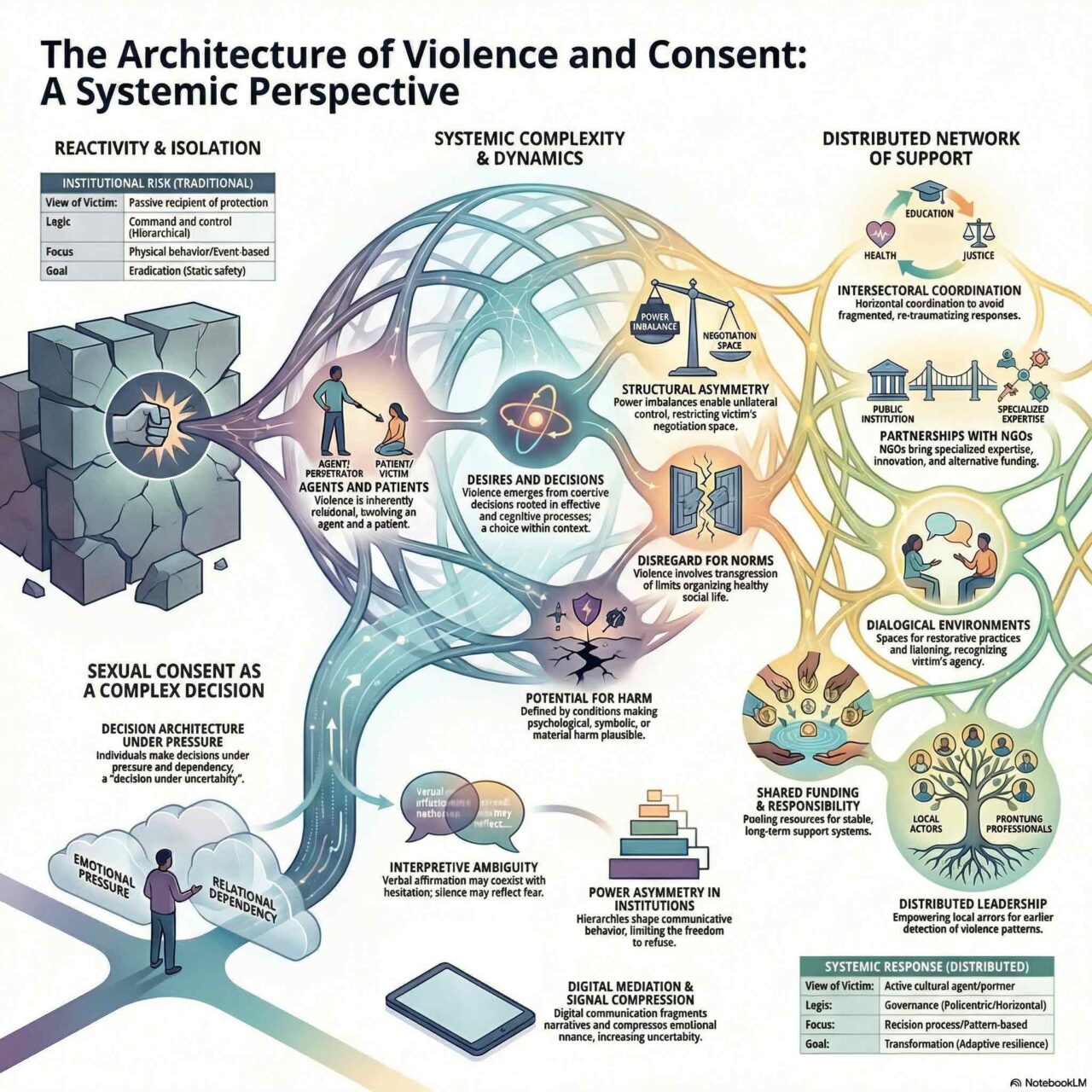
State Pressure and Operating Regimes
State pressure alters operating regimes. This applies both to local dynamics of violence and to organized crime as an adaptive system.
Predictable operations reduce uncertainty for criminal networks. Isolated legal reforms produce strategic adjustments. The system learns.
Violence as a system does not only respond to the force applied. It responds to predictability, fragmentation, and the absence of institutional coordination.
Without functional polycentric governance, each entity acts on its own. The sum of actions does not generate convergence. It generates noise.
Organized Crime, Adaptive Systems, and Criminal Resilience
When violence as a system articulates with organized crime, the phenomenon gains adaptive density.
The adaptive system observes patterns of state pressure. It adjusts illicit flows. It redesigns alliances. It redistributes functions. Adaptive capacity sustains criminal resilience.
Fragmented policy reinforces this process. Isolated interventions can strengthen internal cohesion. Point repression can accelerate criminal reorganization. Episodic combat feeds adversary learning.
Without a systemic reading, the State acts as an involuntary provider of strategic information.
Institutional Architecture and Decision Architecture
Violence as a system exposes the weaknesses of institutional architecture. When normative design fails to consider the interdependence between public policies, it produces unintended effects.
Decisions made under linear logic ignore institutional complexity. Decision architecture needs to incorporate:
– Multi-level analysis
– Continuous institutional coordination
– Feedback monitoring
– Progressive strategy adjustment
Coordination matters more than isolated command.
Polycentric governance does not mean disordered dispersion. It means multiple centers acting under shared criteria. Without this, every policy creates a new fracture.
Unintended Effects and Criminal Reorganization
Violence as a system produces unintended effects when confronted by poorly aligned policies.
Increased police presence may displace patterns of violence to neighboring areas. Legislative changes may incentivize illicit innovation. Operational intensity may raise costs without reducing criminal resilience.
Criminal reorganization is not an accident. It is a systemic response.
The adaptive system responds to state pressure with recalibration.
Institutional Complexity and Public Decision-Making
Institutional complexity is not an excuse for inaction. It is a condition for responsible public decision-making.
Violence as a system requires legislators and managers to abandon the illusion of absolute control. Every norm alters incentives. Every policy redefines arenas. Every symbolic gesture produces real effects.
Systemic diagnosis replaces episodic reaction. Institutional coordination replaces isolated action. Polycentric governance replaces unproductive centralization.
Conclusion: Facing Events or Facing Patterns
Violence as a system forces a choice.
Will the State continue facing episodes, multiplying operational intensity, and accumulating costs? Or will it adopt an institutional architecture coherent with the institutional complexity that characterizes the phenomenon?
As long as fragmented policy prevails, violence as a system will continue to operate through adaptation.
The episode of Pensar Sistemas deepens this analysis and discusses how decision architecture can reduce adaptive capacity and criminal resilience without producing new cycles of criminal reorganization.
The question is not to act more.
It is to decide better.
Happy reading,
Leave a Reply