

When the response grows, but the problem does not recede
Picture a familiar pattern. Arrests increase. Patrol hours rise. Budgets expand. Headlines briefly improve. Then violence shifts location, fragments into smaller groups, or reorganizes around prisons, logistics, and local protection. The response escalates. The problem mutates.
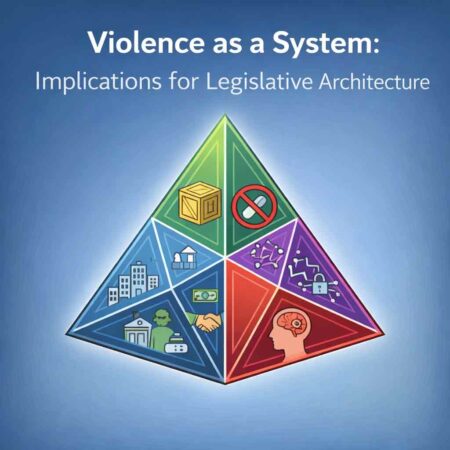
Mainstream debate still treats violence as a sequence of isolated events. That intuition feels comfortable. It also misleads. If you treat violence as a system, you stop expecting structural change from isolated operations, new statutes, or stronger commands. In many contexts, more action changes the shape of the problem, not its underlying dynamics.
The core failure is not the absence of state action. It is the reading that guides it. When institutions interpret violence as episodic, they confuse intensity with effectiveness. They act more, but not necessarily better.
This becomes clearer when you observe organized crime as a system. It survives, reorganizes, and exploits the gaps created by intervention itself. The problem persists not because the state does not respond, but because it often responds to the surface of the phenomenon.
Some recurring signals reveal this analytical error:
- policies repeat even when their effects diverge across contexts
- interventions solve one node and intensify pressure in another
- short term control, followed by institutional frustration and drift
If you do not correct the initial reading, public decision in complex environments starts compromised.
Reader note
The slide deck below offers a structured visual summary of the argument. The diagrams support a systemic reading of violence. They do not replace the reasoning developed throughout the article.
Both the Tetrahedron Model of Criminal Organizations and the definition of violence used here result from the intellectual work of Dr. Sergio Senna, oriented toward diagnostic and response design in complex systems. Treat these models as analytical support, not as simplification, and never as a standalone solution.
Reference context: WHEN CENTRALIZATION PRODUCES LESS CONTROL: complexity and polycentric governance in public safety (Pires, 2026).
Violence as an adaptive system and institutional learning
A meaningful shift starts when you recognize that violence and organized crime do not respond mechanically to state action. They operate as adaptive systems. They learn, reorganize, and exploit asymmetries created by intervention.
You do not need sophisticated technical vocabulary. You need to accept a few simple ideas that feel uncomfortable.
First, adaptation. Criminal networks adjust strategies as conditions change. Routes, markets, recruitment, and operational methods transform in direct response to pressure.
Second, learning. Every intervention generates information. When a policy fails or becomes predictable, criminal actors incorporate that information. They start anticipating institutional routines.
Third, feedback. Some responses, even with good intent, reinforce dynamics they aim to contain. Isolated repression can increase internal cohesion, raise barriers to entry, and make the system more resilient.
Fourth, pattern displacement. When one mode of operation becomes unviable, another emerges. The problem does not vanish. It changes location, form, or intensity.
In this kind of environment, the state does not intervene “from outside.” Intervention becomes part of the system and influences behavior. Ignore that, and you will repeat plausible responses that generate unexpected outcomes.
Two analytical instruments that organize a systemic reading
Recognizing adaptiveness is not enough. Public decision needs observational instruments that organize complexity without reducing it to slogans. At S Lab, two instruments serve complementary functions.
The Tetrahedron Model of Criminal Organizations
The Tetrahedron Model of Criminal Organizations supports the reading of organized criminal systems. It does not operate as a rigid typology. It offers a minimal structure for observation.
It starts from a practical claim. Criminal networks sustain themselves through a dynamic combination of four domains:
- Illicit markets, where resources, disputes, and economic incentives circulate
- A facilitating social environment, including territory, ties, informal protection, and everyday tolerance
- Desires and decisions, related to symbolic motives, identity, expectations, and local rationalities
- Adaptive capacity, expressed in learning, reorganization, and continuous replacement of routes and actors
These domains do not operate in isolation. They reinforce each other. If you intervene in only one domain, you often displace pressure into another. You create movement without structural reduction.
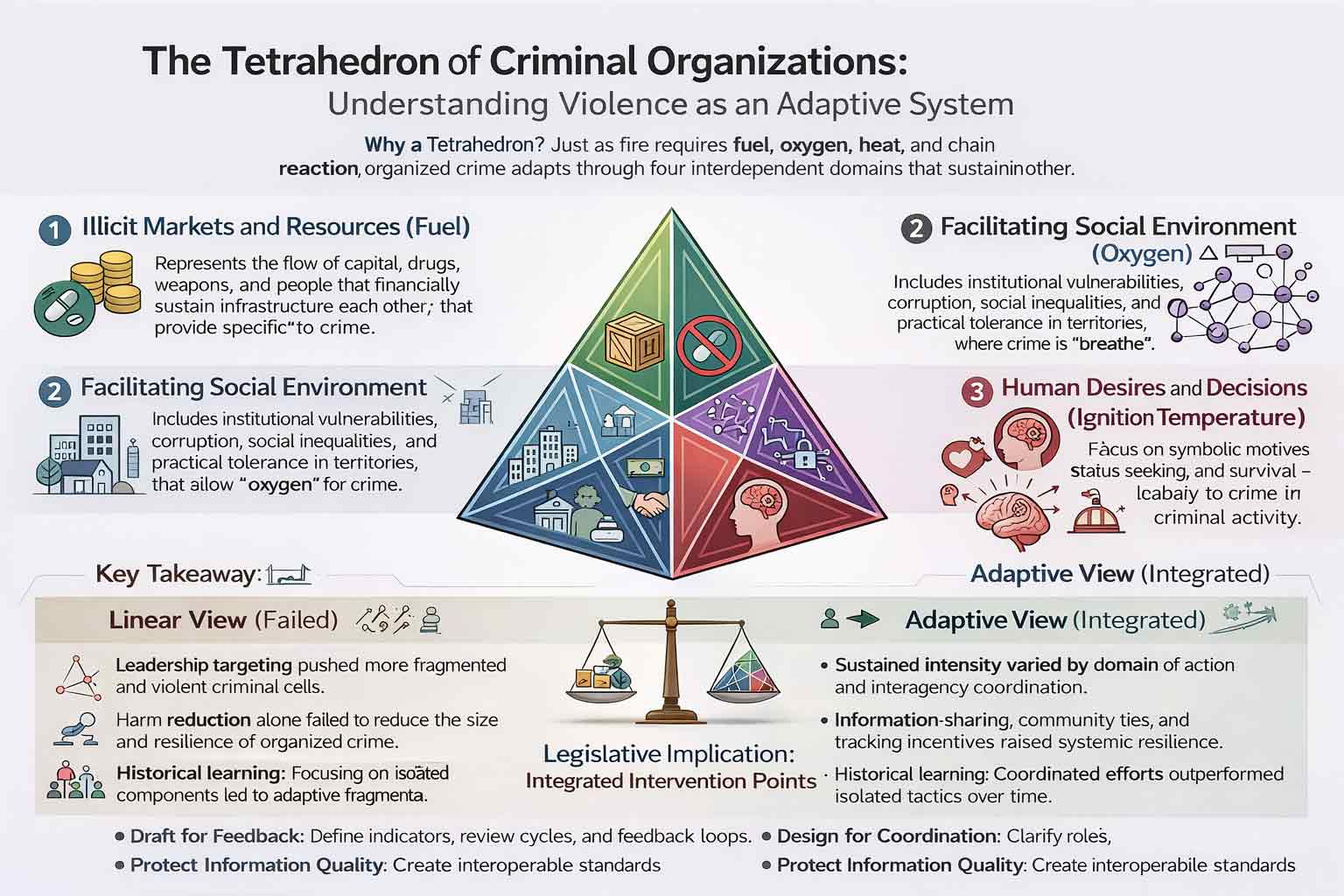
The Tetrahedron does not deliver a ready solution. It prevents the most common failure: deciding while looking at only one angle of the system.
Five elements of violence as a diagnostic criterion
While the Tetrahedron supports the reading of organized systems, concrete violent situations require a different diagnostic lens. At S Lab, violence is not defined only by visible harm or completed aggression. It is diagnosed through five structural elements.
These elements help you separate legitimate conflict from violence that demands an institutional response:
- Agents and patients, meaning who imposes an action and who bears it
- Asymmetry between parties, signaling a real imbalance of power or capacity
- Imposition of desires and decisions, where one side replaces the other’s autonomy
- Breach of norms, formal or informal, that organize coexistence
- Potential for harm, physical, psychological, social, or institutional, even if not yet realized
When these elements combine, violence can exist even without explicit physical aggression. Strategies that ignore this diagnostic frame tend to target only the most visible symptom, leaving intact the conditions that reproduce the problem.
Legislative implications: what this lens changes in lawmaking
Once you read violence and organized crime as adaptive systems, lawmaking changes. Not because legislators become planners of society, but because statutes and oversight shape incentives, information flows, and coordination.
In practice, this lens pushes legislative staff and committees to design for learning and adaptation:
- Draft for feedback. Define indicators, reporting duties, and review cycles that show how the system reacts
- Design for coordination. Clarify roles and interfaces across agencies, and avoid mandates that fragment responsibility
- Protect information quality. Require data standards, interoperability, and audit trails that reduce blind spots
- Build correction into the statute. Use sunsets, pilot authorizations, and revision triggers tied to observed effects
Trade-offs and limits: decide without promising total control
This approach does not promise full control. It improves decision under uncertainty. It also forces trade-offs into the open:
- Speed versus learning. Fast escalation can deliver short-term wins, but it can reduce institutional learning and increase adaptation on the other side
- Central command versus coordination capacity. Concentration can simplify orders, but it can create bottlenecks and weaken local detection
- Simplicity versus validity. Slogans travel fast, but they often hide the variables that reproduce violence
Use this lens to design more realistic laws and oversight. Do not use it to justify permanent exceptionalism, unchecked expansion, or vague mandates that cannot be evaluated.
Final note: read violence as a system to decide better
Treating violence as a system is not an academic exercise. It is a minimum condition for responsible public decision. Organized crime as a system challenges institutions not only through force, but through adaptive capacity.
Without a proper reading, public decision in complex environments tends to act a lot and understand little. With structured instruments, institutions can decide more realistically, acknowledge limits, and track the dynamics they aim to orient.
Continue to Track 3 to see how this reading becomes legislative architecture for complex problems.
Best,
Sergio Senna