

how to organize information to improve parliamentary decision-making
This study examines how visual information organization influences legislative decision quality. In institutional environments defined by complexity, information overload, and time constraints, the way evidence and diagnoses are presented becomes a critical factor for public decision-making. The research addresses the gap between detailed technical analyses and the actual interpretative capacity of political decision-makers.
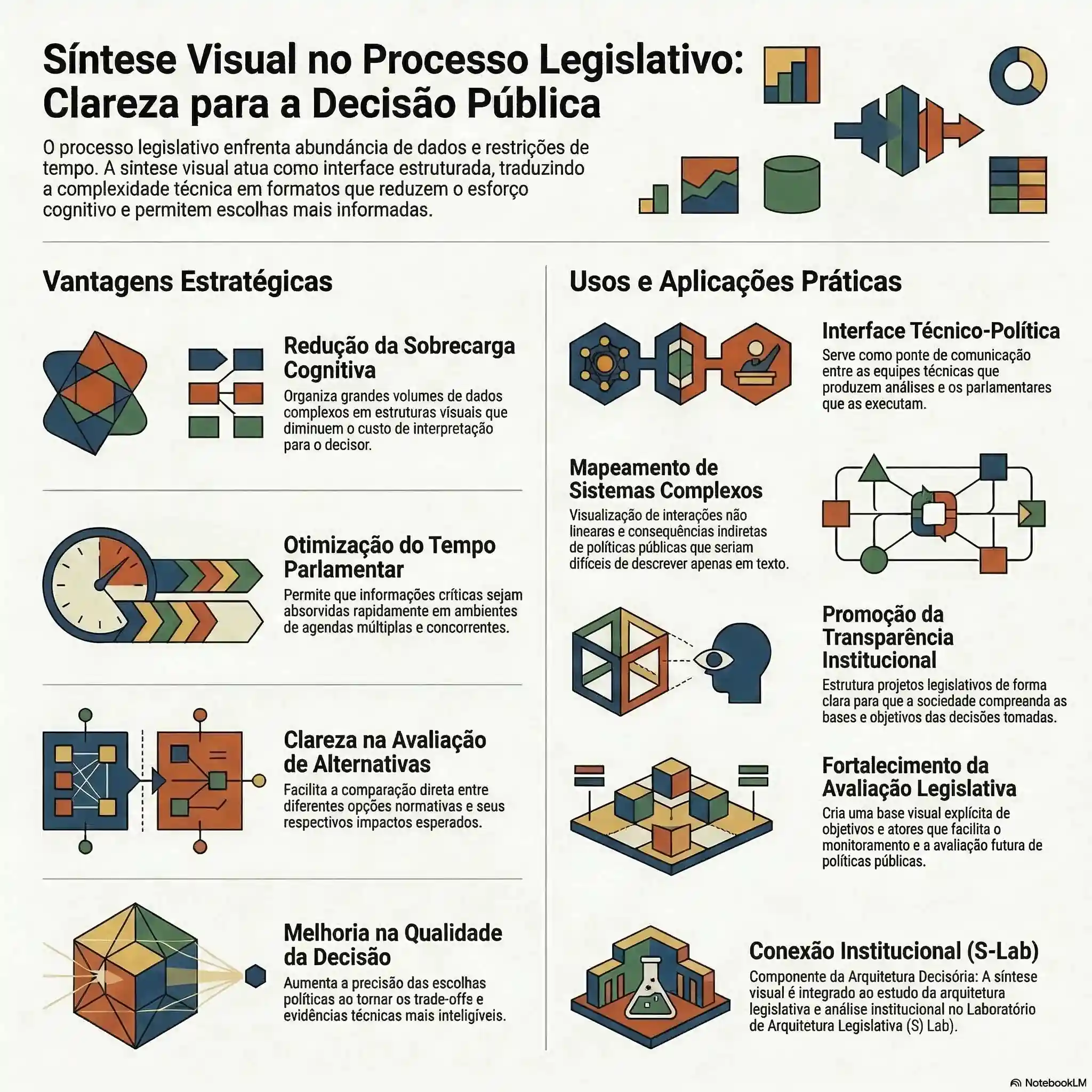
Central Research Question
How can visual synthesis improve the understanding of complex legislative problems and support more informed parliamentary decisions?
Core Thesis
The study argues that the central problem in contemporary parliamentary decision-making is not merely a lack of information, but how such information is organized. Legislative systems produce extensive technical reports, detailed legal analyses, and complex impact assessments. However, the political decision-maker operates under significant time constraints and constant institutional pressure.
In this context, visual synthesis emerges as a decision architecture element capable of reducing cognitive overload without stripping away the problem’s complexity. By organizing evidence, normative alternatives, and expected impacts into a clear visual structure, it becomes possible to improve the interpretation of legislative problems and facilitate the public choice process.
Key Arguments
• Legislative processes operate under conditions of imperfect information and limited time
• Extensive technical reports frequently fail to reach the final political decision-maker
• Visual information organization reduces interpretative cognitive costs
• Structured syntheses allow for a clearer comparison of normative alternatives
• Information architecture directly influences public decision quality
Relevance to the IBRALC Ecosystem
Connections with S-Lab
This study engages directly with several research lines at the (S) Lab | Legislative Architecture Laboratory:
• legislative architecture
• public decision
• institutional analysis
• public policy
• complex social systems
The laboratory investigates how institutions organize collective decision processes and how information architecture influences political choices and institutional outcomes.
Within this context, visual synthesis can be understood as a component of decision architecture. Institutions do not operate solely through formal rules, legal competencies, or organizational structures. They also rely on mechanisms that organize information flow and guide how actors interpret problems.
In the legislative environment, this aspect becomes particularly relevant. Parliamentarians must simultaneously handle multiple agendas, competing political demands, and highly complex public problems. How evidence and diagnoses are presented can directly influence which normative alternatives are considered and which decisions are finalized.
Thus, the study contributes to the S-Lab research agenda by exploring the relationship between informational design, institutional analysis, and decision-making processes in the legislative context.
Institutional Implications
The discussion proposed by the study carries relevant implications for the institutional design of legislative processes. In many political systems, the central challenge is not the absence of technical studies, but the difficulty of transforming specialized knowledge into usable information for the decision-making process.
Extensive reports and detailed technical opinions are essential to ensure analytical rigor and normative consistency. However, the very density of these documents can hinder their use by political decision-makers who must manage multiple agendas simultaneously.
In this scenario, visual synthesis serves as an interface between technical knowledge and political decision. By organizing the legislative problem, available evidence, normative alternatives, and expected impacts into a structured format, it becomes possible to improve communication between technical teams and parliamentarians.
Another relevant aspect concerns institutional transparency. When fundamental information about a legislative project is presented clearly and structurally, public debate tends to become more intelligible. This allows different political and social actors to more accurately understand the trade-offs involved in legislative decisions.
The approach also engages with literature on complex systems. Legislative problems are rarely linear. Public policies produce indirect effects, institutional interactions, and unforeseen consequences. Organizing these relationships intelligibly is a vital condition for more informed decisions.
Furthermore, using visual syntheses can help improve legislative evaluation quality. By making public policy objectives, involved actors, and expected impacts explicit, a clearer foundation for future policy evaluations is created.
Finally, adopting this type of approach can strengthen the institutional capacity of parliaments and legislative bodies. Instead of artificially simplifying complex problems, visual synthesis allows for structuring such complexity in an understandable way, expanding the analytical capacity of decision-makers.
Study Reference
Sergio Senna
Legislative impact in focus: the importance of visual synthesis in parliamentary decision-making
2025