

when law-making meets complex social systems
This study examines how traditional technical specialization reaches its limits when applied to social systems defined by high interdependence and unpredictability. In complex institutional contexts, linear logic in policy formulation often produces unexpected results. The research seeks to understand how complexity science-based approaches can expand the capacity of institutions to address contemporary public problems.
Central Research Question
How does legislative complexity alter the way institutions formulate and evaluate public policies within complex social systems?
Core Thesis
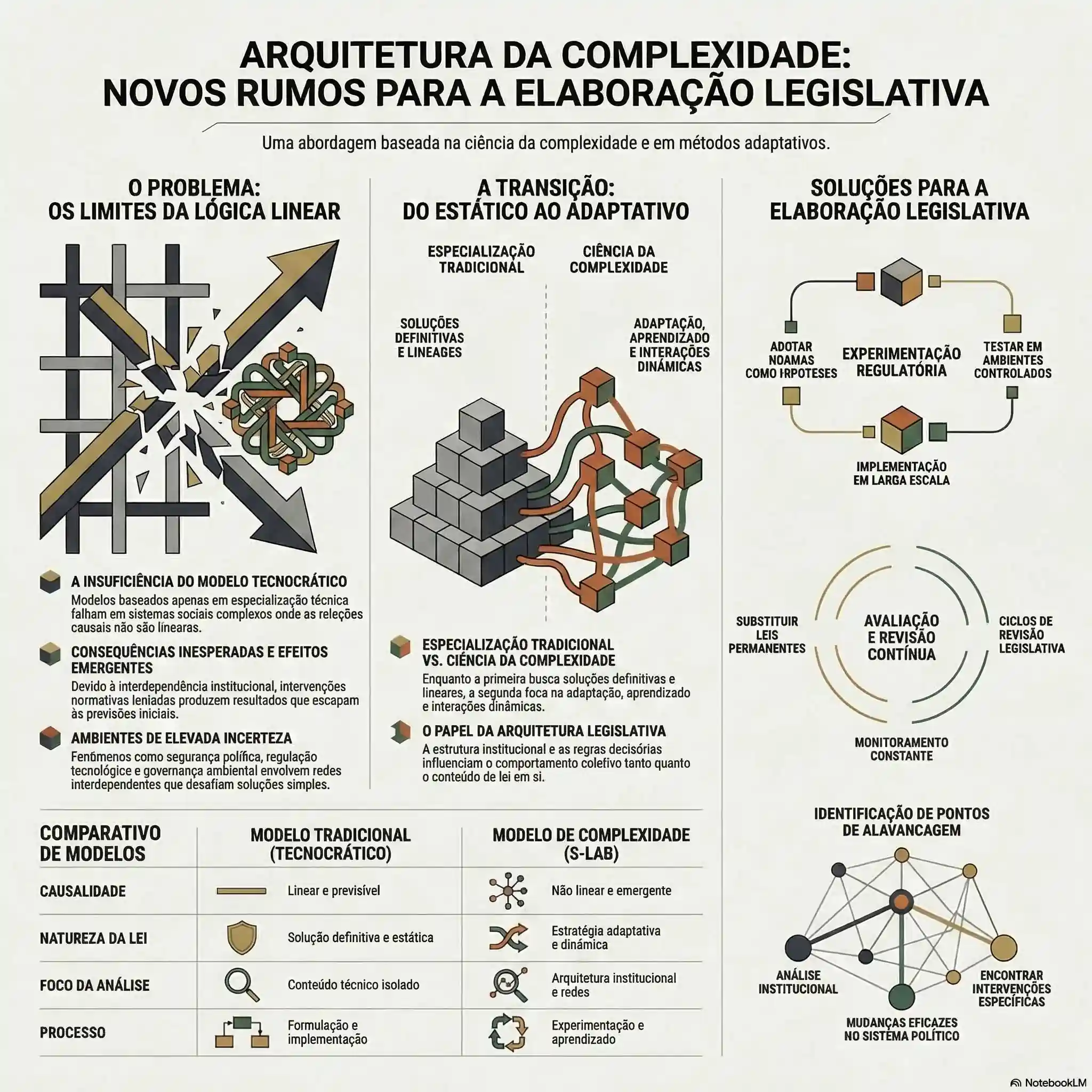
The study argues that law-making and public policy formulation occur in institutional environments defined by interdependence, adaptation, and emergent effects. In these contexts, technocratic models based solely on technical specialization become insufficient to handle complex social problems. Incorporating complexity science allows for a better understanding of legislative complexity, revealing how norms, institutions, and collective behaviors interact within dynamic social systems.
Key Arguments
• Complex social systems present non-linear causal relationships and emergent effects
• Normative interventions can produce unexpected consequences due to institutional interdependence
• Technocratic models perform better on simple or complicated problems but face limits in complex environments
• Institutional architecture profoundly influences public policy outcomes
• Adaptive approaches allow institutions to learn and adjust policies over time
Connections with S-Lab
Relevance to the IBRALC Ecosystem
This study engages directly with the research lines developed at the (S) Lab | Legislative Architecture Laboratory.
The laboratory investigates how institutional rules, decision-making structures, and normative systems influence collective behavior across different policy domains.
The study specifically connects four central axes of the ecosystem:
• legislative architecture
• institutional governance
• complex social systems
• institutional analysis
The concept of legislative complexity also relates to S-Lab research focused on policy design in environments of high institutional uncertainty. By analyzing how norms interact with institutional structures and collective behavior patterns, the study contributes to the development of more sophisticated public governance approaches.
Furthermore, the work reinforces the core perspective of the IBRALC ecosystem: institutions do not operate solely through formal rules. They function within dynamic social systems where political decisions, institutional incentives, and cultural processes continuously interact.
Institutional Implications
The analysis of legislative complexity carries significant implications for institutional design and public policy formulation.
First, it suggests that legislative processes must recognize the dynamic nature of social systems. Legal norms do not produce isolated effects. They interact with existing institutions, political incentives, and social behaviors. This interaction can generate emergent effects that escape the initial predictions of policy makers.
Second, the study indicates the need to incorporate adaptive methods into normative production. Instead of treating laws as definitive solutions, institutions can adopt strategies based on regulatory experimentation, continuous evaluation, and evidence-driven legislative review.
Third, the analysis highlights the importance of institutional analysis within the legislative process. Understanding how different institutional actors interact within the political system allows for the identification of leverage points capable of producing more effective changes in public policies.
Finally, the perspective of legislative complexity expands the analytical capacity of institutions by recognizing that many contemporary problems operate within interdependent networks. Phenomena such as public security, organized crime, technological regulation, and environmental governance involve multiple decision-making centers and government levels.
In these circumstances, effective public policies depend less on linear solutions and more on institutional strategies capable of handling adaptation, learning, and coordination among different actors.
By incorporating these principles, legislative architecture can evolve toward more resilient institutional models, capable of responding to rapidly transforming social environments.
Study Reference
Senna, Sergio.
When Specialization Meets Complexity: Innovation for a World in Transformation.
2025.