

The S-Lab | Legislative Architecture Lab conducts applied research on institutions, governance, and public policy.
The laboratory is part of the intellectual ecosystem centered on the field of Law and Behavior, which investigates the relationship between human conduct, social norms, and the institutions that organize collective life.
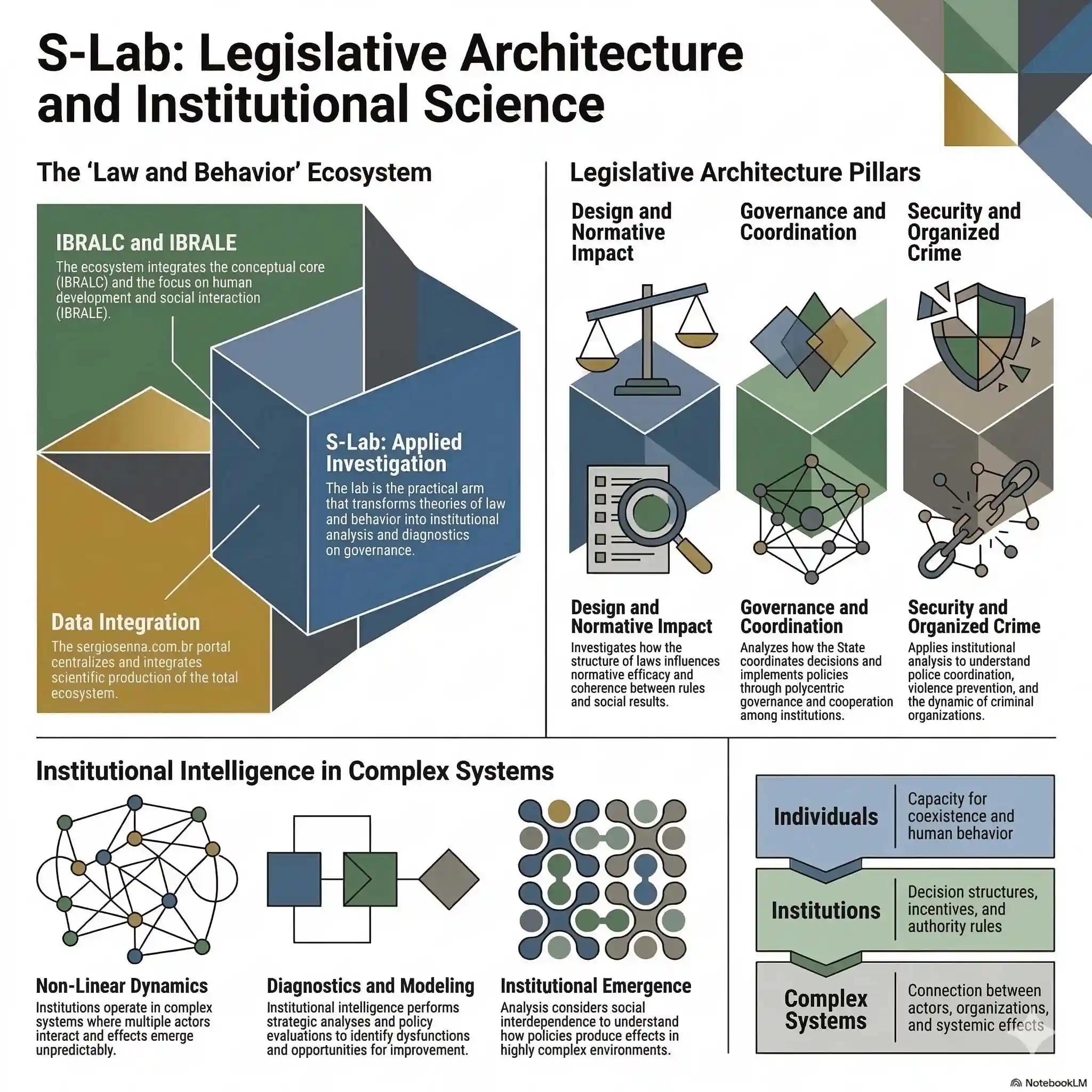
While the conceptual field examines the theoretical foundations of these relations, S-Lab empirically investigates how institutions and rules produce real-world effects on collective decisions and social behavior.
The central problem of institutional research
Institutions organize collective decisions and coordinate the actions of governments, organizations, and citizens.
Laws, regulations, and public policies define:
- institutional incentives
- decision-making rules
- authority structures
- forms of social coordination.
These structures orient collective behavior.
However, many institutions produce unexpected effects, dysfunctions, or results distinct from those envisioned in their formal design.
Institutional research seeks to comprehend these effects.
Legislative Architecture
A central axis investigated by S-Lab is legislative architecture.
This field examines how norms and laws are structured and how different institutional arrangements influence decisions and behaviors.
Investigated themes include:
- institutional design
- normative coherence
- institutional incentives
- legislative impact
- normative efficacy.
The analysis of legislative architecture allows for an understanding of how legal structures influence social outcomes.
Governance and public policy
Another core domain of the laboratory is the study of institutional governance.
Governance involves how different institutions coordinate collective decisions and implement public policies.
Investigated themes include:
- state coordination
- governmental capacity
- public policy implementation
- polycentric governance
- institutional cooperation.
These dimensions directly influence the capacity of institutions to respond to complex social problems.
Public safety and organized crime
S-Lab also develops research on institutions related to public safety.
These studies examine:
- safety governance
- police coordination
- violence prevention policies
- institutional dynamics of organized crime.
These themes belong to the theoretical field investigated by IBRALC and are empirically analyzed at the laboratory.
Complex social systems
Institutions operate within complex social systems.
In these systems:
- multiple actors interact
- decisions are interdependent
- effects emerge non-linearly.
For this reason, institutional analysis must consider factors such as:
- social interdependence
- systemic dynamics
- institutional emergence.
These perspectives allow for an understanding of how public policies produce effects in complex social environments.
Institutional intelligence
Institutional research also involves processes of diagnosis and interpretation of organizational structures.
This field is frequently termed institutional intelligence.
It involves activities such as:
- strategic institutional analysis
- institutional diagnosis
- public policy evaluation
- institutional modeling.
These analyses help identify limitations, dysfunctions, and opportunities for improvement in institutional performance.
Ecosystem connection
S-Lab integrates an intellectual ecosystem dedicated to the study of social life organization.
Within this ecosystem, different hubs investigate complementary dimensions of society.
IBRALE
Human development and social interaction.
IBRALC — Brazilian Institute of Law and Behavior
Conceptual hub examining the relationship between laws, institutions, and human behavior.
S-Lab
Applied research laboratory dedicated to institutional analysis, governance, and public policy.
sergiosenna.com.br
Platform integrating scientific production associated with research developed within the ecosystem.
Conceptual integration
Social life organization depends on the interaction between three fundamental dimensions:
- individuals capable of coexistence
- institutions that structure collective decisions
- complex social systems connecting actors and organizations.
S-Lab empirically investigates these relations, transforming the Law and Behavior theoretical field into applied institutional analysis.
Summary
Research developed at S-Lab examines how laws, institutions, and public policies produce concrete effects on social life organization.
Institutional analysis, combined with perspectives from complexity theory and public governance, allows for an understanding of how institutional systems influence collective decisions and social outcomes.
This post is also available in pt_BR.