

The IBRALC Ecosystem is an integrated intellectual and research architecture developed to examine how human behavior, social norms, institutions, and collective decision-making interact in complex social systems.
It brings together four interconnected sites — IBRALE, IBRALC, S-Lab, and SergioSenna.com — each with a distinct function within a broader analytical framework focused on behavior, society, governance, and institutional design.
Together, these sites form a coordinated research environment for understanding how socialization, interpretation of behavior, institutional incentives, and systemic dynamics shape social life.
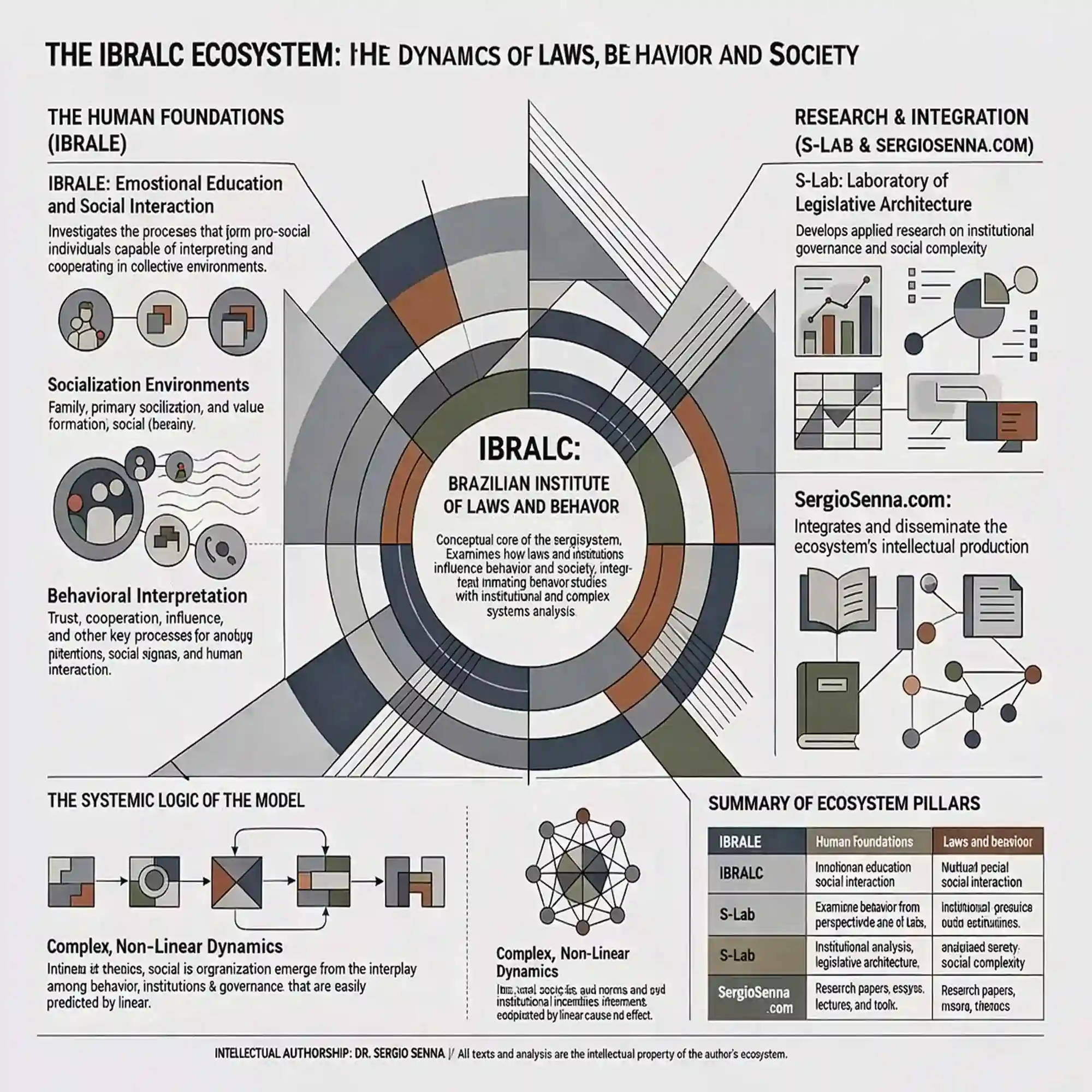
A conceptual architecture for understanding behavior, society, and institutions
Social life is organized through the interaction of human behavior, social norms, and institutions. Individual decisions, interaction processes, and institutional arrangements form complex social systems in which incentives, rules, and interpretations of behavior continuously shape one another.
The IBRALC Ecosystem was built to investigate these relationships in an integrated way. Rather than isolating behavior from institutions or reducing institutions to formal rules alone, the ecosystem examines how people, norms, organizations, and systems interact across multiple levels of social life.
Each site performs a specific role within this architecture. Together, they form an intellectual system oriented toward the relationship between human behavior, social organization, and institutional structure.
Conceptual core of the ecosystem
At the center of the ecosystem lies the theoretical field represented by:
IBRALC — Brazilian Institute of Laws and Behavior
This field investigates the relationship among four fundamental elements of collective life:
human behavior
social norms
institutions
collective decision-making
The central question guiding this domain is straightforward:
How do laws and institutions influence human behavior and the organization of society?
From this conceptual center, the ecosystem is organized into three complementary dimensions:
the human foundations of social life
applied institutional research
scholarly integration
This structure makes it possible to analyze individuals, social interaction, and institutions within the same analytical framework.
The human foundations of social life
IBRALE investigates the processes through which individuals become capable of living in society, interpreting the behavior of others, and participating in collective life.
Social life depends on the human capacity to:
regulate emotions;
interpret social signals;
build relationships of trust;
cooperate in shared environments.
These processes emerge primarily in three structural environments:
Family
primary socialization;
formation of values;
emotional regulation;
empathy and cooperation.
School
social learning;
institutional coexistence;
conflict management;
school culture.
Community
social capital
informal norms
networks of cooperation
social culture
This domain also examines central processes of social interaction, including:
- social perception
- social interaction
- trust
- credibility
- social influence
- persuasion
- nonverbal communication
- microexpressions
- body language
- deception detection
These elements form the behavioral infrastructure of social life.
Stable societies depend on the ability of individuals to interpret intentions, negotiate conflict, and cooperate in collective settings.
Law and behavior
IBRALC serves as the conceptual core of the ecosystem.
Its theoretical field examines how formal rules and institutional structures influence human decisions and the organization of society.
Its main domains of inquiry include:
- legislative architecture
- institutional governance
- public policy
- public safety
- organized crime
- state capacity
- polycentric governance
- social complexity
Within this field, laws and institutions are not treated merely as legal norms. They are analyzed as structures of incentives that orient individual and collective behavior.
Small changes in institutional design can produce broad effects in social organization by influencing:
strategic decisions
state coordination
government capacity
patterns of social cooperation
S-Lab — Laboratory of Legislative Architecture
The S-Lab | Laboratory of Legislative Architecture develops applied research on the theoretical domains explored within IBRALC.
While IBRALC organizes the conceptual field, S-Lab investigates institutional and social problems empirically.
Its main research lines include:
- institutional analysis
- legislative architecture
- public policy evaluation
- public safety governance
- organized crime
- complex social systems
The laboratory seeks to understand how institutions and rules produce real effects in collective behavior.
This work involves institutional diagnosis, strategic analysis, and the study of decision processes in complex settings.
SergioSenna.com — scholarly integration
SergioSenna.com brings together and integrates the intellectual production of the ecosystem.
It functions as a space for synthesis, interpretation, and dissemination of the knowledge developed across the different domains.
This site includes:
- scholarly articles
- analytical essays
- research papers
- books and book chapters
- lectures and interviews
The role of this domain is to integrate different fields of knowledge involved in the analysis of social life.
These include:
social psychology
behavioral science
institutional analysis
complexity science
public governance
Complex systems and social organization
The phenomena studied across the ecosystem are also examined through the perspective of complexity science.
Human societies function as complex adaptive systems.
In systems of this kind:
individual decisions
social interactions
institutions
produce collective patterns that cannot be explained through simple linear relationships alone.
Central concepts in this approach include:
complex systems
social complexity
social emergence
institutional interdependence
systemic dynamics
public order
This perspective helps explain why public policies, institutional reforms, and security strategies often produce unintended results.
Institutional changes that appear minor at first may trigger broad effects across social organization.
The architecture of the ecosystem
The ecosystem follows a radial structure centered on IBRALC.
IBRALC
conceptual core — laws and behavior
IBRALE
human foundations of social life
S-Lab
applied scientific research
SergioSenna.com
scholarly integration and dissemination
This architecture makes it possible to investigate simultaneously:
human development
interpretation of behavior
institutional design
the systemic dynamics of society
Final synthesis
The ecosystem formed by IBRALE, IBRALC, S-Lab, and SergioSenna.com constitutes an intellectual architecture dedicated to the study of how social life is organized.
By integrating behavioral analysis, institutional inquiry, and complexity science, this project seeks to understand how societies generate cooperation, conflict, or institutional transformation.
This approach makes it possible to examine processes ranging from human socialization to complex challenges in public governance, public safety, and institutional design.
Sites in the ecosystem
IBRALC
https://ibralc.com.br
IBRALE
https://ibrale.com.br
S-Lab
https://ibralc.com.br/en/
Sergio Senna
https://sergiosenna.com.br