

A Systemic Framework for Institutional Intervention
By Sergio Senna | March 14, 2026 | Filed under: Complex Adaptive Systems, Violence & Criminal Systems
This study examines how violence can be understood from the perspective of complex systems. The approach to complex systems and violence allows for an interpretation of the phenomenon not as a set of isolated events, but as the result of interdependent institutional, social, and behavioral interactions.
The approach seeks to fill a recurring gap in public policy: the tendency to address complex phenomena with simplified explanatory models and fragmented strategies.
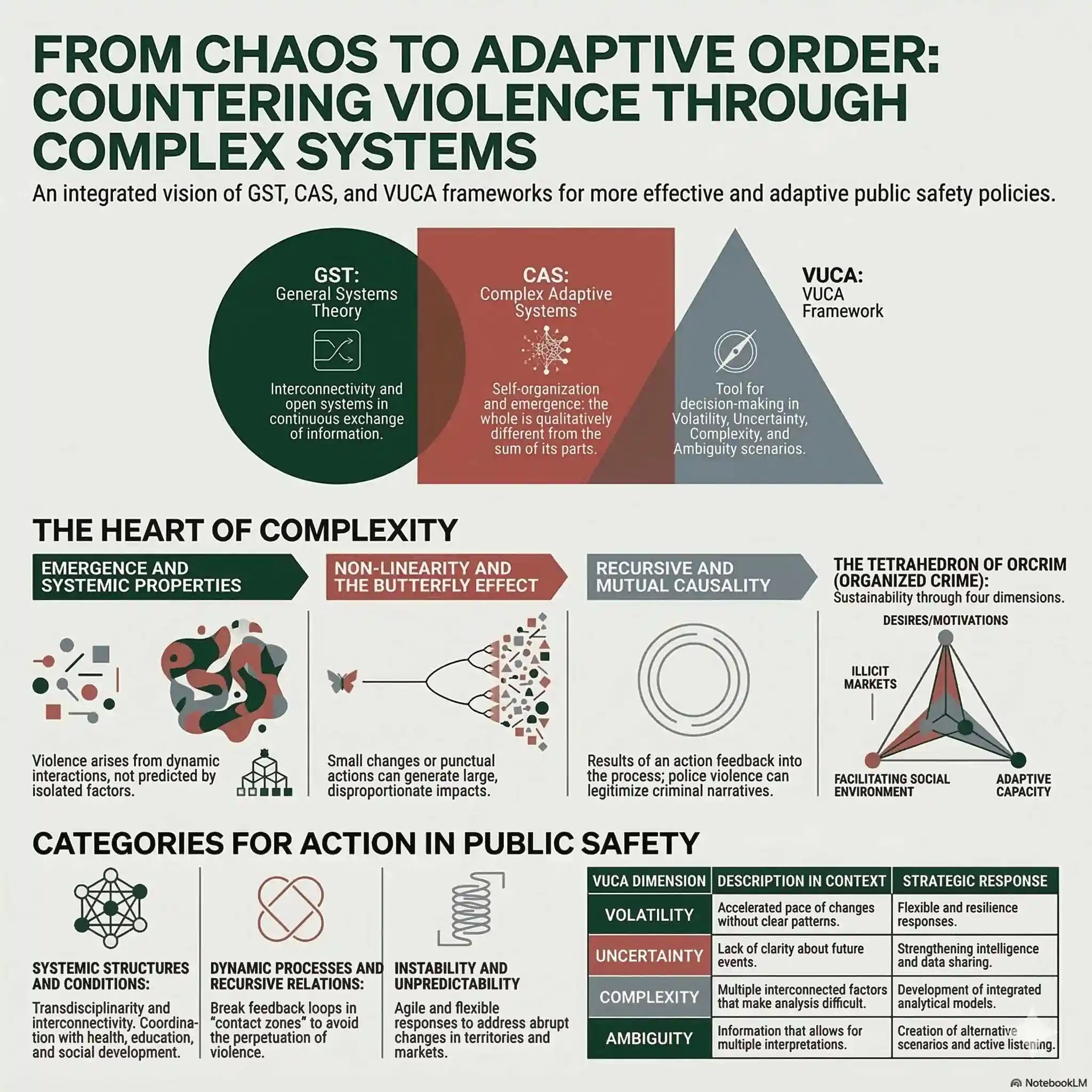
Complex systems and violence: an integrated view of General Systems Theory, complex adaptive systems, and the VUCA framework applied to public safety.
A abordagem busca preencher uma lacuna recorrente nas políticas públicas: a tendência de enfrentar fenômenos complexos com modelos explicativos simplificados e estratégias fragmentadas.
Central Research Question
How can complexity theory orient institutional diagnosis and the counter-violence strategy in contemporary societies?
Core Idea of the Study
The study argues that violence must be understood as an emergent phenomenon of complex social systems. In this type of system, multiple actors interact under conditions of uncertainty, generating collective patterns that cannot be explained solely by individual decisions or isolated factors.
The analysis demonstrates that social complexity, institutional interdependence, and the incentives present in governance structures directly influence the dynamics of violence. Therefore, effective public policies require an approach oriented by systemic analysis, capable of understanding how institutional decisions produce cumulative effects on collective behavior.
Main Arguments
- Violence emerges from interactions among multiple actors embedded in complex systems;
- Institutional decisions produce indirect and often unpredictable effects;
- Fragmented public policies tend to fail in environments of high social complexity;
- Understanding institutional incentives is essential to interpret the dynamics of violence;
- Institutional strategies must consider interdependence, adaptation, and systemic emergence.
Relations with the IBRALC Ecosystem
This study dialogues directly with the research tracks developed at the (S) Lab | Legislative Architecture Lab.
The laboratory investigates how institutional structures influence public decisions and collective behavior in complex environments. The complex systems perspective reinforces the importance of understanding how rules, institutions, and incentives orient social patterns.
The study connects especially to the following ecosystem tracks:
- legislative architecture;
- institutional governance;
- public safety;
- complex social systems;
- institutional analysis.
By exploring the dynamics of violence through complexity theory, the study contributes to the construction of analytical models capable of orienting public decisions in contexts of high uncertainty.
Institutional Implications
The complex systems perspective possesses significant implications for the design of public policies and the institutional organization of the State.
Phenomena such as urban violence, organized crime, and social conflicts cannot be adequately understood by linear cause-and-effect models. These phenomena result from the continuous interaction between institutional factors, social incentives, and human behavior.
This means that institutional interventions need to consider not only the immediate impact of a public policy but also the systemic effects that may emerge over time. Institutional decisions alter incentives, reorganize interaction networks, and can produce consequences not initially foreseen.
In this context, the design of public policies demands greater attention to institutional architecture and the way different decision-making centers interact. Effective institutional systems tend to combine state capacity, institutional coordination, and continuous adaptation mechanisms.
For the public safety field, this approach implies recognizing that the counter-violence strategy depends as much on operational action as on the institutional design that structures decisions, incentives, and information flows within the system.
Study Reference:
Senna, Sergio. How complexity theory can orient the counter-violence strategy. 2025. Research Papers | S-Lab.