

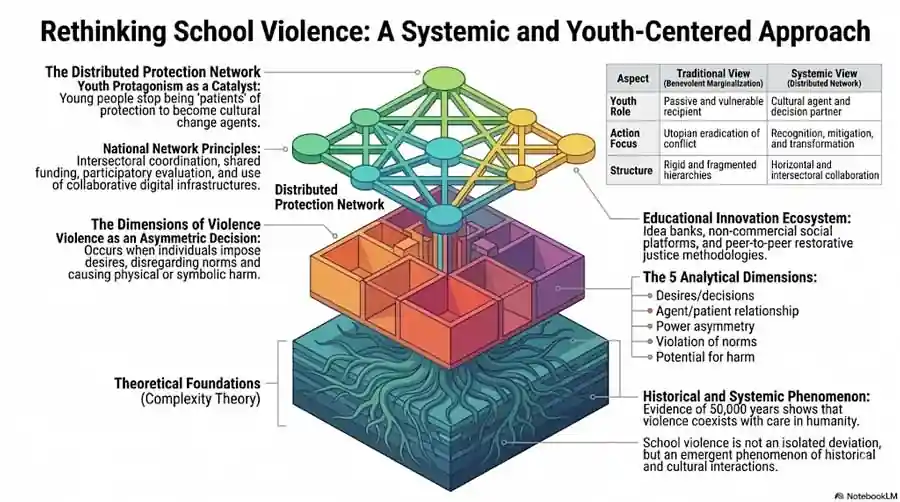
This study establishes a strategic framework for systemic violence mitigation by analyzing how violent patterns emerge within complex social systems, particularly in institutional youth contexts. The research argues that fragmented interventions yield limited results. The critical gap lies in the absence of approaches integrating social complexity, culture, and youth participation into the institutional analysis of structural violence.
Core Research Question
How can social networks oriented toward youth participation contribute to transforming patterns of violence within complex social systems?
Central Thesis
The study argues that violence cannot be understood merely as individual behavior or an isolated event. It emerges from interactions between culture, institutions, and power dynamics. Building care-oriented youth networks can produce cultural shifts capable of altering collective patterns of violence over time, serving as a pillar for systemic violence mitigation.
Key Arguments
• Violence emerges from interactions between cultural norms, power relations, and social decisions.
• Complex social systems exhibit non-linear causality and emergent patterns.
• Youth can act as cultural agents capable of transforming social norms.
• Distributed care networks expand the collective capacity for violence prevention.
• Participatory interventions can drive gradual institutional change.
Relevance within the IBRALC Ecosystem
This study aligns directly with the research lines of S-Lab | Legislative Architecture Laboratory:
• Legislative Architecture
• Institutional Analysis of Violence
• Public Safety Governance
• Complex Social Systems
The laboratory investigates how institutions, rules, and decision-making processes influence collective patterns of behavior and social organization.
Institutional Implications
The analysis suggests that public policies for addressing violence must consider the institutional complexity of social systems. Interventions focused solely on repression or isolated assistance tend to produce limited effects. Institutional structures capable of integrating youth participation, institutional learning, and intersectoral coordination can expand the capacity for cultural transformation and achieve effective systemic violence mitigation.
Study Reference
Pires, Sergio Fernandes Senna
Complexity, Care and Culture: Rethinking Violence and Participation through Youth-Centred Networks
2026