

When we speak of violence, the image that usually comes to mind is one of physical aggression, war, or serious crime. While this association is understandable, it is insufficient. Violence is a much broader, more persistent, and often silent phenomenon. It permeates family dynamics, work environments, schools, institutions, and seemingly mundane daily decisions.
To properly understand this phenomenon, we must move beyond simplistic definitions and adopt a more analytical framework. This is precisely what the concept of the dimensions of violence allows us to do: identify decisional and relational patterns that produce harm even in the absence of explicit aggression.
Before exploring each of these dimensions, it is essential to clarify how violence is being defined in this context.
Our definition of violence in this text
This framework, developed by Dr. Sergio Senna, allows us to move beyond a purely reactive stance. By understanding violence through these five dimensions, we shift our focus to the root of the issue: the quality of our decisions and the ethics of our relationships.
Ultimately, Dr. Senna’s approach demonstrates that if violence is constructed through choices and asymmetries, then peace and integrity are as well. Recognizing the complexity of this phenomenon does not serve to downplay the harm; rather, it provides the necessary conditions and tools to transform it in an intelligent and sustainable way.
Agents and Subjects
All violence involves agents and subjects. The agent is the one who makes the decision or exercises power; the subject is the one who experiences the effects of that decision. An agent is not always an individual. Institutions, rules, public policies, and organizational practices can also act as agents when they produce predictable impacts on others.
Power Asymmetry
Violence presupposes asymmetry. One party possesses more resources—whether physical, symbolic, institutional, or informational—to impose their will. The greater this inequality, the lower the subject’s capacity to respond.
Imposition of Decisions
Violence is not just about causing pain; it is about imposing consequential decisions on the lives of others without them having the genuine ability to consent, participate, or refuse. This imposition can be direct or subtle, explicit or disguised as normality.
Violation of Shared Norms and Values
All violence implies some form of normative breach. It may involve formal laws, institutional rules, or widely recognized moral values. Legality, in itself, does not eliminate the possibility of violence.
The Potential for Harm
Violence is also defined by the concrete potential to cause damage—whether physical, psychological, symbolic, social, or institutional. Many violent practices produce cumulative and silent effects.
This framework provides the necessary lens to properly understand the dimensions of violence presented below.
Dimensions of violence: why they do not operate in isolation
The dimensions of violence are not rigid categories. They overlap, reinforce one another, and often hide within each other. What changes is the manner in which the violent decision manifests and the type of harm produced.
Dimensions of violence: why they do not operate in isolation
Discussing the dimensions of violence is different from simply discussing types of violence. When we use the term “types,” we usually think of separate categories—such as physical, psychological, or institutional violence—as if each existed in a vacuum. In practice, this is rarely the case.
The dimensions of violence help us understand that violence works as a process rather than an isolated event. They show that different forms of violence often occur together, reinforcing each other over time. What changes is not just the type of aggression, but how decisions are made, how power is wielded, and how harm is generated.
A situation may involve no physical aggression at all and yet still be violent. This happens, for example, when someone is constantly devalued, when important decisions are imposed without dialogue, or when seemingly neutral rules place a person at a permanent disadvantage. In these cases, violence is present even without raised voices or physical blows.
This perspective is broader because it helps us perceive what comes before the aggression. Much of violence begins with small, repeated choices, in silences, in unquestioned norms, or in unequal relationships that eventually become “normal.” By the time physical aggression appears, it is usually just the most visible part of a problem that had been brewing for a long time.
Therefore, thinking in terms of the dimensions of violence allows us to identify risk factors earlier and better understand why certain conflicts repeat or escalate. Instead of merely asking “what type of violence occurred?”, the question becomes: how was this situation constructed over time, and who was left without a real choice?
1. Physical violence: the most visible dimension
Physical violence is the most easily recognized because it leaves evident marks on the body. It involves the direct use of force to cause pain, injury, or death.
Clear example:
An assault in a domestic context, a fight in a public space, or the use of excessive force during a police intervention. In all these cases, there is an explicit decision to impose one’s will through physical force.
Although it is the most visible among the dimensions of violence, it rarely emerges in isolation. Generally, it is the culmination of prior processes of humiliation, exclusion, or coercion.
2. Psychological and emotional violence
Psychological violence occurs when words, gestures, silences, or threats are used to control, diminish, or subjugate someone. Its effects can be profound, even in the absence of physical scars.
Clear example:
A manager who systematically disqualifies an employee, ridicules their ideas, or creates a permanent environment of fear. Or a partner who emotionally manipulates another, eroding their self-esteem.
Here, violence is expressed as the asymmetrical imposition of emotional decisions, exploiting psychological vulnerabilities.
3. Symbolic violence
Symbolic violence occurs when beliefs, norms, and discourses legitimize inequalities as if they were natural or inevitable.
Clear example:
A child who learns that they should not question injustices. Or someone who internalizes the idea that they must tolerate abuse to maintain relationships or social status.
Among the dimensions of violence, this is one of the most persistent, as it operates through the internalization of dominance.
4. Institutional violence
Institutional violence occurs when organizations and policies produce predictable and avoidable harm, even without explicit intent.
Clear example:
Healthcare systems that obstruct access to care, schools that humiliate students in the name of discipline, or security structures that treat specific groups as permanent suspects.
In this case, the agent of violence is the institutional arrangement itself, which imposes decisions in an impersonal and asymmetrical manner.
5. Decisional violence: the cross-cutting dimension
All violence begins with a decision. Decisional violence refers to the moment someone chooses to impose their will without considering ethical limits, norms, or the impact on others.
Clear example:
Two children fight over a toy. One decides to take it by force. Even if the physical harm is negligible, the logic of violence is already present.
This dimension cuts across all other dimensions of violence, because all violence is, first and foremost, a choice.
How the dimensions of violence combine in practice
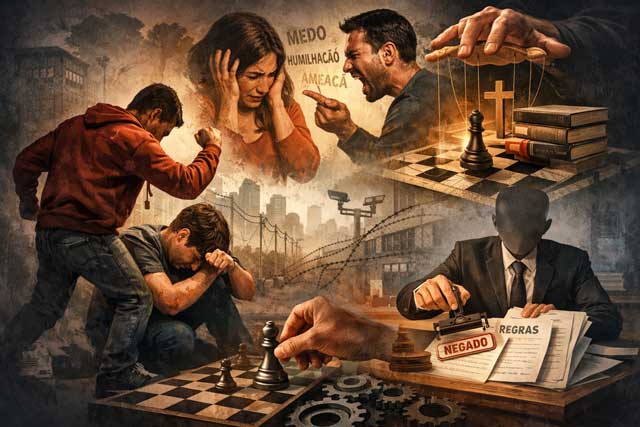
In reality, we rarely find a single dimension in isolation. A school environment can combine symbolic, psychological, institutional, and decisional violence simultaneously. The same occurs within families, organizations, and complex social systems.
Physical violence, when it appears, is usually just the most visible face of a deeper, systemic process.
Why understanding the dimensions of violence is essential
Reducing violence merely to physical aggression leads to flawed diagnoses and delayed responses. Understanding the dimensions of violence allows us to:
- identify early and subtle patterns;
- intervene before escalation;
- hold decisions accountable, not just extreme acts;
- design more effective and sustainable policies and practices.
Conclusion
Violence is not only what hurts the body. It also shapes identities, organizes institutions, and guides decisions. Recognizing the dimensions of violence is essential for moving beyond reactive logic and toward more intelligent and responsible ways of addressing it.
As long as we treat violence as a simple problem, we will continue to repeat solutions that fail. Recognizing its complexity does not relativize the harm—it creates the real conditions to transform it.