

Behavioral surveillance and the promise of predicting intentions
The concept of behavioral surveillance is not new, but it gained significant momentum starting in 2008 when the Department of Homeland Security began testing systems aimed at behavioral prediction in sensitive environments such as airports and borders. The proposal was simple in its form yet ambitious in its rhetoric: to use remote sensors and artificial intelligence to identify, in real-time, individuals with potential hostile intentions.
This was not traditional surveillance involving human-operated cameras, but a more complex technological arrangement. Physiological sensors, eye tracking, thermal cameras, facial expression analysis, body movement, and vocal variations would feed computational models capable of classifying emotional states and patterns deemed “atypical.” The most well-known system in this suite became associated with the FAST program—Future Attribute Screening Technology.
Institutional discourse presented preliminary results showing around 70% accuracy. In isolation, this number sounds promising. For managers pressured by efficiency and prevention, it suggests an operational advantage. The problem begins when one asks a basic question: 70% accuracy in relation to what, exactly?
Here, the first critical confusion arises. These systems do not predict behavior in a causal sense. They perform probabilistic screening based on non-specific physiological signals. Nevertheless, public and political discourse began treating the system as if it were capable of “reading intentions.” This transposition is not a mere semantic detail; it completely alters the type of decisions the State begins to justify.
Behavioral prediction and the risk of operational false positives
For those working in public safety, the central point is not whether the technology is sophisticated. The point is the operational false positive. In high-flow environments like airports, major events, or borders, even a modest error rate carries grave consequences.
Anxiety, fear, grief, stress, fatigue, and personal experiences activate the Autonomous Nervous System in a manner similar to the activation caused by a real threat. Behavioral surveillance detects this activation. It does not distinguish the cause. This limitation is not technical; it is biological and cognitive.
When a system flags a risk based on elevated heart rates, facial micro-tensions, or respiratory changes, it is identifying a state, not an intention. The practical result is the multiplication of false positives: ordinary citizens treated as suspects due to normal physiological responses in stressful contexts.
Researchers critical of FAST warned of exactly this. In a busy airport, a system with 70% accuracy, applied to thousands of people per hour, produces more unjustified interruptions than useful interventions. The cost is not just reflected in lines or delays; it manifests as the erosion of institutional trust, expanded discretionary power, and the normalization of suspicion.
For the manager, this requires an uncomfortable but necessary question: what decision am I willing to authorize based on signals that cannot differentiate threat from distress?
If the answer is not clear, the technology stops being a support tool and becomes a liability.
Body language, physiological activation, and the limits of state inference
Behavioral surveillance usually relies on an implicit assumption: the idea that body signals, facial expressions, and physiological responses contain direct clues about future intentions. This assumption is fragile—not for a lack of sensors or computational capacity, but because it ignores a structural limit of human behavior.
Body language was not designed to communicate criminal intent. It precedes verbal language and is deeply associated with the body’s automatic regulation. Sweating, respiratory changes, facial micro-tensions, pupil dilation, and shifts in speech rhythm indicate activation, not meaning. The body responds before it interprets.
This point is decisive for law enforcement and managers. A system can identify that someone is under heavy stress, but it cannot determine if that stress stems from a fear of flying, a personal conflict, a recent loss, or a violent plan. All these situations produce similar physiological patterns. The system does not fail due to imprecision; it fails due to causal indistinction.
When one attempts to convert physiological activation into a threat indicator, an inferential leap occurs. This leap is not scientific; it is normative. It moves ambiguous data into a concrete state decision, such as a stop, detention, coercive interview, or expanded surveillance.
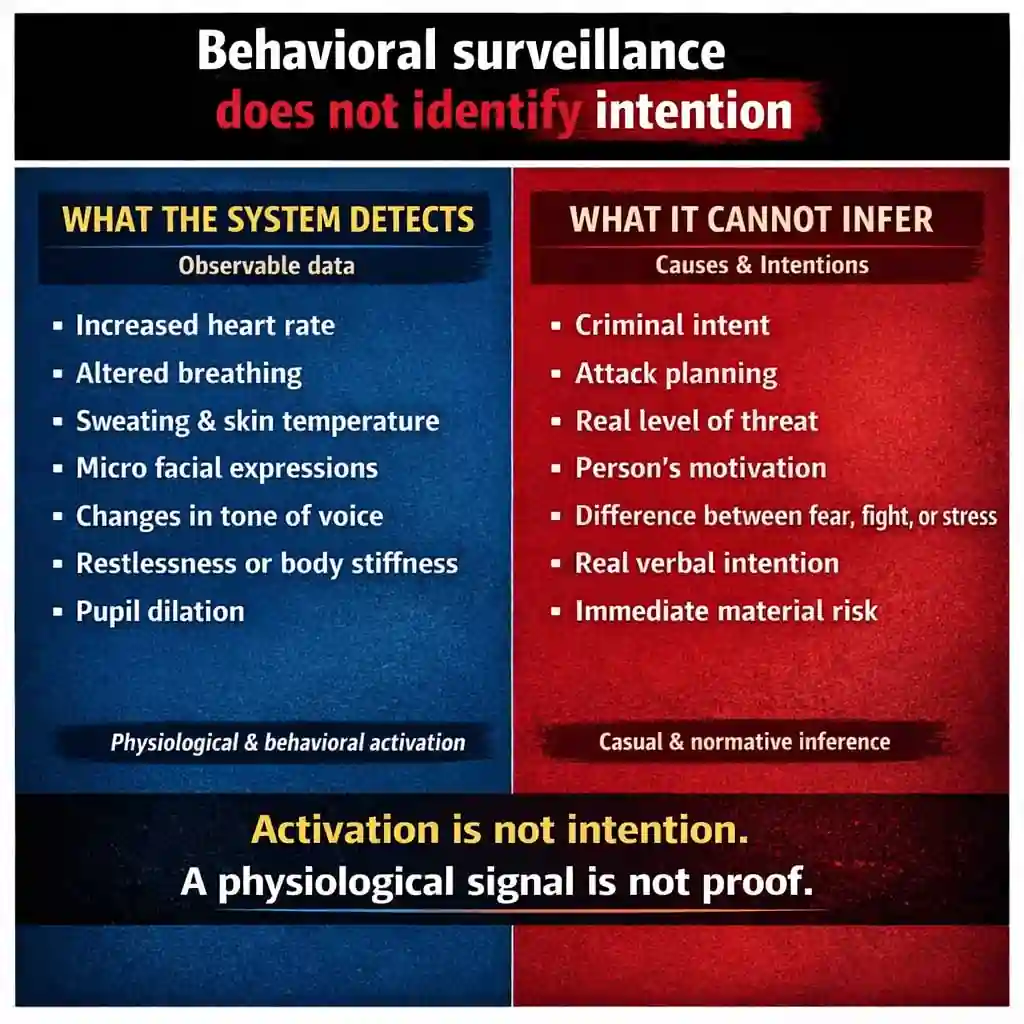
This framework is fundamental to dismantling the belief that more data produces more truth. In practice, it produces more decisional noise. The risk is not in observing behavior—something police work has always done. The risk is in automating inferences that an experienced human observer already knows cannot be made reliably.
When behavioral surveillance begins to guide operational decisions, it does not expand control; it redistributes uncertainty. And, frequently, it shifts that uncertainty onto the wrong citizen.
Operational decision-making guided by amplified uncertainty
In police practice, every decision is born under uncertainty. Stopping, detaining, interviewing, or releasing someone involves situated judgment, reading the context, and risk assessment. The promise of behavioral surveillance is to reduce this uncertainty through data. The actual effect is usually the opposite.
When physiological signals guide operational decisions, uncertainty does not disappear; it simply moves. Instead of being explicit in the officer’s judgment, it hides behind an algorithmic classification. The data creates an appearance of objectivity but does not solve the central problem: the causal ambiguity of human behavior.
For the manager, this creates a clear institutional risk. Decisions start being justified by systems whose logic cannot distinguish common emotional activation from a concrete threat. The frontline officer tends to trust the alert because it comes “from the system.” The system, in turn, is not held accountable for the decision’s impact. Responsibility becomes diluted.
This type of arrangement favors excessive stops, unnecessary detentions, and unjustified escalations. In high-flow environments, operational costs explode. Institutionally, the damage is deeper: it normalizes the idea that suspicion can precede any concrete evidence of wrongdoing.
Here, the operational false positive stops being a statistical error and becomes a governance problem.
Behavioral surveillance, governance, and institutional risk
The debate over behavioral surveillance is often shifted toward privacy. This is a legitimate concern, but insufficient. Even if data is anonymized and deleted after screening, the decisional effect has already occurred. The citizen has already been classified, stopped, or pulled from the flow.
The central problem is not data storage. It is the state use of fragile inferences to guide coercive action. This directly affects the governance of public safety.
Such systems broaden discretionary power without broadening the quality of the decision. They create technological dependency, reduce the agent’s critical autonomy, and make subsequent accountability difficult. When something goes wrong, the justification falls on the protocol or the system, never on the underlying premise.
For managers, the right question is not whether the technology is modern, but whether it improves the quality of decision-making under risk. If the answer is no, the system adds no strategic value. It merely shifts the problem to a less transparent technical layer.
Behavioral surveillance, when presented as a predictive solution, tends to produce more noise than control. Not out of bad faith, but because it attempts to answer a question that does not allow for an objective answer: what someone intends to do.
Operational Conclusion
What managers need to understand before authorizing use
Behavioral surveillance does not fail because it is imprecise. It fails because it is applied to a type of decision that does not permit reliable physiological inference. The error lies in the institutional expectations created around the system.
For public safety managers, certain guidelines must be made explicit:
- Do not delegate decisions to ambiguous signals
Physiological signals indicate activation, not intention. Using them as a basis for coercive action shifts uncertainty to a point that is less visible and harder to audit.
- Do not confuse screening with evidence
These systems can, at most, support broad screening. They do not sustain a stop, detention, interrogation, or any restrictive measure on their own.
- Treat false positives as a structural cost
A false positive is not an exception; it is an expected consequence. If the institutional model cannot absorb this cost, the system becomes operationally unviable.
- Preserve the agent’s critical judgment
The greater the blind trust in a technical alert, the lower the agent’s ability to contextualize, question, and halt wrong decisions.
- Evaluate institutional impact, not just technological impact
The criterion should not be innovation, but the actual effect on flow, legitimacy, accountability, and public trust.
Authorizing behavioral surveillance systems without these clear boundaries does not increase control. It increases decisional risk.
What this type of system can and cannot offer
What it can guide:
- Broad prioritization of attention in high-flow environments
- Exploratory support in studies and simulations
- Analytical training on the limits of behavioral reading
- Strategic discussion on risk management and screening
What it cannot guide:
- Inference of criminal intent
- Individual threat classification
- Isolated police stops
- Detention or interrogation
- Immediate coercive decisions
- Labeling individuals as suspects
Physiological activation is not intention.
Correlation is not causality.
Screening is not a decision.
This distinction is not academic. It is what separates the responsible use of technology from repeated institutional error.
For those who wish to go deeper…
Browse the tabs
Reading note and methodological caution
The information presented in this tab is based on public documents, technical reports, specialized journalism, and available academic analysis. Programs such as FAST and Agent 99 possess varying degrees of institutional transparency, and a relevant portion of their operational details was never fully disclosed.
For this reason, the goal here is not to reconstruct complete technical specifications, but to contextualize the logic, premises, and limits of these programs. The absence of consistent public data, far from being a minor detail, is part of the analytical problem itself when evaluating technologies oriented toward state decision-making.
F.A.S.T
Origins of FAST: political and institutional context
The FAST program—Future Attribute Screening Technology—formally emerged in 2008 within the Department of Homeland Security, in an environment shaped by post-9/11 logic. The institutional priority was not scientific precision, but early prevention in scenarios of extreme uncertainty.
The project was under the responsibility of the Human Factors and Behavioral Sciences Division. The central idea was to explore whether psychophysiological signals could be used as early risk indicators before the occurrence of any observable illicit act. From the beginning, FAST was designed as a mass screening system, not an individual investigative tool.
This context is essential. FAST was not born out of a classic scientific demand, but out of political pressure for technological solutions capable of flagging threats where no concrete evidence existed.
What FAST intended to measure and how it worked
FAST was conceived as an integrated system of remote sensors and automated analysis. Its declared goal was to identify patterns associated with “malintent”—that is, hostile intent. To achieve this, the system combined different types of capture:
- Remote cardiovascular and respiratory signals
- Facial thermal variations
- Eye tracking
- Facial expression analysis
- Body movement and posture
- Changes in speech tone and rhythm
This data was aggregated and processed by computational models seeking to recognize basic emotional patterns. The system known as MALINTENT was described as capable of classifying seven primary emotions based on facial muscle contractions and other behavioral indicators.
It is important to note: FAST did not access thoughts or plans. It operated exclusively on statistical correlations between physiological signals and observable emotional states.
Testing, criticisms, and recognized limits
Preliminary tests released by the DHS pointed to accuracy rates around 70%. However, these numbers were never accompanied by robust controlled studies, nor by clear data on the false positive rate in real high-flow environments.
Independent researchers questioned the model’s validity, highlighting that common stressful situations—such as travel, migration controls, and security lines—naturally elevate the same physiological indicators monitored by the system. FAST began to be criticized not for specific technical failures, but for its central premise: the assumption that a unique physiological signature exists for malicious intent.
Over time, the program moved away from the center of institutional discourse, but its logic remained alive. The idea that observable behavior could anticipate future intention continued to influence other behavioral surveillance projects around the world.
Agent 99
Agent 99: behavioral surveillance in a controlled environment
The program informally known as Agent 99 appears in technical documents, researcher reports, and specialized journalism as an experimental initiative linked to the Department of Homeland Security’s research ecosystem in the late 2000s and early 2010s. Unlike FAST, it was never presented as a structured public program, but rather as a conceptual test environment.
The goal of Agent 99 was not to deploy large-scale surveillance, but to evaluate the extent to which behavioral and physiological sensors could assist human agents in simulated scenarios. The focus was less on complete automation and more on decision support in controlled contexts, such as exercises, simulations, and experimental screenings.
Reports indicate that the program explored:
- Integration of multiple behavioral sensors
- Automated classification of emotional states
- Comparison between human judgment and algorithmic signals
- Evaluation of the impact of a technical alert on an agent’s decision
The relevant point for managers is not Agent 99’s technical performance, but what it reveals about the trajectory of these systems. Even in controlled environments, the results reinforced a recurring limit: behavioral alerts tend to influence the agent more than the information actually justifies. The risk of confirmation bias increases when the signal is labeled as “technical” or “scientific.”
Agent 99 thus illustrates a pattern that would repeat in later programs. Even before operational deployment, it was observed that technology did not eliminate uncertainty; it merely reconfigured how uncertainty entered the decision, often amplifying confidence in fragile inferences.
This experience helps explain why projects like FAST faced growing resistance. The problem was not just in the scale, but in the common premise: the expectation that observable physiological states could support anticipatory decisions about future behavior.
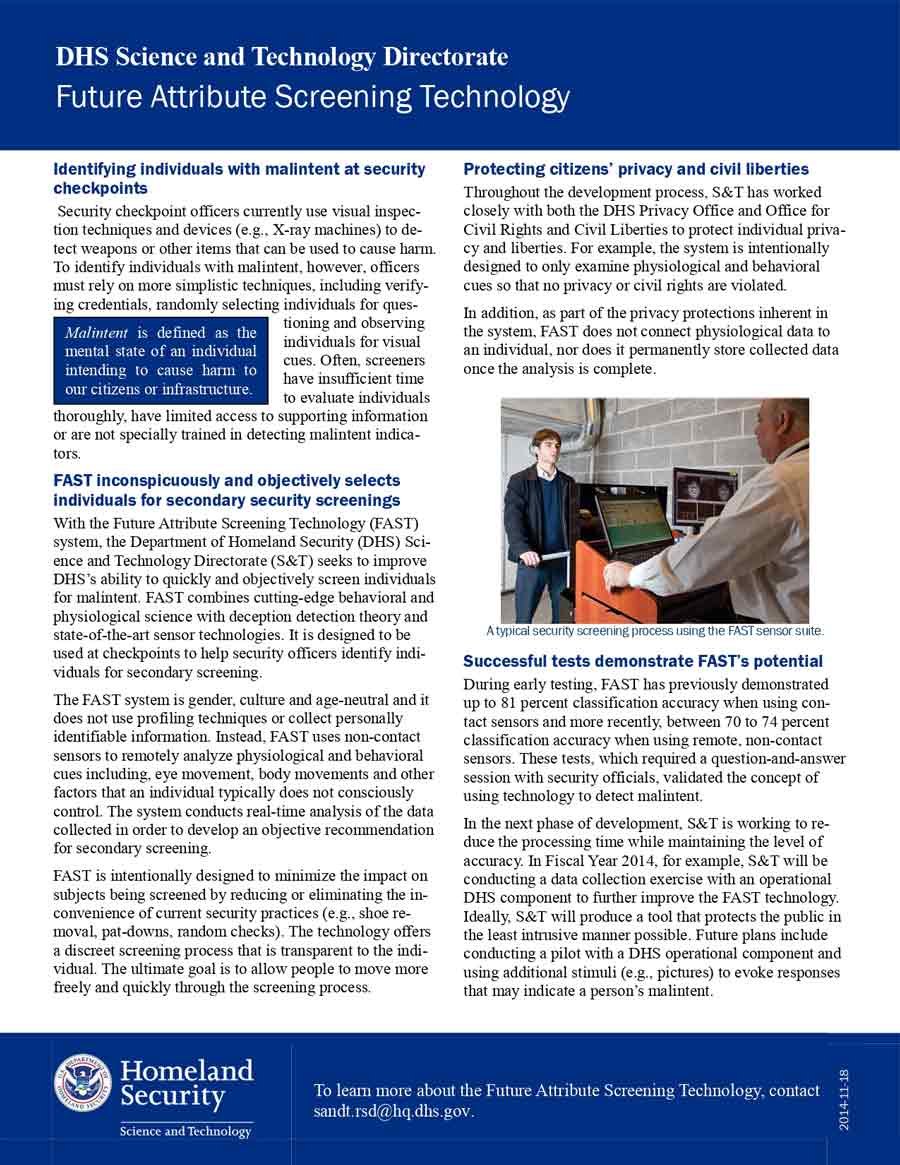
F.A.S.T. Flyer
References
References
DHS “pre-crime” detectors draw criticism. <https://www.homelandsecuritynewswire.com/dhs-pre-crime-detectors-draw-criticism> Accessed January 02, 2022.
Equipment attempts to predict terrorist intentions. <https://veja.abril.com.br/ciencia/equipamento-tenta-prever-intencoes-terroristas/> Accessed January 02, 2022.
Egbert, S., & Paul, B. (2018). Preemptive screening for malintent: The future attribute screening technology (FAST) as a double future device. Futures. doi:10.1016/j.futures.2018.04.003
How China harnesses data fusion to make sense of surveillance data. <https://www.brookings.edu/techstream/how-china-harnesses-data-fusion-to-make-sense-of-surveillance-data/> Accessed January 02, 2022.
Meeting Notes, held July 24, 2008, on implementing privacy protection measures in government data acquisition activities.
Weinberger, S. Terrorist ‘pre-crime’ detector field tested in United States. Nature (2011). https://doi.org/10.1038/news.2011.323