

This text is part of a science communication series based on academic research published by Sergio Senna Pires regarding youth protagonism and the effects of student invisibility in schools.
Here, we translate the study’s primary findings into accessible language while maintaining scientific rigor. At the end, we provide the full article for those seeking deeper technical insight.
1. Youth Protagonism as an Institutional Value
When participation stops being a concession and begins to organize decisions
Youth invisibility does not emerge from silence
It is produced by ordinary decisions
Youth invisibility rarely stems from a lack of speech. Children speak, question, react, and disagree. What changes is the institutional cost assigned to these actions. In school environments oriented by control, predictability, and rigid hierarchy, participation does not vanish through explicit prohibition, but through adaptive learning: speaking disrupts, questioning embarrasses, and insisting exacts a symbolic price.
This process is not episodic. It repeats in micro-interactions, sustained by informal norms, unwritten expectations, and decisional asymmetries that dictate who can speak, when they can fail, and who ends the debate. The result is not indiscipline, but conformity. Silence begins to operate as a functional strategy for institutional survival.
Cultural Psychology helps explain why this pattern is so effective. Children and adolescents construct meanings from interactions, especially those involving shame, ridicule, or symbolic unauthorized status. The transmitted message is not merely verbal. It is affective, relational, and normative. They quickly learn that their own participation “disrupts the environment.” Adaptation occurs before contestation.
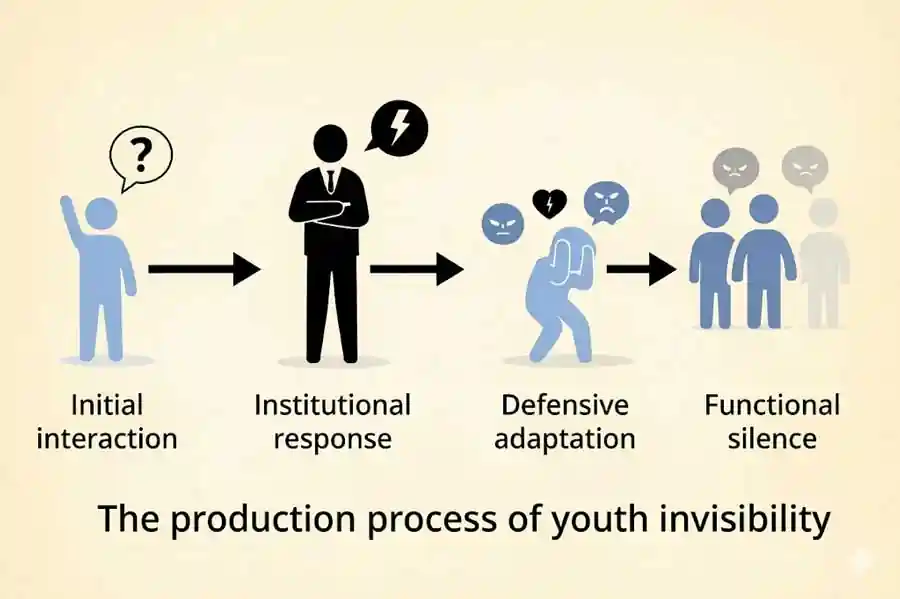
Section Summary
- Youth invisibility is produced, not accidental
- Silence may indicate defensive adaptation
- Informal norms regulate more than formal rules
- Agency is blocked without explicit punishment
2. Protagonism is not about being central in everything
It is about reorganizing decisions, responsabilities, and meanings
The recurring error in educational debate is treating youth protagonism as excessive spotlighting or the loss of adult authority. This reading is fragile. Protagonism does not mean the absolute centrality of the child, but rather the institutional value orienting practices. It emerges when decisions, tasks, and responsibilities are shared progressively, compatible with the involved capacities.
Under this perspective, youth protagonism is neither a localized method nor an extracurricular project. It operates as the organizing criterion for institutional culture. Where protagonism exists, children and adolescents participate in the construction of norms, understand the meaning of rules, and recognize themselves as legitimate agents in collective processes. Where it does not exist, decisions arrive ready-made, and participation appears as an occasional concession.
Environments oriented by protagonism tend to reduce symbolic asymmetries, not by eliminating adult authority, but by making it intelligible and justifiable. Conflict does not disappear. It becomes manageable, formative, and less prone to escalation. Agency develops because failing, insisting, and negotiating stop being moral risks.
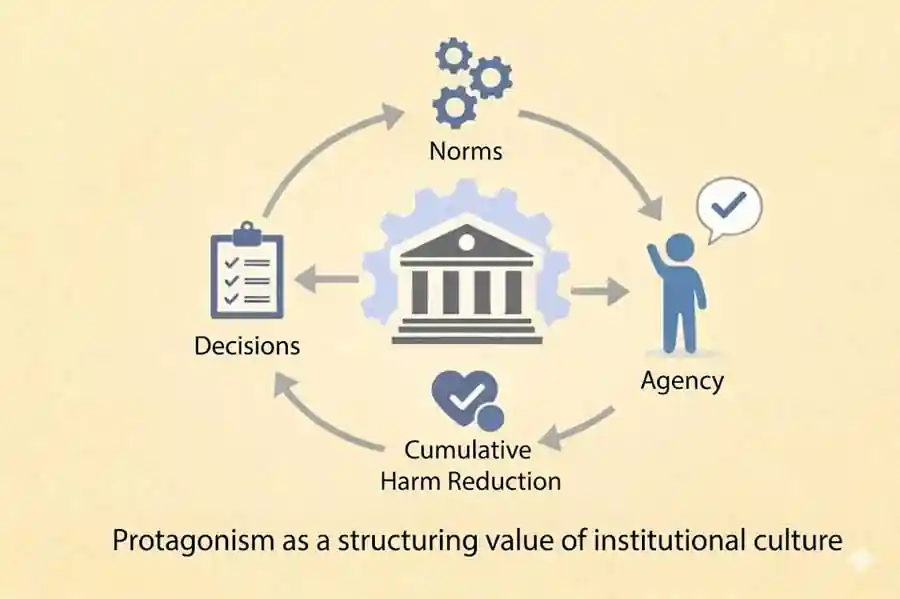
Section Summary
- Protagonism is a value, not a technique
- It does not eliminate authority; it reorganizes decisions
- Reduces symbolic asymmetries
- Favors agency, autonomy, and responsibility
3. Institutional culture decides more than discourse
The blind spot of the silent school
Educational institutions often evaluate their functioning based on superficial indicators: discipline, absence of visible conflict, and routine fluidity. This criterion is dangerous. Excessively silent environments may signal not engagement, but strategic adaptation to the cost of speaking.
Institutional culture consolidates less by what is declared and more by what is repeated. Seemingly neutral decisions, ironic responses, unauthorized interruptions, and implicit rules produce cumulative effects on motivation, participation, and self-reflection. The harm is not immediate. It accumulates: withdrawal, apathy, symbolic resignation.
Reorganizing this culture does not require dramatic disruption. It requires a diagnostic reading. Simple questions often reveal more than formal reports:
Who decides
Who can speak
Who can fail
Who can insist
Who ends the debate
When these answers always concentrate on adults, protagonism is absent. There is functional conformity. The institutional challenge is not making the child speak more, but ensuring that participation stops being expensive.
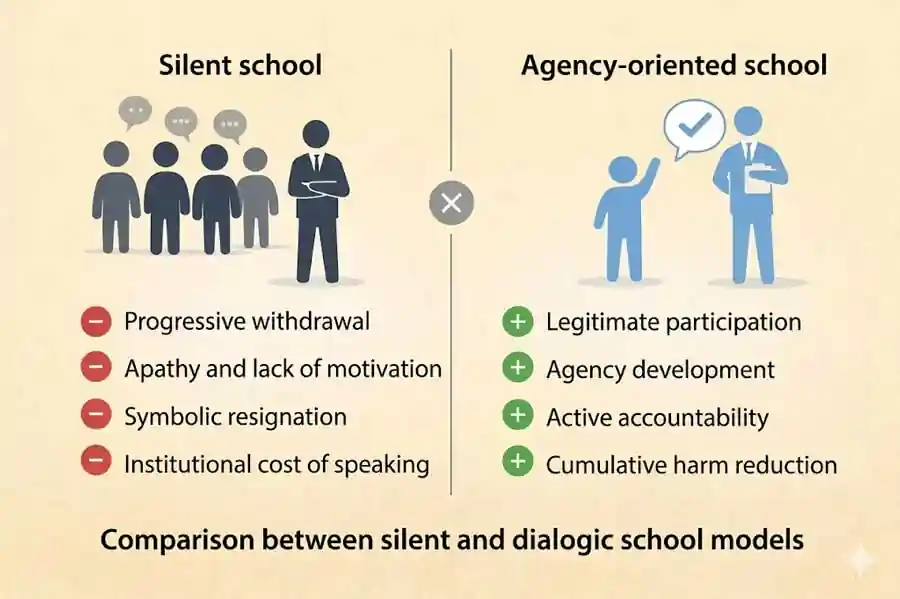
Section Summary
- Silence does not equal good functioning
- Institutional culture orients trajectories
- Harm is cumulative and invisible
- Protagonism reduces low-intensity violence
📚 PART 2 — For those seeking deeper insight:
Click the tabs
Real-case application, tips, and frequently asked questions. Enjoy!
Case Study
📖 Expanded Case Study — How youth invisibility is born in daily school life
During an ordinary class, the teacher explained new content on the board. The class was relatively attentive, though some students showed doubt.
A student raised his hand, hesitating.
Before he could even finish the question, the teacher reacted with an impatient tone:
“You again? I’ve explained this several times already. It seems you aren’t paying attention.”
A few classmates laughed.
The student was visibly embarrassed. He still tried to say he hadn’t understood a specific part, but was interrupted.
“If you paid attention, you wouldn’t be asking this now.”
The class continued.
No space was given for clarification. No listening occurred.
😔 The immediate impact
At that moment, the student:
• lowered his head
• stopped trying to speak
• avoided eye contact
• remained silent for the rest of the class
The mistake stopped being a learning opportunity and became a reason for public shame.
📉 Effects over time
In the following weeks, clear changes were observed:
• the student stopped asking questions
• he participated less in activities
• he showed insecurity
• he avoided self-exposure in class
• he showed a drop in performance
The behavior did not appear out of nowhere.
It was learned.
🧠 What Psychology explains
Public humiliation activates strong social emotions such as:
shame
fear of judgment
withdrawal
avoidance
The brain associates participation with emotional risk.
Silence becomes the strategy.
This process is one of the central mechanisms of youth invisibility in school.
⚠ The structural problem
The teacher’s intention may not have been to hurt.
But the effect was clear:
authority replaced dialogue.
The school taught that:
❌ questioning is dangerous
❌ failing triggers social punishment
❌ speaking is not worth it
🎯 The invisible lesson taught that day
More than the lesson content, the student learned:
👉 your voice does not matter.
This is how youth invisibility takes hold in an everyday and silent manner.
F.A.Q.
❓ Advanced FAQ — Youth invisibility in school
What technically characterizes youth invisibility in school?
It refers to the systematic exclusion of children and adolescents from decision-making processes, pedagogical dialogue, and conflict resolution. Although physically present, they are not recognized as active subjects in the educational process.
Is invisibility merely a lack of formal participation?
No. It also occurs in daily micro-interactions: constant interruptions, devaluing questions, lack of listening, punishment without dialogue, and imposing rules without collective construction.
What are the most commonly observed psychological effects?
Reduced sense of agency, increased insecurity, social withdrawal, passive resistance, or oppositional behaviors. Long-term, it compromises self-esteem and self-regulation.
How does this relate to school indiscipline?
Authoritarian environments tend to produce more conflict, as they fail to teach negotiation, empathy, or shared responsibility. Behavior becomes a reaction to control, not a commitment.
Does youth protagonism weaken teacher authority?
On the contrary. Authority becomes more legitimate when based on dialogue, respect, and the construction of meaning. This increases cooperation and engagement.
Is there a minimum age for meaningful participation?
No. Participation must be adapted to cognitive development, but it is possible starting from early childhood education through choices, agreements, and oriented dialogue.
How can I identify invisibility in my pedagogical practice?
Ask yourself: do students participate in decisions? Do they understand the rules? Can they express conflict? Are their questions valued? If most answers are negative, clear evidence exists.
Does invisibility impact academic performance?
Yes. Silencing reduces engagement, curiosity, and the security needed to learn — central elements of cognitive development.
How does Educational Psychology explain this phenomenon?
Development occurs in social interactions. Listening environments favor autonomy; environments of imposition favor submission or resistance.
Which practices reduce youth invisibility?
Dialogue circles, conflict mediation, collective rule-making, valuing mistakes as learning, and real participation in daily decisions.
Is there evidence of reduced school violence with participation?
Yes. Participatory environments show fewer recurring conflicts and higher student accountability.
Does this require curricular changes?
Not necessarily. It requires relational and pedagogical changes in the conduct of daily interactions.
Tips
💡 In-depth pedagogical tips to combat youth invisibility in school
👂 1. Institutionalize real moments of listening
It is not enough to simply “ask if anyone wants to speak.”
Formal spaces for participation must be created.
How to apply:
• weekly talking circles
• class assemblies
• collective evaluation moments
Why it works:
Listening develops a sense of belonging, autonomy, and social responsibility. Students begin to engage because they perceive that their voices produce real effects.
📜 2. Construct rules with active student participation
Instead of presenting ready-made norms, negotiate criteria.
How to apply:
• discuss real classroom problems
• propose group solutions
• formalize collective agreements
Why it works:
When they participate in construction, students understand the meaning of the rules and tend to respect them more.
⚖️ 3. Transform conflict into social learning
Avoid resolving conflict solely through punishment.
How to apply:
• hear all parties
• reconstruct the event
• discuss the impact of actions
• seek restorative agreements
Why it works:
Teaches empathy, emotional self-regulation, and responsibility.
🌱 4. Value questions as part of the learning process
Never ridicule doubts.
How to apply:
• acknowledge and thank for questions
• rephrase with the class
• use mistakes as pedagogical examples
Why it works:
Creates emotional security to learn and participate.
🏫 5. Observe your non-verbal communication
Posture, tone of voice, and expressions teach as much as words.
How to apply:
• avoid sarcasm
• maintain respectful eye contact
• maintain open posture
Why it works:
Non-verbal communication transmits either welcome or threat.
🧠 6. Give students real responsibilities
Not just symbolic tasks.
How to apply:
• organizing spaces
• mediating simple conflicts
• leading activities
Why it works:
Develops a sense of agency and social maturity.
❤️ 7. Differentiate authority from authoritarianism
Authority educates; authoritarianism silences.
How to apply:
• explain decisions
• listen to disagreements
• maintain clear boundaries
Why it works:
Generates genuine respect, not obedience through fear.
📊 8. Constantly evaluate the classroom climate
How to apply:
• quick surveys
• open conversations
• observation of participation
Why it works:
Allows for adjustments before conflicts consolidate.
🎯 Pedagogical Synthesis
Where there is participation → there is engagement.
Where there is dialogue → there is responsibility.
Where there is listening → there is pro-social development.