

Normative Decision-Making in High-Risk Environments
Legislative Architecture Laboratory – [S] Lab
Normative Strategy in Contexts of Violence, Risk, and Complexity
Legislatures often operate under a dangerous illusion: that a technically “correct” legal text is a solution in itself. In high-stakes environments—defined by violence, systemic risk, and extreme decision-making pressure—experience proves the opposite. Legally consistent norms frequently trigger adverse effects, fuel conflict, or merely displace the crisis across time and territory.
The failure rarely lies in the legal content alone. It begins earlier—in how decisions are structured, the incentives driving institutional choices, unstated premises, and the systemic feedback loops triggered when a norm hits reality. This is where the Legislative Architecture Laboratory intervenes.
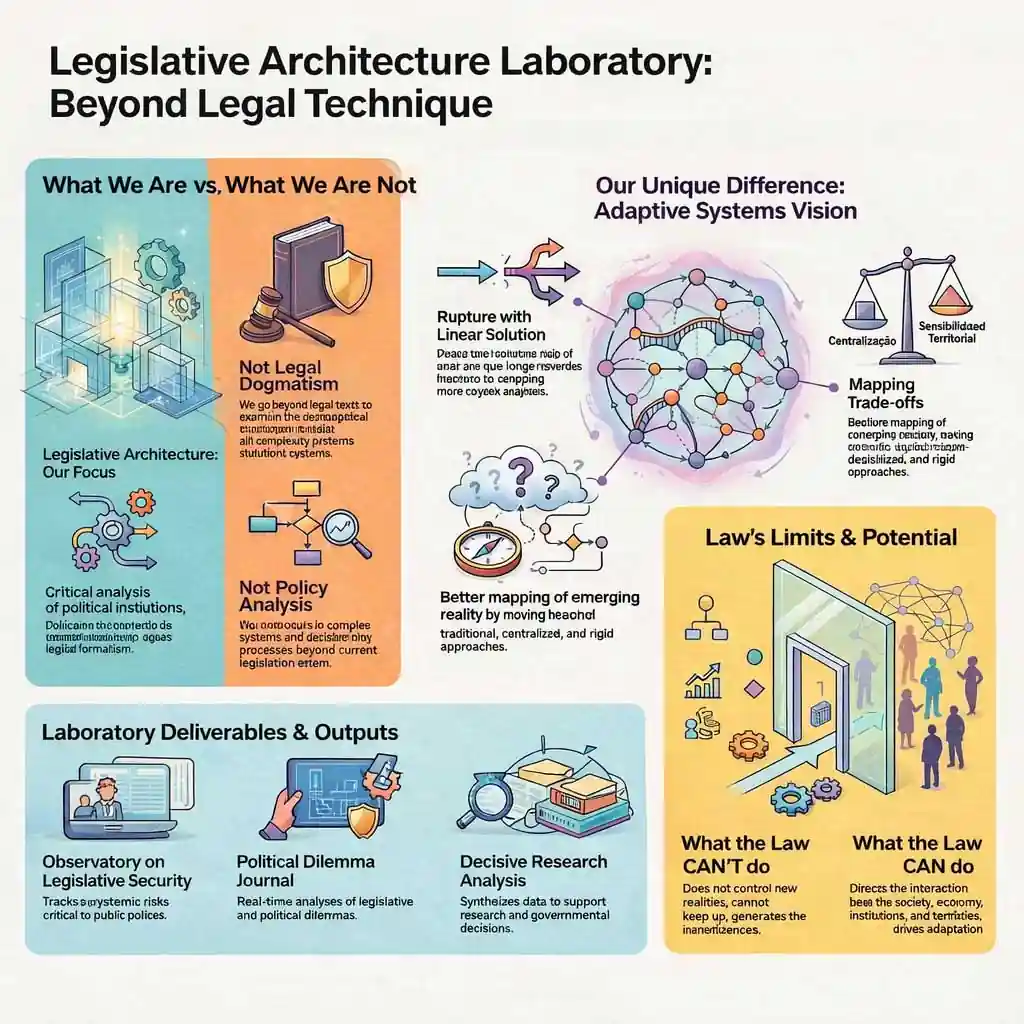
Legislative Architecture is distinct from legal doctrine, incremental policy analysis, or normative opinion. Our focus is not on interpreting law or defending political positions, but on understanding how normative decisions circulate, drive real-world behavior, and reorganize complex institutional systems.
What Legislative Architecture is Not
- It does not interpret norms or debate legal meanings.
- It does not propose abstract or idealized legal solutions.
- It does not evaluate policies based solely on end-point indicators.
- It does not operate as institutional activism or ideological commentary.
What Legislative Architecture Does
- Analyzes decision structures before the norm is even drafted.
- Identifies incentives, asymmetries, and institutional blind spots.
- Anticipates systemic effects and unintended strategic risks.
- Guides rule design in contexts of extreme uncertainty and adaptation.
In unstable environments, legislating is not just writing rules—it is intervening in Complex Adaptive Systems where actors learn, react, and exploit incentives. When this dynamic is ignored, more “command” leads to less control. Solutions based on Simple Causality applied to complex problems generate risks that formal legality cannot capture.
What Law Can Control
- Creating relevant incentives and constraints.
- Structuring decision flows and resource allocation.
- Reducing information asymmetries.
- Establishing baseline coordination conditions.
What Law Cannot Control
- The actual behavior of adaptive agents in the field.
- Strategic adaptation by organized criminal networks.
- Emergent effects and systemic ripples.
- Informal dynamics that bypass the normative system.
Every legislative decision involves trade-offs. Ignoring these tensions does not eliminate them; it merely pushes them outside the visible field of decision-making. SLAB specializes in the structural analysis of normative strategy, focusing on public security, justice, and governance. Our objective is direct: optimize law design to reduce institutional risk and master complexity.
Navigation
Vision & Mission
The Legislative Architecture Laboratory is dedicated to optimizing normative decision processes and providing high-level legislative assessments for environments defined by violence and institutional pressure.
Our premise: in unstable systems, the problem is rarely the text of the law itself. It is found in the incentives, the non-linear reactions, and the unanticipated systemic effects produced when norms meet reality.
We operate at the structural level—analyzing how decisions are made, how laws are evaluated, and how systems learn from previous legislative cycles.
Public Security Legislation
Longitudinal Analysis of Public Security Law
Security legislation is built cumulatively under political pressure and successive crises. Laws and normative adjustments overlap, creating a complex field that only becomes intelligible through systematic, longitudinal analysis. The SLAB Security Observatory tracks and decodes these dynamics to provide a qualified informational base for resilient institutional decisions.
In high-pressure scenarios, diagnostic errors and linear simplifications tend to generate adverse effects. We work to mitigate these errors by qualifying the decision-making process before, during, and after normative production. Our work is guided by three principles: legislation is systemic, normative decisions drive real behavior, and improving law requires process assessment, not just outcome tracking.
SLAB provides deep structural analysis focused on:
- Legislative process architecture
- Normative coherence and systemic consistency
- Impact assessment of unintended consequences
- Reduction of institutional and operational risk
- Optimization of public strategic decisions
We are not activists or legal commentators. Our role is to qualify decision-making at the intersection of science, political decision, and strategic policy. Our goal is clear: ensure normative decisions are consistent, predictable, and resilient against emerging threats.




This post is also available in pt_BR.