

How to decide in systems that do not obey?
Social complexity often repels because it seems abstract, technical, and detached from practice. In this pillar, the proposal is the opposite: to make understandable what is usually treated as hermetic, without reducing real phenomena to simplistic formulas that fail when applied.
Here, complexity is no decorative academic concept. It is the concrete environment where collective decisions, public policies, institutions, and organizations operate daily.
How to decide when the system responds?
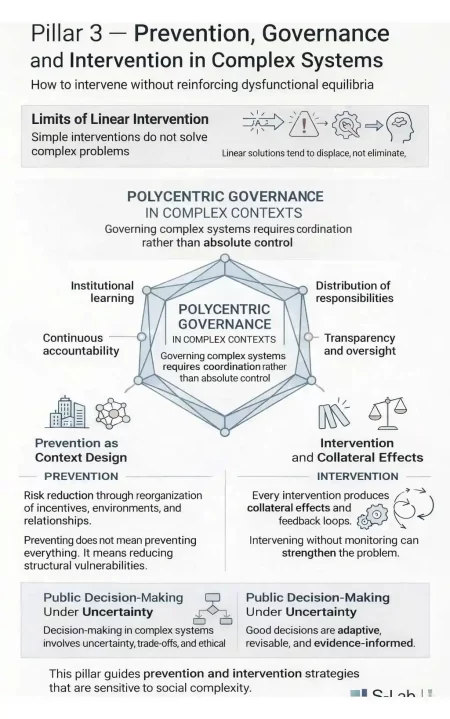
Social complexity is no abstract concept reserved for theory. It describes the concrete environment in which legislative decisions, public policies, and institutional arrangements operate. Each approved norm, each issued guideline, and each implemented policy interacts with incentive networks, social expectations, informal structures, and organized interests.
Ignoring this complexity does not make the decision simpler. It merely reduces the capacity to anticipate reactions and amplifies the probability of unintended effects.
In real social systems:
- causes do not produce proportional effects
- interventions generate indirect and cumulative effects
- replicated solutions fail when displaced from context
- the system reacts, learns, and reorganizes
Decision does not occur upon a neutral surface. It impinges upon a system that already operates according to its own patterns.
This Pillar does not present complexity as conceptual ornamentation. It assumes it as a structural condition of legislative architecture. The norm does not act upon a vacuum. It alters incentives, redistributes risks, produces winners and losers, and triggers strategic adaptations.
Complexity as a permanent condition of collective decision
In simple systems, planning suffices.
In complex systems, legislating requires recognizing limits.
The idea that adequate planning generates predictable results stems from a linear assumption: same cause, same effect. This assumption rarely holds in dense institutional environments.
Small interventions can generate amplified effects when they touch sensitive points of the institutional network. Massive reforms can be absorbed without structural alteration when they encounter diffuse resistance or contradictory incentives.
The system incorporates the norm, interprets its signals, and responds. This response may occur through:
- strategic adaptation of organized actors
- displacement of practices to less regulated zones
- apparent formalization with informal maintenance of patterns
- creation of new unforeseen asymmetries
The legislative decision, therefore, does not end the process. It inaugurates a new phase of interaction.
What it means to decide under complexity
Deciding under complexity does not mean abdicating criteria. It means broadening the field of observation before intervention.
It requires:
- reading the institutional context, including formal and informal incentives
- recognizing interdependence between sectors and levels of government
- systematic attention to side effects and problem displacement
- willingness to revise instruments in the face of accumulated evidence
This stance does not eliminate uncertainty. It reduces the probability of structural error.
In legislative architecture, this implies recognizing that the quality of a norm is not measured solely by its internal coherence, but by its capacity to operate in an adaptive environment.
Complexity and institutional responsibility
Recognizing complexity carries a political cost. Simple solutions communicate better. Linear narratives mobilize support. One-dimensional attributions of guilt reduce ambiguity.
However, decisions oriented by excessive simplification tend to reinforce exactly the patterns they intended to alter. In adaptive systems, institutional predictability can be exploited by strategic actors.
This Pillar organizes a way of thinking that:
- exposes limits before intervention
- recognizes institutional trade-offs
- distinguishes technical error from adaptive response
- protects against the automatic escalation of ineffective measures
Social complexity does not paralyze decision. It redefines its responsibility.
Deciding when the system responds requires abandoning the expectation of total control and replacing it with consistent criteria for analysis, coordination, and course correction.
This is the structure this Pillar offers.
The search for the “root cause” exerts a strong attraction in public debate and legislative formulation. Identifying a single causal factor transmits a sense of control and quickly directs the choice of a normative instrument.
The problem is that many social phenomena do not operate through isolated causes, but through operating regimes.
Operating regimes describe how the system is functioning at that historical and institutional moment. They indicate:
- which incentives are active
- which behaviors are rewarded or tolerated
- which patterns tend to reproduce
- which informal arrangements sustain the observed stability
The same phenomenon can operate under distinct regimes. Violence may exist in a regime of open dispute, informal accommodation, fragmentation, or illicit stabilization. The legislative response that works in one regime may fail completely in another.
When decision ignores this reading, it incurs the automatic transposition of instruments between incompatible contexts. The technique may be adequate, but applied to the wrong regime.
The central question ceases to be “which instrument to apply?” and becomes:
- which pattern does the system tend to reproduce
- where will the intervention be absorbed without altering the core dynamic
- where might problem displacement occur
- where does the possibility for real institutional learning exist
Thinking in regimes does not eliminate risk. But it reduces structural error — especially that which stems from the repeated application of solutions that have already demonstrated limits.
Unintended outcome is not synonymous with technical error
In complex environments, a negative result does not always stem from planning failure or technical incompetence. It may indicate that the system responded adaptively to the intervention.
Social systems learn. Organized actors adjust strategies. Incentives are reinterpreted. Normative gaps are exploited.
Typical examples include:
- punctual reductions that trigger strategic reorganization
- normative hardening that displaces practices to less regulated zones
- excessive centralization that reduces local sensitivity and weakens real coordination
- increased formal control with the growth of parallel informality
Without distinguishing these dynamics, the unintended outcome is automatically interpreted as technical failure. The reaction is usually to intensify the same instrument, amplifying the risk of reinforcing the regime it intended to alter.
This Pillar organizes criteria to distinguish between:
- implementation error
- predictable side effect
- strategic adaptation of the system
Confusing these dimensions leads to an automatic escalation of intervention — more norms, more centralization, more rigidity — without altering the structure that sustains the problem.
Technique, illusion of control, and normative risk
Technique is indispensable to legislative science. It organizes information, structures alternatives, and delimits probable consequences. The problem lies not in the technique, but in the expectation that it replaces institutional judgment.
In complex systems, technique does not guarantee total control. It broadens partial understanding.
Normative risk arises when:
- limited causality is treated as full certainty
- models applied in one context are replicated without adjustment
- probabilistic forecasts are communicated as guarantees
- administrative control is confused with structural transformation
Legislative architecture must operate with explicit limits. These include:
- forecasting limits
- causality limits
- replication limits between contexts
- institutional control limits
Recognizing these limits does not weaken the decision. On the contrary, it increases consistency, protects against excessive promises, and creates space for evidence-oriented review.
Deciding under complexity is not abdicating responsibility. It is exercising responsibility with awareness of the system’s real operating conditions.
This maturity is what this Pillar seeks to consolidate.
Polycentricity, Adaptive Governance, and Legislative Architecture
Complex societies operate with multiple decision-making centers. Legislative, Executive, Judiciary, technical bureaucracies, federative entities, and social actors simultaneously influence normative dynamics. Polycentricity is not disorganization. It is a structural characteristic of complex social systems.
In polycentric environments:
- decisions are made at distinct levels
- incentives vary territorially
- institutional capacities are unequal
- normative interpretations multiply
- learning cycles occur in a distributed manner
Ignoring this structure leads to simplified diagnoses and the illusion that central command solves complexity. Excessive centralization tends to reduce territorial sensitivity, widen the gap between decision and execution, and weaken the capacity for institutional adaptation.
Normative uniformity does not equate to systemic effectiveness.
Adaptive governance as a mature institutional response
Adaptive governance does not mean fragmentation or absence of coordination. It means organizing polycentricity through shared decision criteria, preserving local contextual reading and the capacity for adjustment.
Coordination, in this environment, involves:
- common criteria on objectives and limits
- explicit recognition of institutional trade-offs
- mechanisms for distributed learning
- periodic review of instruments
- transparency regarding assumed risks
Institutional maturity lies not in eliminating decision conflicts. It lies in organizing them within clear parameters, oriented by review and course correction.
Insertion into the S Lab Architecture
With the reorganization of the project, this discussion integrates into Pillar 3 — Legislative Architecture and Complexity.
The S Lab Pillars are not isolated thematic compartments. They are interdependent layers of a legislative science applied to social complexity.
The integrated architecture works as follows:
Pillar 1 — Behavior, decision, and context
Organizes perception and inferential limits, reducing error in the reading of reality.
Pillar 2 — Violence, criminality, and complex systems
Analyzes the stabilization of illicit patterns and strategic adaptation as systemic phenomena.
Pillar 3 — Legislative Architecture and Complexity
Orients normative intervention in adaptive polycentric environments.
Without integration, each Pillar offers a partial explanation.
With integration, a coherent architecture forms: qualified perception, informed decision, regime reading, and responsible intervention operate as structural dimensions of the same approach.
Legislative decision ceases to be understood as simple normative production and is recognized as an intervention in an adaptive polycentric system.
What this Pillar delivers
This Pillar does not promise total control, universal models, or exact forecasts. Such promises belong to the illusion of linearity.
It offers:
- an operational language for dealing with social complexity
- criteria for recognizing operating regimes
- clarity on institutional limits and trade-offs
- instruments for distinguishing technical error from systemic adaptation
- protection against structurally misguided decisions
The goal is not to eliminate uncertainty.
It is to reduce systemic damage and broaden institutional learning capacity in complex environments.
This is where this Pillar sits within the project’s architecture.
Why speak of complexity when everything already seems too difficult?
Because ignoring social complexity does not simplify decisions.
It only makes errors more predictable, more expensive, and harder to correct.
In real social systems:
- causes do not produce proportional effects
- good intentions generate side effects
- solutions copied from other contexts fail
- the system reacts, learns, and adapts
This pillar exists to handle this reality without self-deception.
What this pillar does not promise
This is not a pillar about:
- total control
- universal models
- exact forecasts
- quick fixes
These promises are part of the problem we analyze.
What this pillar delivers
✔ A clear way to think about social complexity
✔ Criteria for recognizing operating regimes
✔ Real limits of institutional intervention
✔ Protection against comfortable and structurally misguided decisions
It does not eliminate uncertainty. It reduces systemic damage.
Social complexity is not a problem to be solved
It is a permanent condition of collective decision-making.
In simple systems, planning suffices.
In complex social systems, deciding requires:
- context reading
- attention to indirect effects
- coordination without the illusion of control
- willingness to correct courses
This pillar stems from this premise.
🧩 Where the other pillars fit in
This pillar integrates the entire project:
- Pillar 1 — how we perceive, feel, and interpret the world and how decisions become uninformed in collective contexts;
- Pillar 2 — how patterns of violence stabilize and adapt
- Pillar 3 — how to intervene without reinforcing these patterns
Without this integration, each pillar becomes a partial explanation.
Decision under complexity is not a technical error
Unintended outcomes do not always indicate a planning failure.
In many cases, they indicate an adaptive response of the system.
This pillar helps to distinguish between:
- implementation error
- predictable side effect
- strategic adaptation of the system
Confusing these dimensions leads to an escalation of interventions that worsen the problem.
Who was this pillar designed for?
This content is especially useful for those who:
- decide in institutional environments
- formulate or evaluate public policies
- act in security, justice, or governance
- deal with unforeseen effects
If you seek ready-made recipes, this pillar will frustrate you.
If you seek responsible decision-making in complex contexts, it was made for you.
How to use this pillar
You can:
- read the tabs for conceptual deepening
- use the criteria as an analytical lens
- articulate this pillar with previous ones
- avoid already known decision errors
It is not a checklist.
It is guidance for thinking better before intervening.
Closing
Social complexity does not paralyze. It orients.
It does not promise easy solutions. It avoids dangerous illusions.
This is the final commitment of this pillar.
For those who wish to delve deeper….
Click on the tabs
Social Complexity: From the Illusion of Control to Real Effectiveness
Deciding in public systems requires accepting that social complexity is not a problem to be solved, but the real and dynamic environment where every intervention occurs.
This pillar offers the bases for replacing the illusion of control with adaptive governance, capable of transforming uncertainty into institutional learning and resilient results.
Why read this content?
- To avoid problem displacement: understand why linear and simplistic solutions tend to only move violence around instead of eliminating it.
- For the security of the public decision: learn to distinguish between implementation failures and adaptive responses of the social system itself.
- To build real governance: discover how coordination between multiple decision centers (polycentricity) overcomes ineffective centralization in crisis contexts.
- To manage ethical and technical risks: understand the trade-offs of intervening in systems where small actions can generate unforeseen and non-linear side effects.
1 - Fundamentals and Challenges
Social complexity, governance, and responsible decision-making
Social complexity usually repels readers not because it is inaccessible, but because it confronts comfortable expectations. It dismantles the idea of total control, challenges simple solutions, and requires accepting limits. In public policy, security, and institutional governance, this often generates resistance. Yet, ignoring social complexity does not simplify the world. It only makes errors more predictable.
This pillar exists to make knowledge traditionally treated as hermetic understandable and usable, without reducing it to slogans or technical recipes that fail at the first contact with reality. Here, social complexity appears not as a theoretical fad, but as a structural condition of collective decision-making and public intervention.
If previous pillars explain how we perceive, decide, and produce patterns of violence, this pillar answers the most difficult question: how to intervene in complex social systems without aggravating the very risks one intends to reduce.
2 - The Nature of Complexity
Why social complexity repels and why it is a public problem?
Social complexity repels because it offers no narrative shortcuts. It does not point to single culprits, does not guarantee results proportional to the effort invested, and does not allow for stable forecasts. In political contexts, this is uncomfortable. In institutional contexts, it is even more problematic, as it dismantles the expectation that good technique replaces difficult decisions.
The problem is not recognizing social complexity. The problem is reacting to it with artificial promises of simplicity. This is where technocratic discourses, standardized solutions, and the repetition of failed strategies arise, continuing to be applied because they produce short-term symbolic comfort.
This pillar stems from an explicit commitment: not to turn complexity into an excuse, but also not to sell it as something controllable by decree.
Social complexity is not something to be solved, but a condition for deciding
In simple systems, causes produce proportional effects. In complex social systems, this relationship breaks. Small decisions can produce amplified effects, while large interventions may generate marginal impacts or displace the problem to another point in the system.
Social complexity is not a defect of the contemporary world. It is the environment in which collective decisions occur. Deciding under social complexity requires accepting three uncomfortable premises:
- not every correct decision produces good immediate results
- not every negative result stems from a technical error
- not every effective policy in one context works in another
Ignoring these premises does not make the decision more efficient. It only makes it more predictable and, therefore, more exploitable by adaptive systems such as criminal networks and illicit arrangements.
From causes to operating regimes
A large part of policies fail because they insist on identifying “the cause of the problem,” when what truly orients the decision is understanding which operating regime is active in that context.
Operating regimes describe how the system works now, which behaviors it rewards, and which patterns it tends to reproduce. The same phenomenon can operate under distinct regimes: fragmented control, illicit stabilization, open dispute, or institutional accommodation. Applying the same instrument to these contexts generates radically different results.
Thinking in regimes shifts the decision logic. The question ceases to be “which instrument to use” and becomes:
- which pattern tends to reproduce
- where will the intervention be absorbed
- where might problem displacement occur
- where is there a real possibility for institutional learning
This shift does not guarantee success. But it reduces structurally misguided decisions, especially the automatic transposition of solutions between incompatible contexts.
3 - Risks and Illusions of Technique
Decision under complexity is not a technical error
In environments of social complexity, unintended results are usually treated as technical failures. This reading is comfortable, as it preserves the belief that one simply needs to adjust the correct instrument. The problem is that, often, the result does not stem from an error, but from an adaptive response of the system.
Social complex systems learn from intervention. When a policy produces side effects, it does not necessarily mean poor formulation. It means the system reacted, reorganized, and exploited institutional predictabilities.
Deciding well under social complexity requires distinguishing between:
- implementation error
- predictable side effect
- strategic adaptation of the system
Confusing these dimensions leads to the automatic escalation of interventions, in which each apparent failure justifies more of the same, reinforcing exactly the regime one intended to alter.
Illusion of control and technocratic comfort
Many public decisions fail not through ignorance, but through the illusion of control. Technique offers symbolic comfort in contexts of uncertainty. It organizes routines, standardizes procedures, and creates the sensation of mastery over the problem.
The risk arises when this logic is applied to governance in complex systems. In these contexts, technique stops supporting the decision and begins to replace it. The result is predictable: comfortable decisions in the short term and ineffective ones in the medium and long term.
This pillar does not propose abandoning technique. It proposes repositioning it correctly. Technique helps when causality is partially legible. It fails when sold as a total solution for systems that do not obey linear logic.
4 - Adaptive Governance
Social complex systems, local stabilization, and non-linear effects
Public interventions frequently produce localized stabilizations. Punctual reductions in violence, temporary control of illicit markets, or institutional reorganizations are common examples. The error lies not in these interventions, but in treating them as structural transformation.
In social complex systems, local stabilization does not equate to lasting change. Furthermore, effects are rarely proportional. Doubling resources does not double results. Hardening norms does not guarantee deterrence. The system learns, reacts, and adapts.
Recognizing this is not pessimism. It is a minimum condition for intervening in complex systems with responsibility.
Polycentricity, coordination, and adaptive governance
Polycentric governance is not an organizational defect. It is a structural condition of complex societies. Multiple decision-making centers broaden local sensitivity but also disperse responsibilities and hinder systemic learning.
The recurrent error is trying to solve polycentricity through excessive centralization. This reduces territorial sensitivity and increases the gap between decision and execution.
The alternative is adaptive governance. Coordination, in this context, does not mean unifying commands, but aligning decision criteria. More mature systems share minimum understandings about limits, acceptable risks, and realistic objectives, even when instruments vary.
Without this alignment, polycentricity generates symbolic competition and the repetition of errors. With it, it becomes a source of distributed learning and early course correction.
5 - Maturity and Deliverables
The political cost of institutional maturity
Governing under social complexity carries a political cost. It reduces slogans, makes attribution of authorship difficult, and requires tolerance for ambiguity. For this reason, it is usually avoided.
Institutional maturity reduces heroic promises and increases explanations. It exposes limits, recognizes uncertainties, and admits public course corrections. In polarized environments, this is interpreted as weakness. In practice, it indicates institutional learning capacity.
This cost appears as:
- lower visibility of immediate results
- greater exposure to criticism
- difficulty with simple communication
- the need to sustain unpopular decisions
Avoiding this cost, however, usually incurs a higher price in the medium term. Comfortable but structurally misguided decisions reinforce dysfunctional regimes and transfer the burden to future management.
What this pillar delivers and what it does not promise?
This pillar does not promise control, universal models, or guarantees of success. These promises are part of the problem we diagnosed.
What it delivers is different:
- a way of thinking about social complexity
- criteria for recognizing operating regimes
- clarity on limits and trade-offs
- protection against predictable decision errors
The goal is not to eliminate uncertainty, but to reduce systematic damages produced by poorly oriented decisions.
Social complexity as the common language of the pillars
Pillar 4 integrates the entire project. It offers the language that allows for the articulation of emotions, informed decisions, violence, and intervention without treating them as isolated themes.
- Pillar 1 shows how we perceive and feel
- Pillar 2 reveals how we decide under asymmetries
- Pillar 3 explains how patterns of violence stabilize
- Pillar 4 orients how to intervene without reinforcing these patterns
Social complexity does not paralyze. It orients. It does not promise easy solutions. It avoids dangerous illusions.
This is the final commitment of this pillar.