

The endless “cat and mouse” cycle
The scenario is almost choreographed: a large-scale police operation is launched, headlines celebrate record seizures, and local crime drops abruptly. Yet, after a short time, the indicators return to their previous level or reveal an even more sophisticated form of criminal activity. Adaptive criminal learning helps explain this paradox: why does organized crime survive reforms, new technologies, and massive investments?
The answer does not lie only in the lack of resources, institutional insufficiency, or the absence of tougher laws. The problem also lies in a failure of systemic perception. When public safety operates in a repetitive, reactive, and predictable manner, it can produce the opposite effect of what was intended: while fighting crime, the State ends up teaching its adversary how to survive better.
This is the predictability error. With each operation, the criminal system observes patterns, identifies routines, calculates response times, recognizes institutional vulnerabilities, and adjusts its behavior. The central question is no longer only “how can we hit harder?” but “how can we prevent each state blow from becoming free training for organized crime?”.
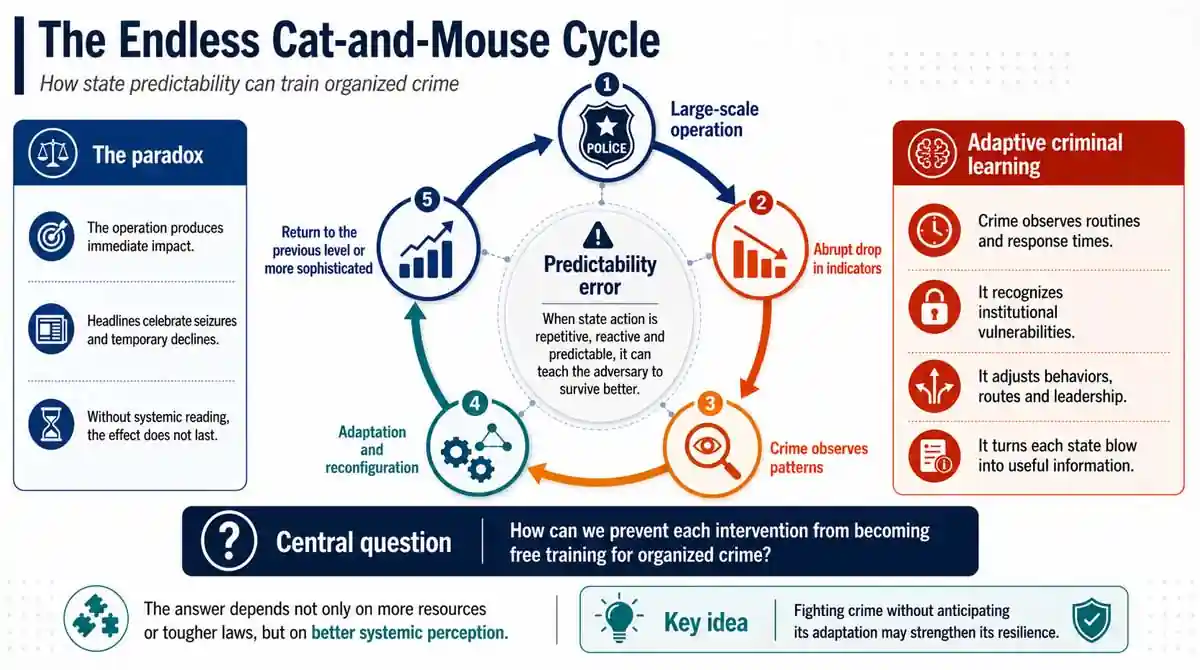
Crime is not an object, it is a living system (adaptive criminal learning)
The greatest flaw in many public safety policies is treating organized crime as a static structure that can simply be “broken.” This image is seductive, but insufficient. Criminal organizations do not operate merely as illegal organizational charts. They function as living, adaptive networks connected to markets, territories, social ties, institutional routines, and human decisions.
The State does not “break” crime in the same way it breaks an object. It perturbs a system. When an intervention occurs, the criminal network does not necessarily collapse. It reacts, interprets the disruption, redistributes functions, replaces leadership, changes routes, adjusts communication patterns, and reorganizes its connections.
This is why violence may persist even with more investment, more operations, and more technology. The increase in state force, when not accompanied by systemic reading, may generate only more expensive cycles of reaction and recomposition. In this process, adaptive criminal learning turns state pressure into useful information for new forms of survival, displacement, and reorganization. Public policy must cease to be a spasmodic response and become a continuous intervention on the conditions that allow crime to learn, adapt, and resist.
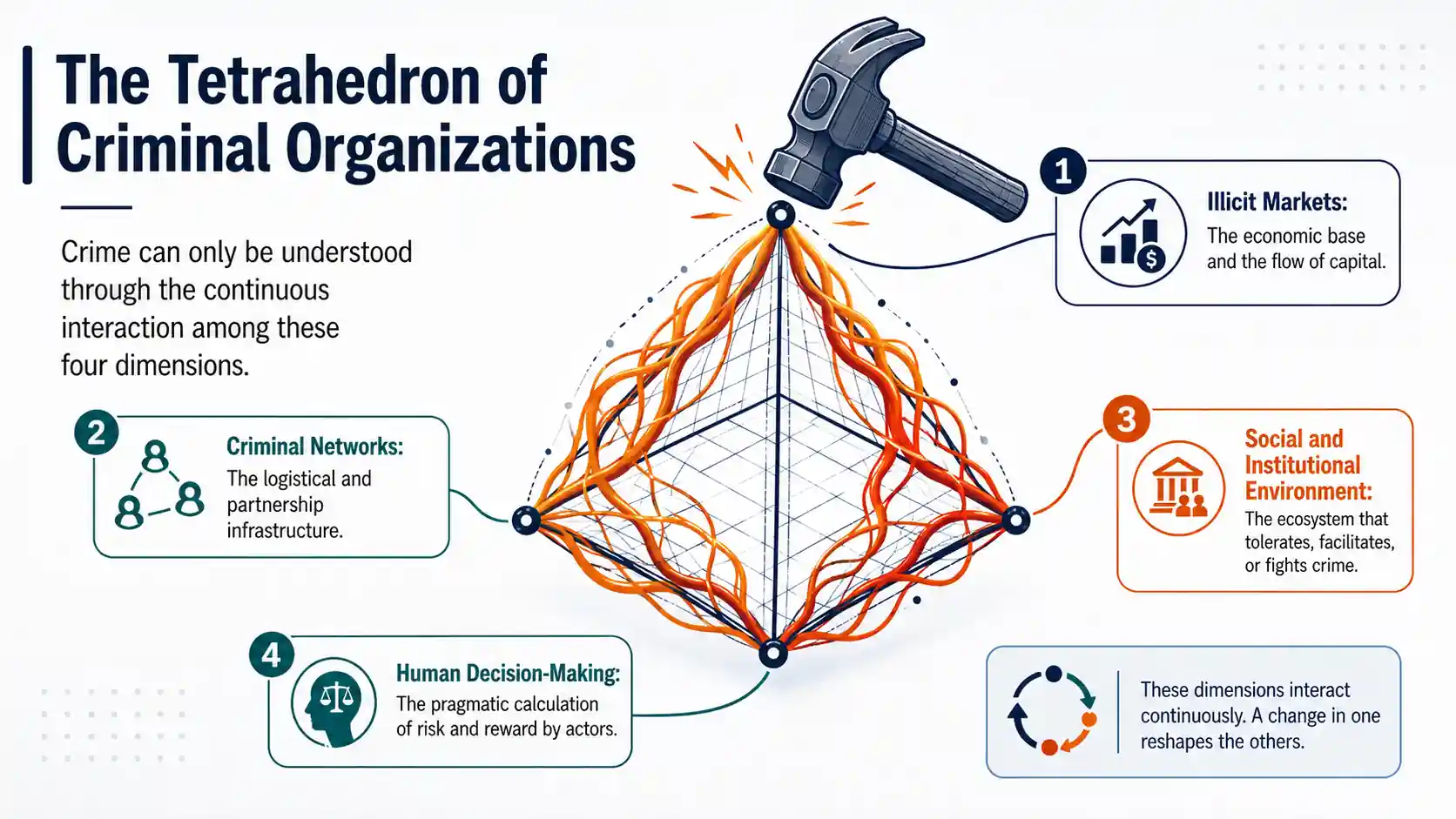
The Tetrahedron of Criminal Organizations
To understand adaptive criminal learning, we must see the multidimensional architecture of criminal organizations. The Tetrahedron of Criminal Organizations proposes four interdependent dimensions.
The first dimension involves illicit markets and resources. Money, drugs, weapons, stolen goods, illegal services, and financial flows create the incentives that sustain the system. Without these markets, the organization loses economic energy. However, attacking only resources may be insufficient if the other dimensions remain active.
The second dimension involves adaptive criminal networks. Much of the group’s strength resides there. The network can replace parts, recruit new participants, fragment functions, and preserve operations even after arrests or deaths of leaders. This systemic redundancy explains why removing important individuals does not always produce lasting disorganization.
The third dimension brings together facilitating social and institutional factors. Corruption, fragmented bureaucracy, disputes among agencies, low public trust, fear among the population, and the absence of qualified state presence create an environment favorable to criminal persistence. Crime thrives when it finds gaps, institutional rivalries, and territories in which public authority appears discontinuously.
The fourth dimension involves human motivations and decisions. People join, collaborate, remain silent, or stay linked to criminal networks for varied reasons: loyalty, habit, fear, belonging, coercion, economic calculation, lack of alternatives, or expectation of protection.
These four faces do not operate in isolation. When the State attacks only one of them, the others may compensate for the loss, because adaptive criminal learning allows the organization to reorganize its resources, ties, and decisions under state pressure. Focusing only on seizures, for example, may temporarily reduce resources, but it does not necessarily alter the networks, social incentives, institutional vulnerabilities, or motivations that sustain the organization.
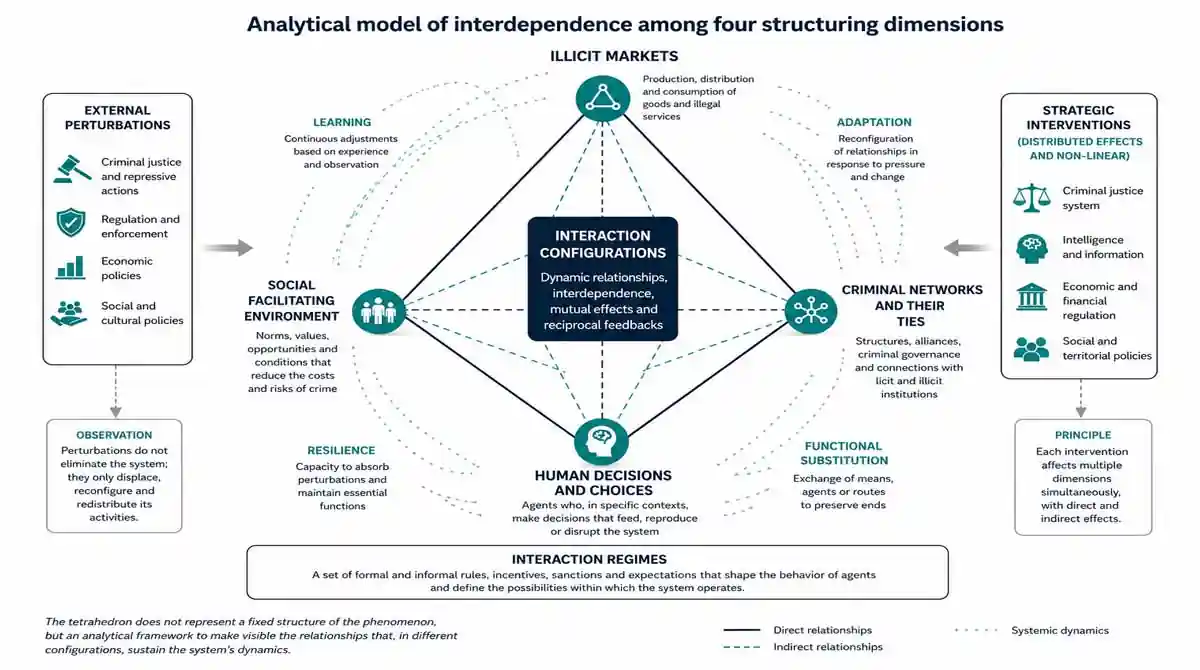
The danger of governmental predictability
One of the central concepts of this framework is exploitable predictability. In the chessboard of public safety, when the State always uses the same opening moves, it makes the adversary’s work easier. Standard operations, predictable patrols, bureaucratic indicators, and repetitive institutional responses offer criminal networks a survival map.
Repetitive efficiency can become a strategic vulnerability. The government believes it is improving its response, but the criminal network is also learning. It observes schedules, routes, procedures, priorities, success metrics, and the limits of coordination among public agencies.
It is like the cat-and-mouse dynamic, but with a decisive difference: the mouse is taking notes on the State’s tactics. With each repetition, the criminal organization learns where to hide, when to move, how to replace leaders, how to disperse stocks, and how to exploit state slowness or fragmentation.
The learning asymmetry appears precisely there. Crime learns in a distributed, pragmatic, and rapid manner. The State, in many cases, learns in a fragmented, slow, and bureaucratic manner. This difference helps explain why some operational victories produce little structural effect.
The Inca Paradox and the false victory
The so-called “Inca Paradox” helps illustrate why some victories may become strategic mistakes. In highly hierarchical systems, capturing or eliminating the top may disorganize the entire structure. However, contemporary organized crime rarely operates only as a hierarchical tree. Many networks behave more like rhizomes: decentralized, redundant, and capable of recomposition.
When the State eliminates a central element of a network, it may open space for the system to reorganize in a more intelligent, flexible, and aggressive way. A short-term victory, celebrated in the headlines, may remove a known and relatively predictable leader, but allow the rise of younger, more technological actors who are less legible to institutions.
This is the risk of poorly planned repression: it can operate as selective pressure. Instead of destroying the system, it selects the most adaptive participants, eliminates old patterns, and accelerates criminal innovation. The metaphor of fire helps explain the problem. Throwing more institutional fuel onto a poorly understood dynamic may expand the fire instead of extinguishing it.
Operational regimes: stabilization, adaptation, and disorganization
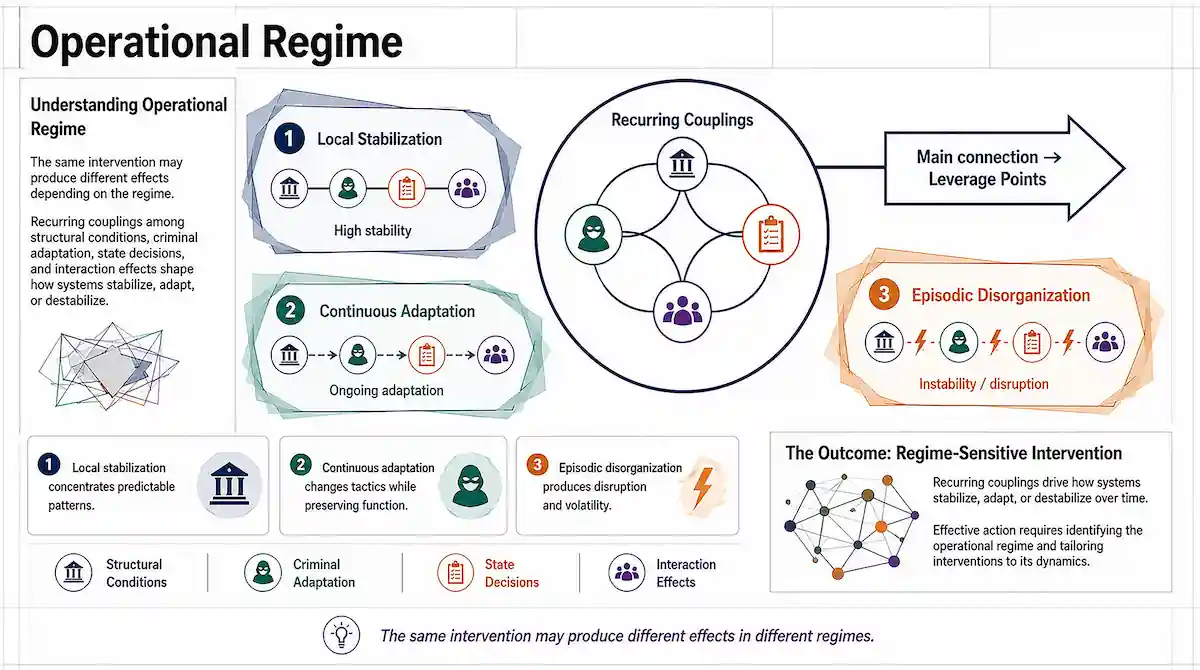
Public safety must distinguish different operational regimes of criminal organizations. Not every network is in the same state, and not every intervention produces the same effect.
In the regime of local stabilization, the criminal organization maintains relatively predictable routines, controls markets, regulates internal conflicts, and preserves some degree of illegal order. In this scenario, the State must avoid interventions that merely confirm its own patterns and allow the network to anticipate the response.
In the regime of continuous adaptation, the network has already learned to respond to operations, arrests, disputes, and changes in the environment. It tests routes, replaces functions, diversifies markets, and adjusts its exposure. Here, adaptive criminal learning becomes more visible: crime does not merely resist, but incorporates state action as useful information.
In the regime of episodic disorganization, state intervention, an internal rupture, or an external dispute temporarily reduces network coordination. This moment may open a strategic window. However, if the State does not act on the four dimensions of the tetrahedron, disorganization may be brief. The network may return more decentralized, less visible, and more difficult to confront.
These regimes help answer a practical question: why does the same strategy work in one context and fail in another? Because effectiveness depends on the state of the system. An action suited to one regime may be useless or counterproductive in another.
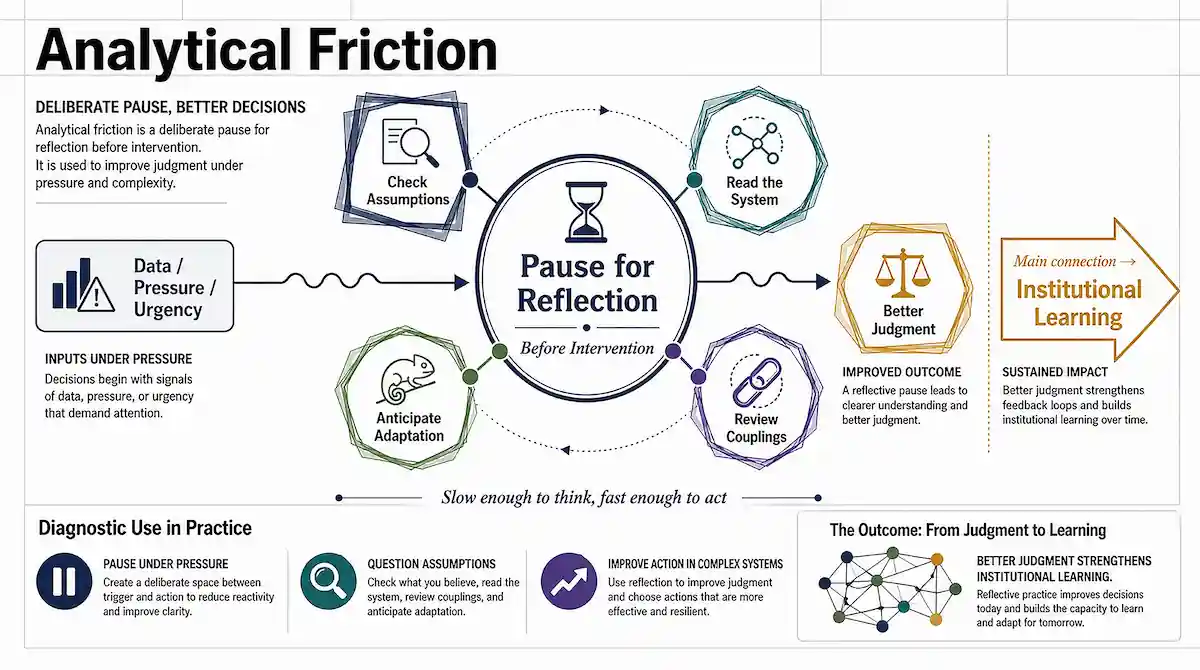
Analytical friction: slowing down to decide better
The solution is not inaction. What we propose is analytical friction: a deliberate pause before intervention, created to improve judgment under pressure. Instead of acting only to produce immediate impact, the decision-maker must ask: what adaptation can this operation provoke? What pattern are we revealing to the adversary? Which part of the tetrahedron will actually be affected? Which operational regime are we facing?
Analytical friction does not mean bureaucratic slowness. It means slowing down enough to think and acting quickly with more intelligence. In complex systems, haste without reading can increase the resilience of the target.
This shift requires replacing vanity metrics with adaptation sensors. Arrests, tons of seized drugs, and the number of confiscated weapons may indicate effort, but they do not, by themselves, demonstrate systemic weakening. More strategic indicators include the recovery time of the illicit market after an operation, the speed of leadership replacement, the recomposition of routes, the dispersion of stocks, changes in patterns of violence, and the network’s capacity to maintain coordination after state pressure.
The objective is not only to measure the strength of the blow. It is to measure the resilience of the system that was hit.
Polycentricity and institutional learning
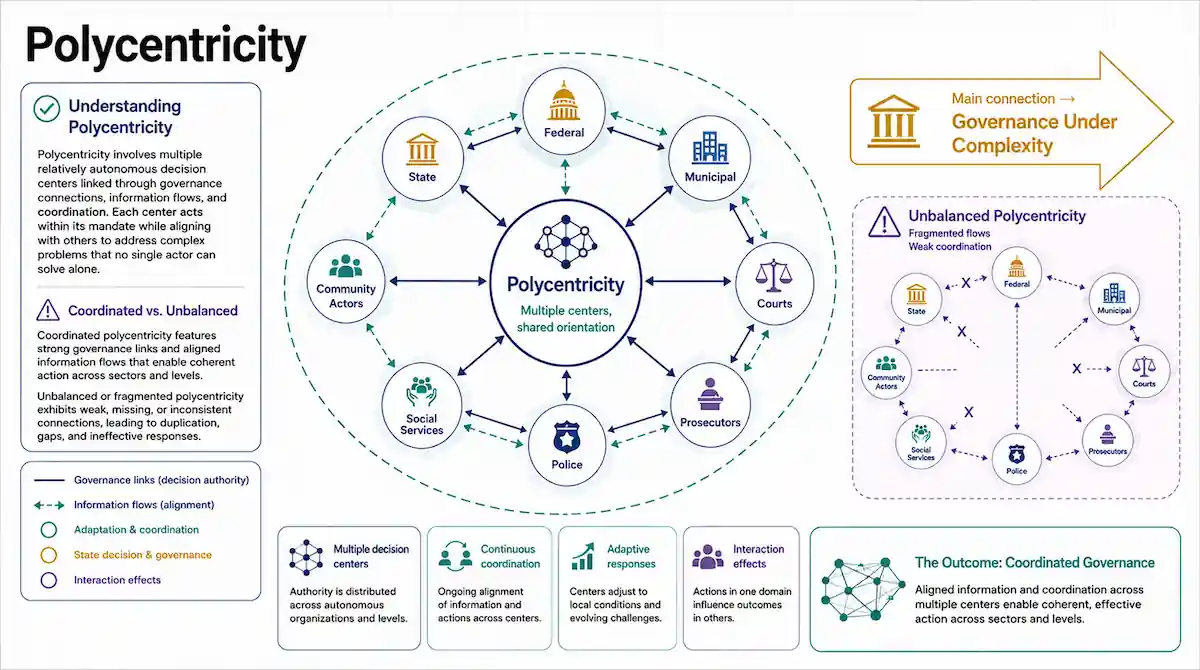
No institution faces an adaptive criminal organization alone. The response must be polycentric, that is, composed of multiple decision centers with differentiated functions, but connected by shared rules, information, and objectives.
Polycentricity, however, must not be confused with fragmentation. When agencies act without coordination, without interoperability, and without shared learning, crime exploits the gaps between them. The criminal network observes where information does not circulate, where there is a symbolic dispute over authority, where bureaucracy delays decisions, and where accountability is diffuse.
For this reason, confronting adaptive criminal learning requires institutional learning. The State must transform operations into accumulated knowledge, patterns into testable hypotheses, and errors into strategic revision. Without this, each agency learns little, learns late, or learns alone, while the criminal system learns from all of them at the same time.
Strategic humility and new questions about the adaptive criminal learning
Real progress in public safety requires strategic humility. Organized crime is a moving target. There is no magic weapon, saving technology, or definitive operation capable of solving the problem if the strategy remains static, predictable, and disconnected from the conditions that sustain the system.
The decisive question is not only how to arrest more, seize more, or act faster. The question is how to reduce crime’s capacity for recomposition, alter the incentives that sustain its persistence, make it harder for crime to read the State, and prevent each intervention from becoming adversarial learning.
To dismantle complex systems, we need intelligence that anticipates adaptation, not only force that provokes it. We need to resist easy solutions, headlines of quick victory, and metrics that merely flatter the institutional ego.
The final question is simple and uncomfortable: are we willing to sacrifice some apparent victories in exchange for a strategy capable of weakening the system in the long run, or will we continue serving as involuntary trainers of organized crime?
Enjoy the reading,
Sergio Senna