

In the previous article, we showed that organized crime should not be understood merely as a collection of groups, factions, or leaders. It operates as a system: it connects illicit markets, adaptive networks, enabling social environments, and human decisions. Now we need to move to an even more uncomfortable question: criminal adaptive advantage grows when this system learns from every state intervention.
Crime learns from state action
This does not mean that all criminal actors share a single intelligence, central command, or sophisticated long-term planning. Learning happens differently. It emerges from repeated experience, from observing the effects of repression, from selecting practices that work, and from abandoning those that increase risk. Every operation, every legal change, every policing cycle, and every institutional response pattern provides information to the criminal system.
This learning, however, does not occur only inside criminal organizations. It intensifies at the edges between systems. These are the contact zones where crime observes more effectively, tests alternatives, and finds opportunities for recomposition. Such edges appear between legality and illegality, controlled and disputed territories, prison and street, formal economy and illicit market, police action and community reaction, public policy and its concrete implementation.
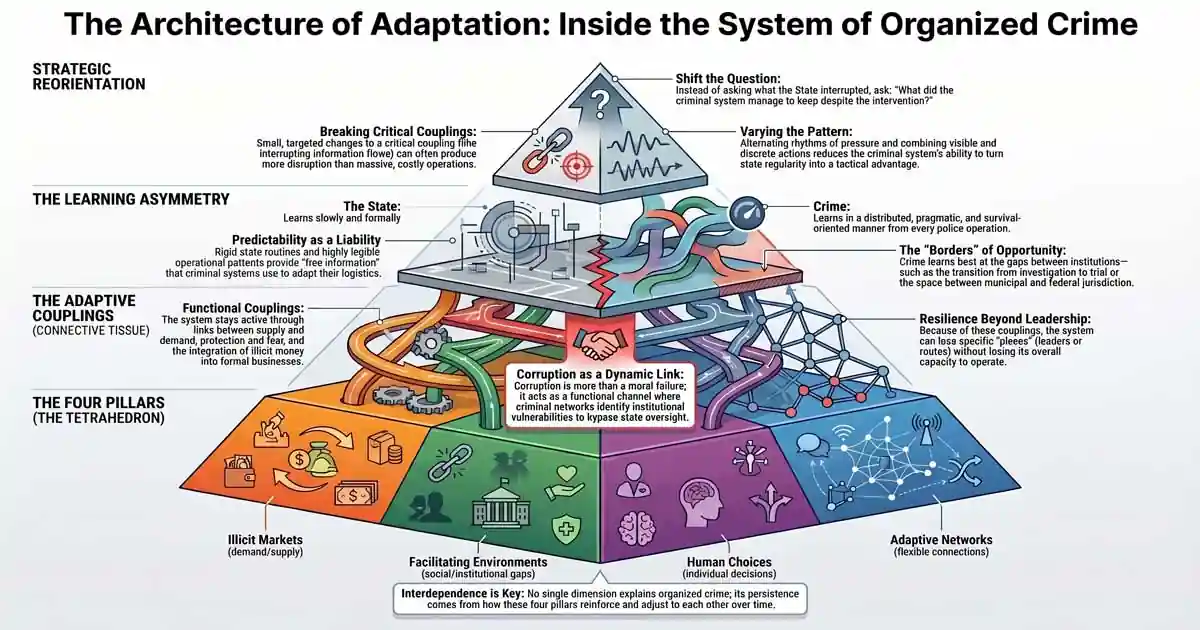
The Criminal Organizations Tetrahedron
To understand these connections, the Criminal Organizations Tetrahedron helps reorganize how we read the problem. The model is based on four interdependent dimensions: illicit markets, the enabling social and institutional environment, human choices, and adaptive criminal networks. None of these dimensions, by itself, explains the persistence of organized crime. What sustains the system is the way they connect, reinforce one another, and adjust over time.
That is why couplings matter so much. A criminal system does not persist only because there are actors willing to commit crimes. It persists because certain dimensions remain functionally connected. There are couplings between demand and supply, protection and fear, illicit money and formal businesses, prison and external command, social vulnerability and recruitment, corruption and institutional predictability. When these couplings persist, the system may lose pieces, leaders, or territories without necessarily losing its capacity to operate.
Corruption as adaptive coupling
Corruption offers a decisive example. It should not be seen only as individual misconduct or moral failure by public officials. Within the Tetrahedron, corruption may function as a coupling between the adaptive capacity of criminal networks and the enabling social and institutional environment. On one side, criminal organizations adjust their practices, identify vulnerabilities, test intermediaries, diversify payment methods, hide connections, and learn which institutional points are more permeable. On the other side, the enabling environment offers loopholes, fragile routines, weak supervision, fear, economic dependence, selective impunity, or normative ambiguity.
When these two poles become coupled, corruption ceases to be merely an isolated act. It becomes a channel of adaptation. Crime learns where to buy silence, where to obtain information, where to neutralize oversight, where to anticipate operations, and where to turn state predictability into advantage. In this case, the problem does not lie only in the corrupted agent, but in the stabilized relationship between a criminal network that learns and an institutional environment that allows, tolerates, or fails to interrupt that learning.
This reading changes how intervention should be conceived. If corruption is treated only as individual conduct, the response tends to focus on punishing the agent who was caught. That punishment is necessary, but it may be insufficient. The coupling may remain active through other intermediaries, other channels, and other forms of protection. The strategic question becomes different: what functional connection between criminal network and enabling environment made this corruption useful, repeatable, and adaptable?
Learning asymmetry between state and crime
At this point, one of the greatest asymmetries in public security becomes visible. The state learns slowly, formally, in fragmented ways, and at high political cost. Crime learns in a distributed, pragmatic way, oriented toward survival. This difference is not destiny. It can be reduced, provided that public decision-making also learns from the effects it produces.
The first practical possibility is to improve decision response time. This does not mean acting hastily, but reducing the distance between observing an unwanted effect and adjusting the intervention. When an operation displaces an illicit market to another territory, that displacement should not be treated as a late surprise. When the imprisonment of leaders generates rapid functional substitution, this should not be read only as a sign of success. When pressure on a route produces logistical diversification, the relevant fact is not only the blocked route, but the system’s capacity to create alternatives.
Exploitable predictability and state patterns
The second possibility is to recognize exploitable predictability. What is predictable to crime can be used against the state itself. Rigid routines, automatic responses, and overly legible operational patterns reduce the uncertainty faced by the adversary. But this finding also opens an opportunity. If predictability is part of the problem, it can be adjusted.
This predictability often appears precisely at the edges. Crime observes where institutions meet and where they leave gaps: the transition from investigation to criminal procedure, from prison to sentence enforcement, from social policy to territorial control, from visible repression to intelligence, from municipal action to state or federal action. At these edges, small mismatches may create major opportunities for exploitation and expand criminal adaptive advantage.
Varying operational patterns, alternating rhythms of pressure, combining visible and discreet actions, integrating territorial intelligence, and avoiding identical responses are ways to reduce this adaptive advantage. The goal is not improvisation. It is to prevent the state’s own regularity from becoming an input for criminal recomposition.
What does the criminal system manage to preserve?
The third possibility is to observe behavioral selection. In adaptive systems, practices remain when they find favorable conditions. If a certain form of recruitment persists, it probably finds social, economic, or symbolic incentives. If a route is recomposed, there is still an active function in the system. If an organization loses leaders but preserves discipline, extortion capacity, and territorial protection, then the target reached did not correspond to the decisive point of support.
Therefore, the relevant question is not only “what did the state manage to interrupt?” The more important question is: “what did the criminal system manage to preserve despite the intervention?” This inversion changes how results are read. It allows us to identify which couplings remain active and which edges remain open to recomposition.
Nonlinearity and small changes
The fourth possibility involves nonlinearity. In complex systems, small changes can generate large effects, while large operations may produce limited results. This requires prudence, but it also creates room for more intelligent decisions. It is not always necessary to confront the entire system at once. Sometimes, altering a critical coupling, reducing informal protection, making a logistical function harder, interrupting an information flow, or breaking an expectation of impunity may produce effects greater than broad and costly actions.
Understanding how crime learns does not lead to pessimism. On the contrary, it helps recover strategic capacity. If the criminal system observes edges, exploits couplings, tests alternatives, and selects behaviors, the state must also learn to observe these points with greater precision.
The gain does not lie in promising total control. It lies in reducing decisions that strengthen criminal adaptation and expanding those that produce real disorganization. When the state begins to see its own effects as part of the system, it stops merely reacting to crime and begins to dispute the learning capacity that sustains criminal adaptive advantage.
Still, an inevitable question arises: if this is possible, why does the state find it so difficult to adjust its own action? That is the subject of the next article.
Regards
Sergio Senna
This post is also available in pt_BR.