

An adaptive crime strategy begins with a difficult recognition: a tactical operation can deliver exactly what it promised and still fail to change the system. The headlines celebrate. Drugs, guns, and cash are seized. Key actors are removed from the streets. Three months later, the market is back, only two blocks away, with new faces, different routes, and the same customers.
The operation may have worked tactically, but the system learned.
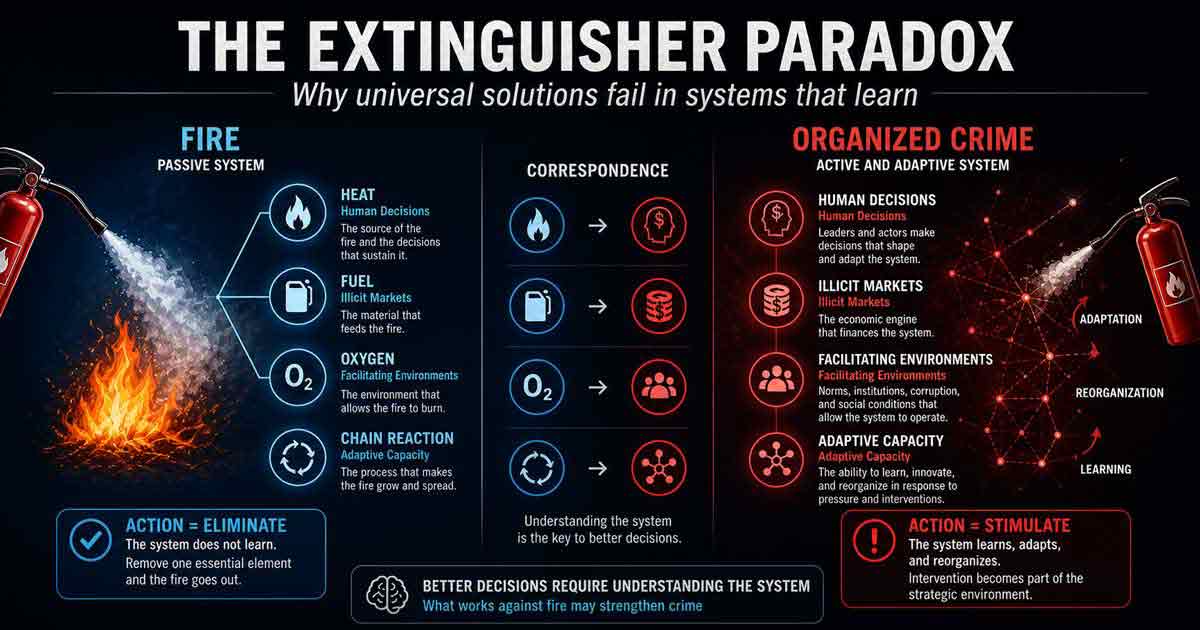
That is the starting point of what I call the extinguisher paradox: a recurring error in public safety in which institutions treat an adaptive adversary as if it were a passive system.
In a fire, intervention follows a relatively direct logic. Fire depends on heat, fuel, oxygen, and a sustaining chain reaction. Remove one of these elements, and the fire stops. The firefighter does not need to worry that the fire will observe the intervention, change its route, corrupt an inspector, recruit new intermediaries, or redesign its own structure. Fire is a passive system. Organized crime is not.
When Intervention Becomes Adaptation
A criminal system reacts to pressure. It observes enforcement patterns, detects institutional routines, identifies weak points, tests alternatives, replaces people, moves goods, changes communication channels, and learns which state actions are predictable.
This is why strategies that look logical in linear systems often disappoint in public safety. Removing one visible element may not eliminate the function that element performed. A person can be replaced, a route can shift, a marketplace can relocate, a payment channel can move through another intermediary, and a territorial presence can become less visible without disappearing. The same action that extinguishes a passive system may stimulate adaptation in an active one.
This does not mean enforcement is useless. It means enforcement must be interpreted systemically. A seizure may matter, an arrest may matter, and territorial pressure may matter. But the central question is not only what the state removed. The deeper question is what the criminal system did after the state acted: did it collapse, move, fragment, learn, or become more resilient?
An adaptive crime strategy therefore asks a different question. It does not stop at tactical success. It examines what happened after pressure entered the system and whether the intervention reduced criminal capacity or merely changed its visible form.
Intervention Can Become Information
Here is an uncomfortable truth: every time the state acts in a predictable way, it may be teaching the adversary how to survive.
A police operation does not only apply pressure. It also reveals information. It may reveal timing, entry routes, legal thresholds, coordination limits, investigative priorities, institutional blind spots, or political urgency. If similar actions repeat over time, criminal actors may begin to read them as signals.
For public safety leaders, this creates a difficult problem. Democratic institutions must operate under legality, accountability, and procedural constraints. They cannot act arbitrarily, and some predictability is necessary for the rule of law. But operational repetition can become exploitable. When the state acts in ways that are always visible, always similar, and always politically defensible, the adversary may learn faster than the institution corrects. The state counts the operation. The criminal system studies it.
This is where organized crime differs from ordinary disorder. Adaptive criminal systems do not merely resist intervention. They incorporate intervention into their learning process.
The Real Question Is Not “Did We Act?”
Public safety institutions are often judged by visible outputs: arrests, seizures, patrols, warrants, operations, statistics, and press conferences. These indicators matter, but they can be misleading if they are treated as proof of systemic disruption.
A system may lose actors and preserve functions. It may lose a route and preserve supply. It may lose visibility and preserve control. It may lose territory temporarily and preserve governance through fear. This is the practical meaning of the extinguisher paradox. Against fire, removing one element can end the process. Against organized crime, removing one element may only force the system to reorganize.
The implication is not pessimism. It is better diagnosis. Instead of asking only, “What did we remove?”, public safety leaders should ask: What did the system learn from our intervention?
That question changes strategy. It moves decision-makers from a logic of visible suppression to a logic of systemic interpretation. It directs attention to functions, relationships, replacement capacity, market incentives, local fear, institutional gaps, and the speed of criminal adaptation.
An adaptive crime strategy is useful precisely because it helps explain why violence and organized crime can persist even after more investment, more operations, and more visible enforcement. The issue is not always lack of effort. Sometimes the deeper problem is that the criminal system absorbs pressure faster than institutions interpret feedback.
A Different Kind of Public Safety Strategy
Countering adaptive organized crime requires more than intensity. It requires strategic intelligence about how pressure travels through the system.
A successful intervention should not only produce immediate outputs. It should reduce the system’s ability to adapt, replace, displace, conceal, and learn. That requires attention to critical couplings, functional substitution, exploitable predictability, and institutional learning.
This is also why public safety leaders need more than a list of tactics. They need a vocabulary for reading adaptive criminal systems: how they respond to pressure, how they preserve functions, how they exploit routines, and how they reorganize after disruption.
The goal is not to stop acting. The goal is to stop acting as if organized crime were fire. A fire does not study the firefighter; a criminal system may study the state. That difference changes everything.
Provocative question:
Which of your institution’s routine operations has become an extinguisher paradox: tactically successful but systemically absorbed?
Series note:
This article is part of the series How Crime Learns, based on [Countering Adaptive Organized Crime: A Strategic Guide for Public Safety Leaders]. The book introduces the CRIMOR model and a strategic vocabulary for understanding adaptive criminal systems, avoiding predictable errors, and improving public safety decisions under uncertainty.
Next in this series: why repeated state routines can become intelligence for criminal networks through what I call exploitable predictability.