

Public security needs crime adaptation sensors because arrests, seizures, patrol hours, and operations do not tell the whole story. They show that the State acted. They do not always show whether the criminal system lost capacity, changed behavior, or simply absorbed the pressure and continued to operate. That difference is not academic. It defines whether public security is learning or merely repeating visible action.
This does not mean that arrests and seizures are irrelevant. They matter. Police operations reduce immediate harm, remove dangerous actors, produce evidence, protect residents, and interrupt violent situations. The problem begins when institutions treat these numbers as proof that the criminal system itself has been disrupted. A visible operation may alter the surface of the problem while the underlying system remains intact.
The better question is not only what the State did. The better question is what the criminal system did after the State acted. Did it lose capacity, or did it replace people? Did supply fall, or did the market absorb the loss? Did residents become safer, or did they stop reporting out of fear and exhaustion? Did the intervention reduce criminal control, or did it push activity into a less visible form?
That is why public security metrics need to evolve. Traditional indicators tell us what institutions produced. They do not always tell us whether the system weakened, adapted, moved, or learned.

The arrest that changes nothing
Imagine an operation against an open-air drug market. The police arrest several sellers, seize drugs, publish results, and report operational success. From the perspective of traditional metrics, the intervention looks effective. There were arrests. There were seizures. There was visible State action.
But two days later, new sellers occupy the same place. Prices remain stable. Buyers continue to arrive. Storage points move slightly. Lookouts adjust their positions. The market absorbs the shock and continues to operate.
In that situation, the operation was not useless. It may have contained immediate risk, removed violent individuals, interrupted a specific episode, or generated evidence for future investigations. But it did not necessarily transform the criminal system. It produced containment, not structural disruption.
This distinction matters. Public security often treats containment as if it were transformation. Containment may be necessary, especially when lives are at risk. But if the system replaces functions quickly, the State needs to see that clearly. Otherwise, institutions celebrate movement as progress and confuse operational effort with strategic effect.
The same logic applies to seizures. A large seizure only indicates meaningful disruption if it affects availability, price, route stability, risk perception, or replacement capacity. If supply remains stable and prices do not change, the network may have absorbed the loss as an ordinary cost of operation. The seizure still matters, but it means less than the dashboard suggests.
The problem, then, is not counting arrests and seizures. The problem is counting them without asking what happened next.
Why violence persists despite more action
Many citizens ask a fair question: if governments invest more, arrest more, seize more, and patrol more, why does violence persist? The uncomfortable answer is that organized crime does not behave like a passive target. It reacts to pressure, tests alternatives, learns from losses, and reorganizes functions.
That is where the metaphor of fire reaches its limit. A fire does not learn from the extinguisher. It does not change fuel, move oxygen, recruit new flames, or study the firefighter’s routine. Organized crime does. When the State attacks one market, another market may compensate. When leaders are arrested, networks may redistribute functions. When police pressure increases in one territory, activity may move to another. When legal routines become predictable, criminal actors may incorporate them into their own calculations.
Crime organized as a complex adaptive system does not persist only because it has money, weapons, territory, or social protection. It persists because these elements connect and reinforce one another. Markets, networks, enabling environments, and human decisions interact. Together, they form regimes of operation, relatively stable patterns through which the criminal system survives, adapts, and recomposes itself under pressure.

When the State becomes predictable
Criminal networks learn from State action. They observe where operations occur, how long pressure lasts, which agencies act first, which territories receive attention, and where coordination tends to fail. They test routes, lose cargo, replace people, change schedules, and adjust behavior. They do not need formal reports to learn from the State. Repetition is often enough.
The State learns in a different rhythm. Democratic institutions must respect legality, accountability, documentation, supervision, public justification, and institutional coordination. These requirements are not weaknesses. They are part of legitimate public power. But they create a structural difference in learning speed. A criminal network can adjust in hours. A public institution often needs meetings, reports, authorization, legal review, budget negotiation, and political cover.
This difference is learning asymmetry. It becomes especially dangerous when institutions repeat familiar actions in familiar ways. If operations follow the same territorial rhythm, the same timing, the same duration, and the same public narrative, the State becomes increasingly legible to the adversary. Its action still produces pressure, but it also produces information.
Transparency and legal routines are democratic virtues. The risk begins when routines become so predictable that criminal networks use them as operational signals. In that scenario, State action may still generate arrests and seizures, but it also teaches the adversary how to survive the next intervention.
This is exploitable predictability. It occurs when the criminal system uses institutional regularity to reduce its own uncertainty. The State acts, but the adversary learns faster.
Why regimes of operation matter
Not every criminal environment reacts in the same way. Some problems remain relatively legible. In those cases, focused technical measures can produce visible and sustained results. Vehicle theft, for example, may respond to better tracking, pressure on resale markets, and rapid identification of receivers. The causal chain is not perfect, but it is more readable.
Other environments operate under continuous adaptation. In open-air drug markets, militia-controlled territories, corruption networks, and areas under criminal governance, the system often absorbs pressure and reorganizes. Arresting visible actors may not affect the market. Seizing goods may not reduce supply. Occupying a territory may not change the informal rules that guide local decisions.
This is why public security should not decide only by measures chosen in advance. It should decide by regimes of operation. A response that works in one regime may fail in another. Worse, it may create more predictability for the adversary. The problem is not the measure itself, but the mismatch between the intervention and the system’s mode of operation.
Crime adaptation sensors help institutions avoid this error. They show whether the system operates under local stabilization, continuous adaptation, or episodic disorganization. This reading does not guarantee success, but it reduces the probability of repeating strategies that the criminal system has already learned to absorb.
What crime adaptation sensors measure
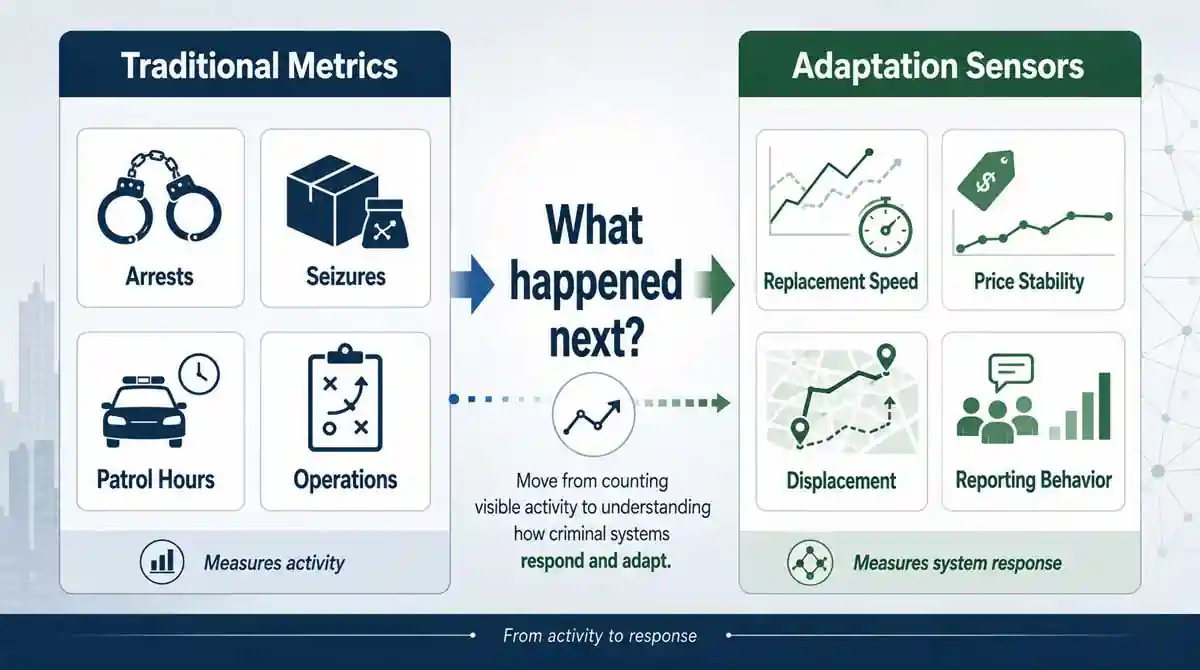
Crime adaptation sensors are qualitative and quantitative indicators that help answer a practical question: did the intervention change the system, or did the system simply adapt?
They do not replace traditional metrics. They interpret them.
In the CRIMOR Tetrahedron, these sensors can observe four connected dimensions. The first is the market: prices, availability, routes, product substitution, and supply stability. The second is the network: leadership replacement, recruitment, communication shifts, and redistribution of functions. The third is the social and institutional environment: fear, reporting behavior, corruption patterns, community dependence on illicit order, and coordination gaps. The fourth is human decision: perceived risk, loyalty, incentives, coercion, and the availability of lawful alternatives.
In a drug market, adaptation sensors may track the speed with which arrested sellers are replaced, whether retail prices changed, whether product availability declined, whether activity moved to other streets or hours, whether residents became more or less willing to report, and whether the network altered storage, transport, communication, or lookout routines.
In vehicle theft, they may track how quickly stolen parts appear on resale platforms, whether thefts move to nearby neighborhoods after concentrated enforcement, whether black-market prices remain stable, and whether identified offenders are replaced by new actors.
In corruption-prone environments, they may track changes in reporting behavior, repeated institutional delays, unusual leakage of operational information, selective enforcement patterns, and shifts in the relationship between criminal actors and local authorities.
The logic is straightforward: evaluation must move from activity to response. A week with high arrests and stable prices tells one story. A week with high arrests and rising prices tells another. The same operational result can mean different things depending on how the system reacts.
Without this distinction, the State may believe it is winning while the criminal system is merely reorganizing.
Why this matters to ordinary citizens
This discussion may sound technical, but its consequences are concrete. When governments rely only on visible metrics, they tend to repeat visible actions. More operations. More arrests. More announcements. More numbers. Citizens see movement, and movement may create a temporary sense of control. But movement is not always progress.
If the market remains stable, if violence returns, if residents remain afraid, or if the same territory falls back under criminal influence, then something important was not measured. The institution may have measured its own effort, but not the system’s response.
The public deserves more than performance statistics. It deserves evidence that security institutions are learning from what happens after they act. That does not require promises of total control. No serious public security strategy can promise that. Organized crime, when it operates as an adaptive system, does not disappear because one operation succeeded. It reacts, hides, fragments, relocates, and recomposes.
The honest question is not whether the State acted. The question is whether the State learned.
How institutions can begin
This shift does not require rebuilding the entire public security system at once. A realistic path begins with one territory, one market, one network, or one recurring crime pattern. Institutions can preserve traditional indicators and add a small set of adaptation sensors around them.
This is the practical value of crime adaptation sensors: they do not ask institutions to stop measuring activity. They ask institutions to connect activity to system response.
Before repeating an operation, decision-makers should ask what happened after the last one. Were arrested actors replaced? Did prices change? Did the market move? Did residents report more or less? Did the network become more hidden? Did the intervention reduce capacity, or did it only change the surface?
These questions create analytical friction. They introduce a structured pause before repetition. They do not prevent urgent action, and they should not paralyze operational response. Their purpose is different: to prevent institutions from repeating familiar actions without checking whether those actions have already become part of the adversary’s learning process.
This matters because public security operates under pressure. Political leaders want quick answers. The media rewards visible action. Citizens want relief. Police officers need institutional support. Managers need results they can explain. These pressures are real, but they also make predictable responses more attractive.
When a criminal system adapts, the easiest action to communicate is not always the best action to repeat.
The ethics of imperfect decision-making
Adaptation sensors also require a different form of political communication. Leaders need to explain that not every intervention transforms the system. Some actions contain harm. Some produce temporary relief. Some displace the problem. Some reveal that the State must change course.
That is not weakness. It is institutional learning.
The public does not need false certainty. It needs responsible explanation. It needs to know whether the State is only counting its own activity or also observing the adversary’s response. In complex security environments, responsible leadership does not consist in promising control that no institution can deliver. It consists in acting under uncertainty, measuring honestly, correcting course, and reducing predictable errors.
This is the ethics of imperfect decision-making. It accepts that decisions will always carry risk, but it refuses to hide risk behind comforting numbers.
Measuring what matters
Public security institutions should continue to count arrests, seizures, patrols, investigations, and prosecutions. These indicators remain relevant. But they are not enough.
An arrest matters more when the criminal function is not immediately replaced. A seizure matters more when supply, price, routes, or risk perception change. A patrol matters more when crime does not simply move to the next street. A large operation matters more when it reduces the system’s capacity to adapt.
The State needs to measure effects, not only effort. That is the reason crime adaptation sensors matter for public security, criminal intelligence, policing, and policy evaluation.
Every intervention measured only by visible output risks teaching the adversary more than it teaches the institution. Every dashboard that tracks activity without tracking response may create institutional self-deception. Every celebrated success that ignores recomposition widens the gap between appearance and reality.
Adaptation sensors do not solve organized crime. No single concept can do that. But they improve the quality of decision-making because they help institutions see whether the criminal system is weakening, hiding, moving, or learning.
In adaptive criminal systems, the State does not need the illusion of perfect control. It needs better ways to learn before repeating what the adversary has already learned to absorb.
Visual abstract

Editorial note: This infographic was generated with NotebookLM based on the entry on adaptation sensors presented in Countering Adaptive Organized Crime.
