

The PCC and Comando Vermelho terrorist designation marks a major change in the operating environment of Brazilian organized crime. In May 2026, the United States designated Primeiro Comando da Capital (PCC) and Comando Vermelho (CV) under its terrorism authorities, expanding the financial, investigative, and international pressure that can be directed at two of Latin America’s most powerful criminal organizations.
Why this matters: stronger U.S. pressure can close financial channels, expose intermediaries, increase compliance costs, and expand international cooperation. But adaptive organized crime does not remain unchanged while governments act. PCC and Comando Vermelho can learn from pressure, replace functions, shift routes, reorganize financial flows, and change the relationships that keep their operations viable.
The immediate debate has focused on whether the terrorism designation is legally and politically appropriate. Brazil has publicly challenged that approach, and Brazilian authorities, jurists, and security specialists have raised concerns involving sovereignty, the fit between terrorism and organized-crime categories, secondary economic effects, and possible complications for established forms of bilateral cooperation. Those concerns belong in the analysis because they affect the institutional environment in which the policy will operate.
The Washington Paradox addresses a different question. Whatever judgment one makes about the designation itself, the United States has altered the risks and incentives surrounding PCC and CV. What should public safety leaders watch now?
What is the Washington Paradox?
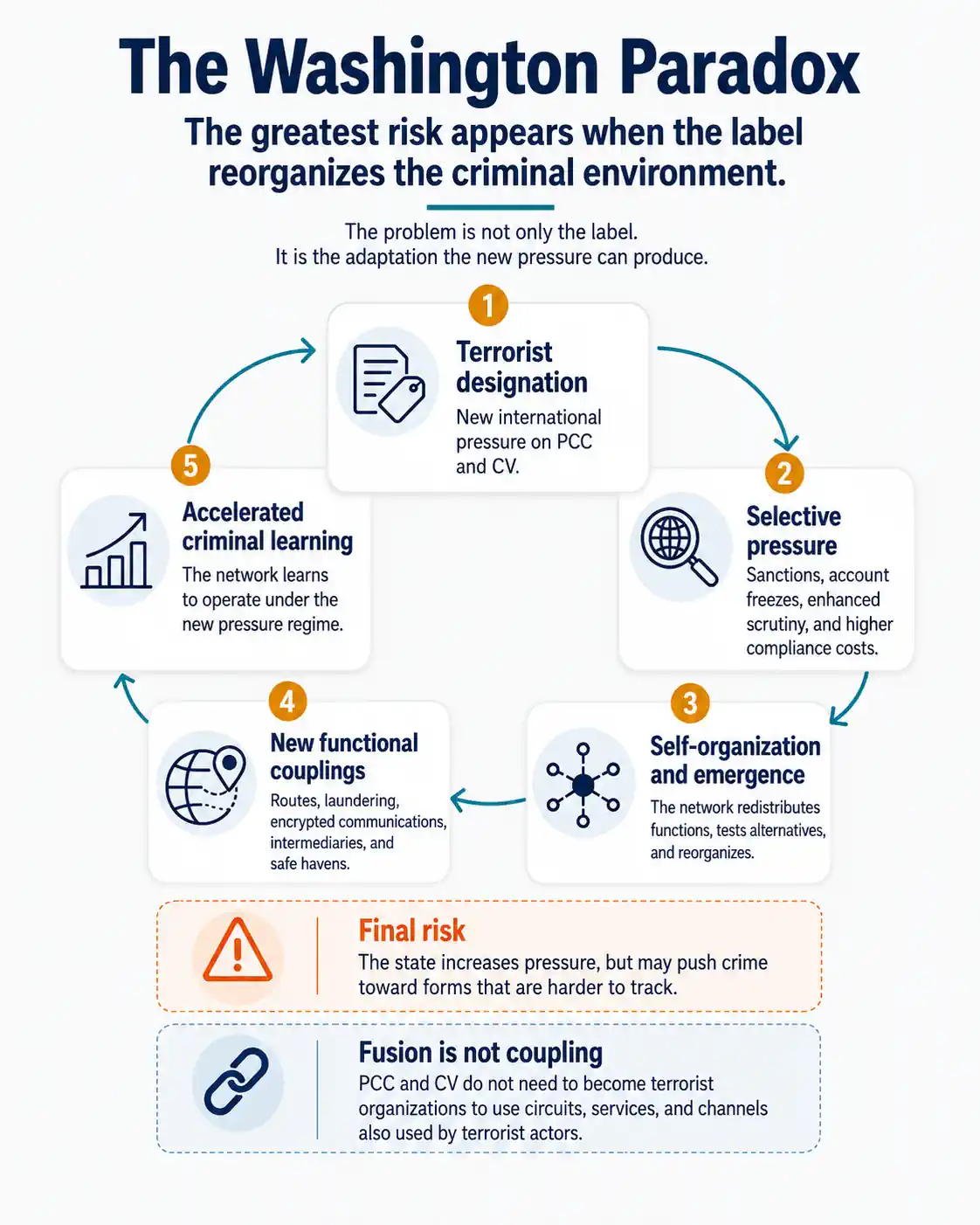
The Washington Paradox describes the strategic tension created when stronger pressure reaches a criminal system capable of learning from that pressure. An intervention can weaken existing arrangements while creating incentives for new ones to emerge.
Accounts may be frozen, intermediaries exposed, transactions interrupted, and international scrutiny intensified. Those are significant effects. Yet a criminal organization can lose a particular person, route, company, or account without losing the function that person or structure performed.
That distinction matters. Disrupting what is visible is not necessarily the same as reducing the system’s capacity to operate. The more useful question is what PCC and Comando Vermelho become after the intervention.
A similar problem appears in the Extinguisher Paradox. Fire does not study the firefighter and reorganize around previous attempts to extinguish it. Criminal networks can observe state behavior, test alternatives, preserve successful adaptations, and abandon those that fail.
How can stronger pressure reorganize PCC and Comando Vermelho?
PCC and CV depend on more than formal leadership. Their operations connect illicit markets, prison networks, logistics, financial flows, territorial relationships, protection arrangements, corruption, communications, and individual decisions.
CRIMOR Tetrahedron: Mapping Organized Crime as a System
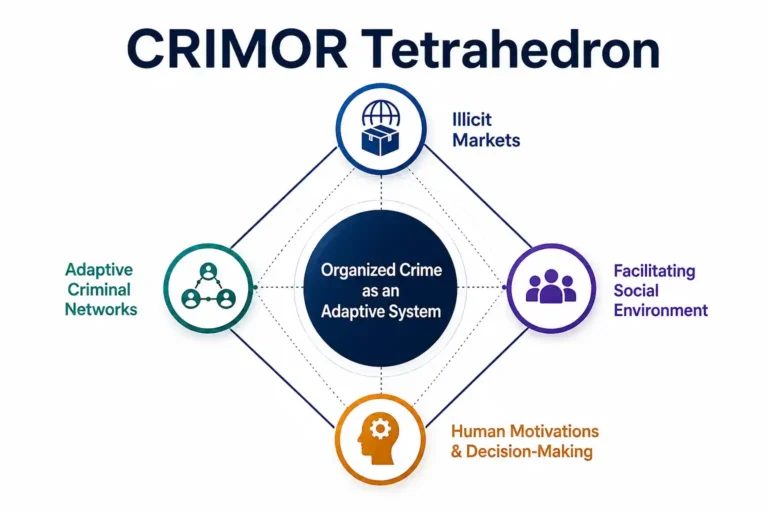
The CRIMOR Tetrahedron maps organized crime through markets, networks, environments, and human decisions.
The CRIMOR Tetrahedron organizes these interactions through four interdependent dimensions: illicit markets and resources, adaptive criminal networks, enabling social and institutional environments, and human motivations and decision-making. Pressure introduced into one dimension can travel into the others.
Consider financial enforcement. Blocking an account may immediately remove access to resources, but the network can respond by changing intermediaries, fragmenting transactions, using different businesses, moving operations across jurisdictions, or increasing reliance on protected relationships. The intervention remains consequential, but its strategic value depends on the cost and speed of replacement.
This is why the amount of pressure alone provides an incomplete measure. Managers also need to know where that pressure travels and how much freedom the network retains to reorganize around it.
Why does selective pressure matter?
The designation increases the cost of maintaining visible relationships with PCC and Comando Vermelho. Financial institutions, companies, logistics providers, and other intermediaries now have even stronger incentives to identify exposure and withdraw from relationships that create legal, financial, or reputational risk.
That pressure can remove vulnerable arrangements quickly. It can also alter which criminal arrangements become comparatively more useful. Actors who depend on highly visible channels become liabilities, while those capable of concealment, redundancy, and functional substitution gain value.
Over time, such selection can modify the network itself. Financial activity may become more fragmented, responsibilities can move toward less visible operators, and previously secondary intermediaries may acquire greater importance.
None of this reduces the value of strong enforcement. It tells managers what to look for after enforcement begins to work.
Why can relationships matter more than labels?
A coupling is a relationship through which parts of a system exchange resources, information, protection, access, or operational capacity. Two organizations do not need common ideology, unified leadership, or a formal alliance to depend on the same money launderer, corrupt official, transportation route, document provider, communications service, or logistical intermediary.
The distinction between fusion and coupling is especially useful here. Fusion requires deeper convergence of identity, command, or purpose. Coupling requires only functional compatibility.
Stronger scrutiny can make some clandestine services more valuable precisely because they already know how to operate under pressure. PCC and CV do not need to transform themselves into a different type of organization for their relationships with other illicit networks to change.
For analysts, that opens a productive line of inquiry. Instead of asking only whether PCC or CV has established a formal relationship with another named organization, investigators can examine which functions, intermediaries, and circuits gain importance after the designation.
That is also why critical couplings deserve attention. Some relationships carry several functions at once or are unusually costly to replace. Identifying them can reveal where pressure has a greater chance of making recovery difficult rather than simply forcing activity elsewhere.
How do we know whether the pressure is actually working?
Arrests, asset freezes, seizures, blocked transactions, and investigations remain important measures. They tell public institutions what they accomplished and how much immediate pressure they imposed.
Crime Adaptation Sensors: Why Public Security Must Measure How Crime Learns
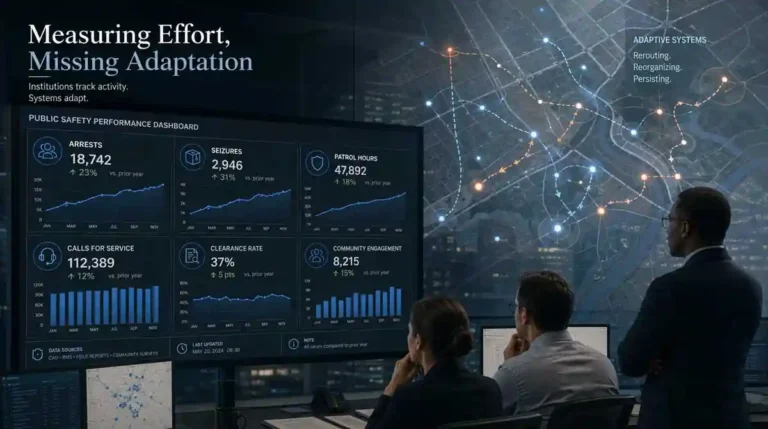
Crime adaptation sensors reveal when public security learns, and when organized crime only moves, hides, replaces, and adapts.
Adaptive systems require another layer of observation. Crime adaptation sensors focus on what happens after the intervention: how quickly leadership is replaced, whether payment functions return, where routes move, how transaction structures change, whether illicit prices remain stable, which intermediaries appear, and whether command becomes more distributed or less visible.
Suppose authorities dismantle an important financial channel. If collection, payment, laundering, and logistical financing reappear within days through another structure, the intervention has revealed substantial replacement capacity. If restoration becomes slower, more expensive, less reliable, and easier to detect, the pressure has reached deeper into the criminal system.
For managers, the comparison is more informative than either measure alone. One set of indicators shows what authorities removed. The other shows what the criminal network was able to rebuild.
What can U.S.-Brazil cooperation add?
The United States and Brazil observe different boundaries of the same transnational criminal environment. U.S. institutions possess exceptional reach into international finance, sanctions, cross-border investigations, and global compliance networks. Brazilian institutions remain much closer to the prison, territorial, investigative, political, and social environments in which PCC and Comando Vermelho maintain their influence.
Effective cooperation can connect these perspectives. International financial disruption becomes more informative when Brazilian authorities can identify what changed afterward in command structures, logistics, territorial activity, corruption networks, or recruitment. Brazilian intelligence becomes more useful when investigators can connect those changes to international financial and commercial flows.
The institutional challenge is coordination without flattening different sources of knowledge. As argued in Why Centralized Enforcement Against Organized Crime Can Backfire, cross-jurisdictional action benefits from strong coordination, but rigid command can suppress local intelligence and slow the feedback needed against adaptive networks.
The most valuable cooperation may therefore involve more than acting together. It can help both countries learn faster from what happens after they act.
What would strategic success look like?
A demanding measure of success asks whether PCC and Comando Vermelho are becoming less able to recover. Leadership replacement should take longer, financial alternatives should become more expensive, logistical channels less reliable, protection arrangements more fragile, and essential functions increasingly difficult to reconstruct.
That standard directs attention away from the sheer number of targets and toward the structure of recovery. A highly visible leader may be easier to identify than a relationship connecting money, logistics, corruption, and command. Yet disrupting the second may impose a much higher adaptation cost.
Pressure becomes strategically more valuable when it narrows the criminal system’s options. The goal is not merely to produce more disruption but to make recomposition progressively harder.
What should we watch after the Washington Paradox?
The U.S. designation has created a rare opportunity to observe PCC and Comando Vermelho under a new level of international pressure. The next phase will reveal which arrangements disappear, which functions move, how quickly replacements emerge, and whether the organizations can preserve their operating capacity at acceptable cost.
That is the central question behind the Washington Paradox. Stronger powers give governments more ways to reach an adaptive adversary. The next challenge is learning fast enough to understand what that adversary becomes in response.
For public safety leaders, the most useful next step is Crime Adaptation Sensors: Why Public Security Must Measure How Crime Learns. It provides concrete criteria for distinguishing pressure from lasting disruption.
To understand where those adaptations occur, continue with CRIMOR Tetrahedron: Mapping Organized Crime as a System. If the next question is where intervention may produce disproportionate effects, Critical Couplings: When One Relationship Can Change the System develops that part of the analysis.