Why do organized criminal systems survive arrests, seizures, new laws, leadership takedowns, and repeated enforcement pressure?
The conventional answer usually looks for what is missing: more resources, stronger laws, better intelligence, greater coordination, or more effective enforcement. Sometimes that diagnosis is correct. But it leaves a harder possibility largely unexplored: what if intervention itself changes the criminal system we are trying to control?
Criminal networks observe pressure. People change routes, replace intermediaries, redistribute functions, test institutional limits, exploit predictable routines, and learn from failure. A successful operation can therefore produce two results at the same time: an immediate public safety gain and new information for the adversary.
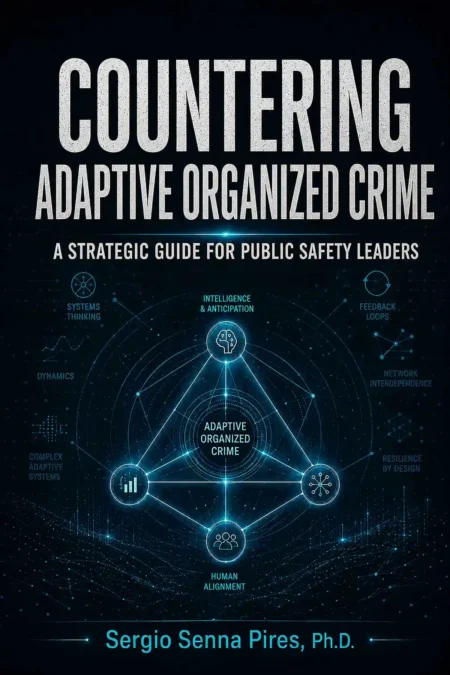
I wrote Countering Adaptive Organized Crime: A Strategic Guide for Public Safety Leaders around this problem. In the book, I connect knowledge from complex adaptive systems, public policy, governance, psychology, intelligence analysis, criminology, institutional analysis, and legal reasoning. These are robust intellectual traditions, but public safety research and practice have not yet integrated many of their implications for organized criminal adaptation.
The result is not a universal theory of crime or a catalog of ready-made solutions. It is a decision-oriented vocabulary for a more difficult question: how should public institutions act when the criminal system they confront can also learn from their actions?
What are some of the most promising concepts in the book?
Some concepts come from established scientific traditions and receive a specific application to public safety. Others are original formulations developed within this framework. Their value does not lie in creating terminology for its own sake but in making visible relationships that conventional public safety language often treats separately.
| Concept | Short definition |
|---|---|
| CRIMOR Tetrahedron | An analytical model connecting illicit markets and resources, adaptive criminal networks, enabling social and institutional environments, and human motivations and decisions. |
| Extinguisher Paradox | The problem is created when methods suitable for passive systems are applied to adversaries that observe intervention, learn from it, and reorganize. |
| Exploitable Predictability | Institutional regularities that become sufficiently legible for criminal actors to anticipate pressure and adjust their behavior at lower cost. |
| Learning Asymmetry | The unequal speed and cost at which public institutions and criminal networks experiment, learn from failure, and modify their behavior. |
| Adaptive Elasticity | The capacity of a criminal system to absorb pressure, redistribute roles, substitute functions, and continue operating without returning in exactly the same form. |
| Regime Induction | Intervention aimed not merely at visible actors or events, but at changing the relationships and conditions that sustain a criminal system’s current operational regime. |
| Managed Predictability | The strategic balance between the predictability required for legality and accountability and the variation needed to prevent institutional routines from becoming exploitable. |
| Analytical Friction | A deliberate pause for checking assumptions, reading relationships, anticipating adaptation, and improving judgment before intervention. |
These concepts connect to a broader distinction that runs throughout the book: actors and functions are not the same thing. Arresting a logistics coordinator may produce substantial operational value. But if suppliers, communication channels, financial flows, protection arrangements, and market demand remain available, another person may assume the same function.
The visible actor changed. The criminal capability may not have changed to the same degree.
Why does this matter for public safety in the United States?
U.S. readers should not approach the book as a collection of Brazilian solutions for American problems. Brazil provides something more useful: a demanding environment in which criminal adaptation, federalism, institutional fragmentation, illicit markets, territorial control, prisons, political pressure, and interactions among multiple decision centers become especially visible.
Concepts can travel across jurisdictions. Interventions must remain regime-sensitive.
This distinction is particularly relevant in the United States because public authority is also distributed across federal, state, county, municipal, prosecutorial, correctional, regulatory, intelligence, judicial, and social institutions. Criminal networks can move across these boundaries even when information, authority, budgets, and institutional learning do not move at the same speed.
That creates favorable conditions for learning asymmetry. A trafficking network does not need a complete understanding of the American public safety architecture. Different participants can learn different fragments: where inspections concentrate, which financial controls create greater risk, how long enforcement pressure normally lasts, what investigative priorities recur, or where coordination is weaker. Those lessons can accumulate without centralized planning.
The same reasoning can be applied to fentanyl supply chains, open-air drug markets, organized retail crime, financial networks, prison-based coordination, and other U.S. problems. Consider an open-air drug market. If enforcement repeatedly follows recognizable schedules, geographic priorities, or operational patterns, criminal actors may learn when pressure is likely to increase and adjust location, visibility, staffing, or transactions accordingly. In the framework developed in the book, this is one possible form of exploitable predictability.
The relevant question is therefore not only whether enforcement produced displacement. Decision-makers also need to ask whether the intervention altered the relationships that allowed the market to reconstitute elsewhere.
This is why I treat organized crime as more than an organizational chart. Criminal adaptation can emerge from distributed decisions made by brokers, couriers, sellers, financial intermediaries, corrupt collaborators, consumers, local actors, and many other participants. No central criminal planner is required for the system to learn.
How can professionals and AI use the guide?
I did not organize Countering Adaptive Organized Crime only for linear reading. Public safety problems rarely arrive in the order of a textbook, so the guide allows readers to begin with the problem they actually face and move through related concepts.
A police commander concerned about repeated displacement might begin with Exploitable Predictability, Adaptive Elasticity, and Managed Predictability. An intelligence analyst examining rapid network recomposition might move from Functional Substitution to Critical Couplings, Learning Asymmetry, and Operational Regime. A policymaker trying to understand why a successful intervention failed after replication might begin with Transposition Error, Policy Feedback, and Regime-Sensitive Intervention.
This structure also makes the guide particularly compatible with AI-assisted reading. Readers can use an AI system to retrieve concepts, compare entries, build a reading path around a concrete problem, identify relationships among ideas, or test an interpretation against the vocabulary developed in the book.
For example, a reader could ask:
Using Countering Adaptive Organized Crime, build a reading path for analyzing repeated criminal displacement after enforcement. Connect Operational Regime, Exploitable Predictability, Critical Couplings, Adaptation Sensors, Learning Asymmetry, and Regime Induction. Distinguish the author’s concepts from your own interpretation.
This does not transfer judgment to artificial intelligence. AI can assist with navigation, retrieval, comparison, and analytical contrast. Public officials, analysts, researchers, and practitioners remain responsible for interpreting the situation and deciding what follows.
This matters because the central problem is not simply access to more information. Public safety institutions already generate enormous amounts of information. The harder challenge is identifying which relationships matter, recognizing when conditions have changed, detecting criminal adaptation early enough, and learning from the effects of previous decisions.
When criminal systems learn, public institutions must learn differently
The argument is not that enforcement fails or that organized criminal systems cannot be disrupted. Enforcement, prosecution, regulation, intelligence, financial controls, and incarceration can produce important effects.
The harder question comes afterward.
Did the intervention remove a function or only its current operator? Did the market contract or relocate? Did the network become weaker or simply less visible? Did institutional action increase uncertainty for criminal actors, or did repetition make the next government response easier to anticipate?
These questions do not produce a universal formula for defeating organized crime. They provide something more realistic: a better basis for deciding under uncertainty and for learning from what happens after intervention.
Criminal systems learn from intervention. Public safety institutions need the capacity to learn from the interaction faster than the adversary learns from the response.
Explore the Book