

The kingpin strategy rests on a persuasive operational idea: some criminal leaders hold together relationships that matter far beyond formal command. They may arbitrate disputes, control access to suppliers, authorize payments, maintain territorial discipline, or preserve relationships that took years to establish. Removing such a leader can create consequences that reach well beyond the arrest itself.
Why this matters: investigators and commanders already know that leadership removals produce uneven results. One organization struggles for months after losing a leader; another restores command before the operation has disappeared from the news cycle. For intelligence analysts and operational planners, the relevant issue is dependency. What depends on that person, and how quickly can other actors restore it?
Why leadership removal can work
Complex adaptive systems do not imply that every actor is equally replaceable. Criminal networks distribute many activities, but certain relationships can become unusually important under particular conditions.
Consider a leader who does more than issue orders. He may settle disputes between distributors who do not trust one another, guarantee payment to a supplier, and maintain access to an official who protects a logistical route. Removing him affects several relationships at once. The resulting disruption comes from losing connections that other actors cannot immediately reproduce, not simply from leaving an empty position at the top.
A different organization may have a highly visible boss, while several people already possess the authority to authorize payments, negotiate supplies, or discipline local groups. Arresting that leader can remain legally and operationally important, yet the network may continue its main activities with limited interruption. Rank alone tells us little about this difference.
Leadership is not the same as dependency
A leadership operation can involve three different analytical objects. Treating them as equivalent makes prominence look like systemic importance, even though each one provides different information for intervention.
| Analytical object | What it tells the analyst |
|---|---|
| Target | The person has legal, investigative, or operational reasons to be removed. Target value does not by itself indicate how much the criminal system depends on that person. |
| Node | The actor’s position and connections within a network. A highly connected node may still perform activities that other actors can reproduce quickly. |
| Critical coupling | A relationship whose disruption can affect several activities or make restoration unusually costly. Strategic importance lies in what the relationship sustains, not only in the visibility of the actor. |
A prominent leader can therefore be a high-value target and a central node while remaining relatively easy to replace. A less visible actor may sustain trust, financial access, arbitration, or protection that took years to establish. The critical couplings framework directs attention to the consequences of losing those relationships rather than simply counting how many connections surround a leader.
CRIMOR changes what analysts map
The CRIMOR Tetrahedron extends the analysis because leadership does not operate only inside a criminal hierarchy. The model connects illicit markets and resources, adaptive criminal networks, enabling social and institutional environments, and human motivations and decision-making.
CRIMOR Tetrahedron: Mapping Organized Crime as a System
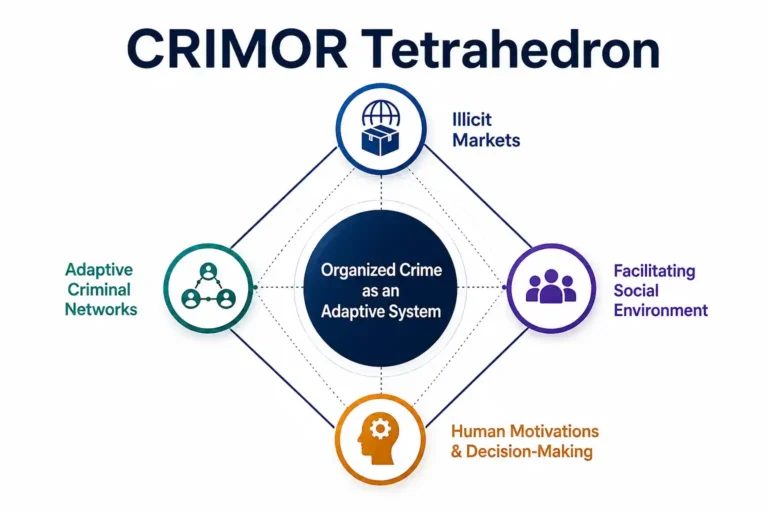
The CRIMOR Tetrahedron maps organized crime through markets, networks, environments, and human decisions.
Before an operation, analysts can ask what the leader actually sustains across those dimensions. Perhaps he personally guarantees access to a financial intermediary. Rival local commanders may accept his arbitration while distrusting an appointed successor. A protection arrangement with public officials may depend on confidence accumulated over years and may not transfer with the title.
Succession also depends on decisions made by other people. Subordinates can accept new authority, defect, or wait. Rivals may cooperate temporarily or exploit uncertainty. Suppliers can demand new guarantees. An intermediary may withdraw because dealing with the successor increases exposure. Fear, profit, coercion, and loyalty influence these choices, but the people involved still have to make them.
This makes leadership dependency larger than an organizational-chart problem. Markets, network relationships, institutional access, and individual decisions can reinforce one another around a specific leader. The greater that concentration, the more consequential removal may become.
Personal replacement is not functional substitution
Looking only for the “new boss” can conceal how quickly the organization is recovering. A criminal system can restore essential activities without recreating the previous command structure.
| What analysts may observe | What may actually be happening |
|---|---|
| No clear successor emerges | Command may be distributed among several actors instead of concentrating around another kingpin. |
| The former hierarchy fragments | Payments and logistics may continue through separate intermediaries, while local commanders preserve discipline. |
| Several actors compete for authority | Essential activities may already be operating while leadership remains disputed. |
| The organization looks different | Functional substitution may have occurred even though personal replacement has not. |
One person may assume payments, another logistics, while local commanders recover responsibility for discipline. Arbitration can migrate from a single leader to a small group. No individual has replaced the previous kingpin, yet the functions that kept the organization operating have returned.
For analysts, this changes what deserves attention after removal. Are suppliers receiving payment again? Have communication channels resumed? Can local commanders enforce agreements? Has another intermediary restored access to money or protection? A network that answers these problems without producing a new boss has demonstrated considerable adaptive capacity.
Before removal, map what can actually break
A systems-based kingpin strategy begins before the arrest. Analysts need to identify which activities are unusually concentrated around the leader, which relationships depend heavily on personal trust or access, and which actors already possess the capacity to take over what matters.
We are currently developing a methodology to structure this pre-removal assessment. The goal is to organize how analysts examine functional concentration, relational dependency, substitution capacity, and the signals that should be monitored after removal. The methodology is intended to turn these questions into a more consistent decision-support process without reducing adaptive criminal systems to a rigid checklist.
This does not require predicting the network’s exact response. The practical advantage is knowing what may become vulnerable when the intervention occurs.
Suppose intelligence shows that one leader personally connects a trafficking network to two financial intermediaries. His removal creates a different opportunity from the arrest of a leader whose payment structure already operates independently. In the first case, new payment channels and replacement intermediaries deserve immediate attention. In the second, concentrating resources there may produce little additional effect.
The operation now begins with a hypothesis about dependency. Intelligence collected before removal also establishes what officers and analysts should watch once the organization begins adjusting.
The window after removal
When important dependencies converge around a leader, removal may produce a temporary period of uncertainty. Financial partners reassess exposure. Suppliers may hesitate before extending credit. Subordinates watch competing claimants. Previously stable protection arrangements can become less reliable.
Authorities who have already mapped those relationships can use the instability while criminal actors are still rebuilding them. A new financial intermediary may become visible. Competition for authority can expose communications that previously remained protected. Suppliers seeking guarantees from an unfamiliar successor may generate information that did not exist under the former arrangement.
The value of the kingpin operation increases when the period after capture becomes part of the intervention. The state is no longer waiting to discover whether another leader will appear. It is observing and pressuring the relationships through which command, money, access, and protection could return.
Measuring what comes back
Arrest statistics establish that authorities reached the target. They reveal much less about what happened to the activities that the leader supported.
Crime Adaptation Sensors: Why Public Security Must Measure How Crime Learns

Crime adaptation sensors reveal when public security learns, and when organized crime only moves, hides, replaces, and adapts.
Crime adaptation sensors help follow the response. Leadership replacement time remains useful, but functional signals can reveal more: payment channels reopen, supply becomes stable again, unfamiliar intermediaries appear, communication patterns change, or territorial discipline returns despite continuing leadership disputes.
A network that restores payment and supply within days has shown considerable substitution capacity even if no new boss emerges. Months of unreliable coordination, expensive alternatives, and weakened protection tell a different story.
The more informative measure is therefore the cost, speed, and reliability with which criminal actors restore the activities that depended on the removed leader. That information also improves the next intervention because it reveals where the organization was redundant and where dependency was real.
When leadership removal changes more than leadership
The kingpin strategy becomes more useful when authorities treat leadership as a hypothesis about dependency. Some leaders matter mainly because of the authority they exercise. Others connect relationships that cannot be reproduced at the same speed or cost.
Once that distinction enters the analysis, preparation changes, the period after removal gains strategic value, and evaluation follows what the network manages to restore. The remaining challenge is methodological: estimating those dependencies early enough to know when leadership removal can create an opportunity for deeper disruption.
The main next step is Critical Couplings: When One Relationship Can Change the System. It develops the relationship behind this analysis and explains why an apparently ordinary connection can become strategically decisive under the right conditions.
Crime Adaptation Sensors: Why Public Security Must Measure How Crime Learns
Crime adaptation sensors reveal when public security learns, and when organized crime only moves, hides, replaces, and adapts.
This post is also available in pt_BR.