

Not all relationships within a system produce the same effects. Some support routine exchanges. Others, under certain conditions, become so sensitive that a relatively small change can reverberate across several parts of the system.
We call these relationships critical couplings.
Why it matters: Organized crime often survives major enforcement operations because the functions that sustain it can be transferred, replaced, or rebuilt. Critical coupling analysis shifts attention from the most visible targets to the relationships whose disruption can propagate across the system. It also raises a more strategic possibility: authorities may sometimes reduce redundancy first, making a key relationship more sensitive before applying concentrated pressure.
In Countering Adaptive Organized Crime, we explain that a critical coupling is a highly sensitive form of coupling. Small changes, disturbances, or variations in one part can produce disproportionate effects elsewhere. These relationships often emerge at the boundaries where illicit markets, adaptive criminal networks, enabling social environments, and human decisions come into contact.
The idea may seem simple, but it changes the logic of how we frame questions in public safety. Instead of looking only at where crime is most visible, we can ask which relationships give an intervention the greatest capacity to alter how the criminal system operates.
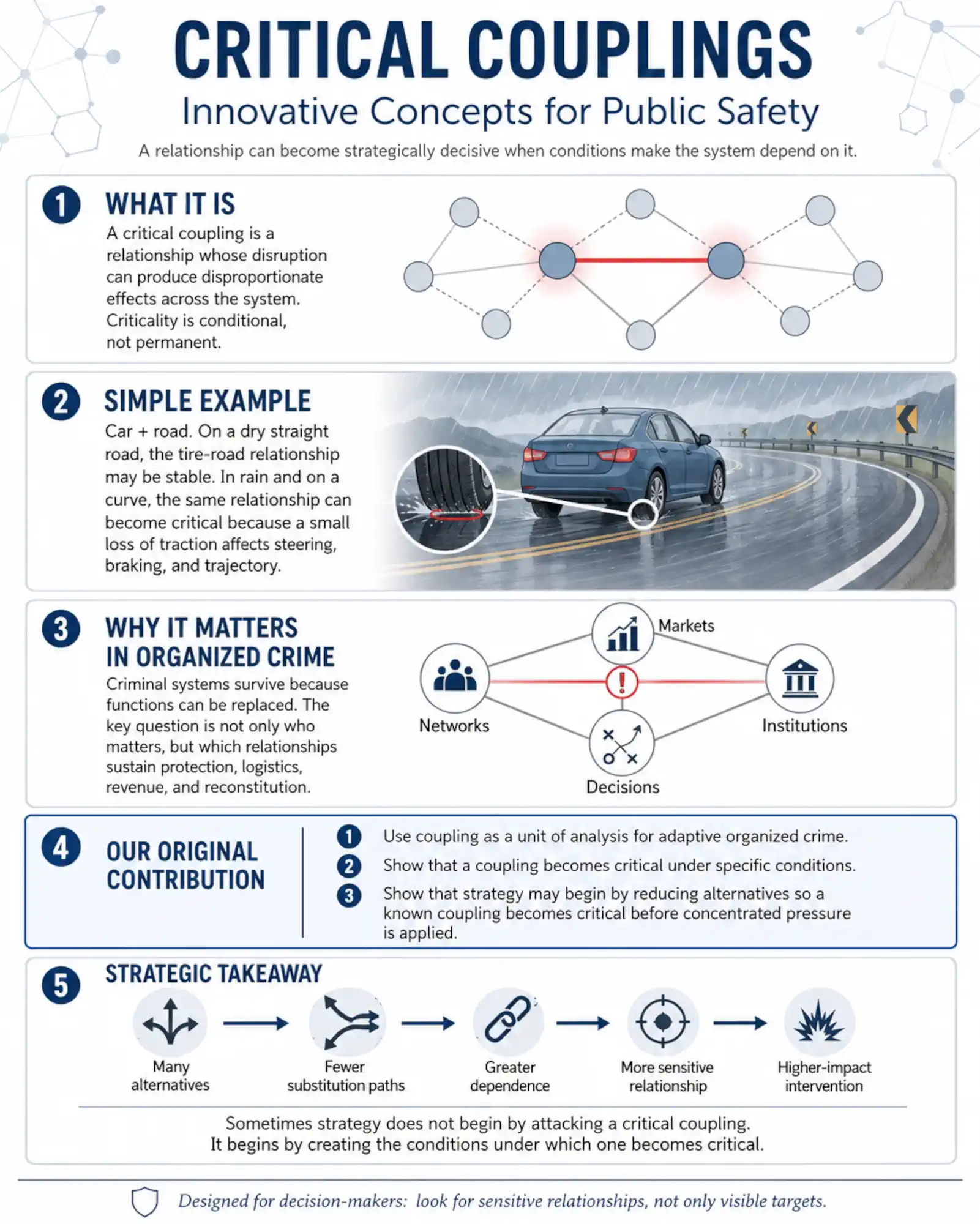
How can a car help explain a critical coupling?
In Couplings: why can connections matter more than the parts themselves?, we use the relationship between a car and the terrain to explain the concept of coupling. The vehicle remains distinct from the road, yet the two influence the behavior we observe, primarily through the interface between tire and surface.
Now imagine a dry, flat, well-maintained road. Small irregularities produce limited effects. The driver accelerates, brakes, and changes direction within a broad range of predictable performance.
Then it begins to rain. The car enters a curve, and traction decreases. The relationship still involves the same vehicle, the same tires, and the same road, but the conditions have changed. A small loss of traction can now affect braking, steering, and trajectory at the same time. The driver must also change how the vehicle is handled, showing how a change in the conditions surrounding one coupling can propagate through connected systems.
In our example, the tire-road coupling became critical under those conditions.
If the rain stops, the driver reduces speed, or the vehicle returns to a straight, dry stretch of road, that relationship may lose its criticality. This reveals a fundamental feature of the concept: a coupling does not have to remain critical all the time.
In complex adaptive systems, this variation goes beyond external conditions. The participants themselves alter relationships, create alternatives, replace people, shift routes, and reorganize functions. In The Crime That Learns, we describe criminal systems that incorporate state intervention into their strategic environment and continuously reorganize their couplings.
That is why the question we should ask is, “Which coupling has become critical at this moment, under these conditions?”
This is also the formulation adopted in Countering Adaptive Organized Crime. Under different operating regimes, a sensitive relationship may become visible, remain protected, shift elsewhere, or emerge temporarily during periods of disruption.
What turns an ordinary coupling into a critical one?
A coupling becomes especially important when changes in that relationship can propagate into other functions of the system.
Imagine a criminal organization with multiple suppliers, several routes, different payment methods, and several people capable of performing the same function. Losing one supplier may mean very little. Another can take its place.
Now imagine that successive changes reduce those alternatives. The network becomes increasingly dependent on a small number of channels to preserve an essential function. In that case, the relationship itself has changed.
The fewer the substitution options, and the more functions that depend on that connection, the greater its potential sensitivity. A disruption that once produced only local adaptation may begin to affect logistics, revenue, decision-making, protection, or the network’s capacity to reconstitute itself.
This is why the scale of an operation and its strategic importance are not the same thing. A large-scale intervention may strike something that is easily replaced. A selective action against a sensitive relationship may generate much broader consequences.
In Countering Adaptive Organized Crime, we explain that criminal operators actively protect these relationships through redundancy, corruption, intimidation, secrecy, and warning systems. Networks with high adaptive elasticity build alternative pathways so that the loss of a single connection does not interrupt essential functions.
Where should we look for critical couplings in organized crime?
Critical couplings often emerge at the boundaries between different dimensions of the system.
An illicit market needs resources. A network must convert money into operational capacity. A territorially embedded organization must convert coercion into compliance. Institutional information can provide advance warning. Economic resources can finance protection. Human decisions can sustain demand, silence, cooperation, or resistance.
Our analytical interest lies in these transitions, and this is where we should look for the focus and organizing center of a particular enforcement operation.
Some couplings are especially likely to form at boundaries where different operating logics meet. In these regions, relationships may amplify or dissipate disturbances, and some become sensitive enough to alter the behavior of the system as a whole.
This also explains why an important person does not necessarily correspond to a critical coupling. A leader may be replaced quickly. A communication channel may have alternatives. A route may be shifted.
What we need to identify are the functions that depend on the relationship and how the system can replace them if that relationship is disrupted.
When can corruption become part of a critical coupling?
Consider a territorially embedded criminal network that exploits local markets and maintains relationships with vulnerable parts of the institutional environment.
As long as the organization has several ways to obtain information, protection, and predictability, losing one of those relationships may produce only adaptation. Another contact emerges, a different institutional routine is exploited, or another intermediary assumes the function. The situation changes, however, when a particular connection begins to concentrate several important functions.
An official or group of officials may provide information about operations, facilitate licensing, provide access to administrative routines, or reduce exposure to enforcement. The analytical focus then shifts away from the corrupt individual alone. What matters is the relationship that converts institutional access into criminal capacity.
Removing the official may be necessary. But the diagnosis must ask whether the function disappeared or whether someone else can quickly restore it.
This distinction helps explain why critical couplings matter more than a list of important actors. The visible target may disappear while the relationship reemerges.
Can the state cause a coupling to become critical?
At this stage, the concept moves beyond diagnosis and begins to guide strategy. If criticality depends on the conditions under which a relationship operates, the state does not have to limit itself to searching for couplings that are already critical. In some situations, it can alter operating conditions, reduce alternatives, and increase the system’s dependence on a known connection. The logic then changes:
many alternatives → fewer substitution options → greater dependence → a more sensitive relationship → an intervention with greater capacity to propagate
This brings critical couplings close to the idea of regime induction. In Countering Adaptive Organized Crime, we propose interventions on sensitive relationships to change how the system learns, adapts, and reorganizes. Examples include financial couplings, institutional protection, decision thresholds, and cycles of criminal learning.
Instead of repeatedly applying pressure to a system with numerous escape routes, strategy can first seek to reduce its freedom to reconstitute itself.
How could this work in a market controlled by a Brazilian criminal militia?
Consider a hypothetical example involving the sale of LPG, bottled cooking gas, in a territory controlled by a Brazilian criminal militia, a type of armed territorial organization that combines coercion, illicit markets, extortion, and relationships with public institutions.
A criminal organization may dominate local distribution while still depending on products that enter the territory through a formal supply chain. If many suppliers, intermediaries, and substitution options remain available, seizing one shipment or shutting down an unauthorized retailer may produce little more than displacement.
There is a coupling between the territorial criminal network and the supply coming from the regulated market, but that relationship still contains substantial redundancy.
Brazil’s LPG retail chain is subject to regulation and authorization by the National Agency of Petroleum, Natural Gas and Biofuels, known as ANP, which maintains records of authorized retailers. In 2026, LPG distributors also began submitting acquisition and sales information to the Distribution Transparency System, established as part of federal measures to monitor fuel supply.
Now imagine a coordinated federal and state strategy combining intelligence, regulatory oversight, and criminal investigation to identify the channels supplying illicit distribution. Instead of acting only against street-level sellers, authorities progressively reduce irregular suppliers, intermediaries, and replenishment routes. The strategic objective would be to produce the following shift:
many available channels → few available channels → greater dependence → greater sensitivity of the relationship
This is a demanding strategy because Brazil’s federal system distributes regulatory, investigative, policing, and prosecutorial responsibilities across institutions operating at different levels of government. Effective intervention therefore depends on coordination among agencies that retain distinct legal authorities and operational missions.
That is why we have repeatedly addressed polycentric governance. Rather than creating a single command center for every function, a polycentric architecture allows institutions to preserve their authority while exchanging information, capabilities, operational outputs, and access needed for coordinated action.
Through this strategy, the state changes the criminal system’s structure of alternatives. If the network becomes heavily dependent on only a few channels to preserve that market, the coupling between supply and territorial distribution can become critical. Disrupting one of those channels can then produce greater effects because the organization has more difficulty replacing the function.
The example is hypothetical. ANP already regulates and authorizes LPG retail activity and holds information about participants in the market; a specific territorial traceability strategy would require the corresponding legal, operational, and intergovernmental architecture. What matters here is the underlying logic.
Sometimes strategy does not begin by attacking a critical coupling. It begins by creating the conditions under which a coupling becomes critical.
Why does this change public safety strategy?
Thinking in terms of critical couplings shifts our attention away from important things in isolation and toward sensitive relationships.
Leaders matter. Money matters. Weapons matter. Territory matters. Markets matter. But none of these dimensions, by itself, explains how a criminal system preserves its functions.
The analysis advances when decision-makers identify the relationships connecting these dimensions, observe the conditions under which those relationships gain or lose importance, and ask how much effort the network must mobilize to replace them.
This perspective also supports a two-stage strategy. First, authorities reduce redundancy and constrain opportunities for reconstitution. Then they concentrate pressure on the relationships that have become more sensitive.
It is in this second stage that, in “Systemic Suffocation of Organized Crime: Why Cutting Off the Money Is Not Enough,” we develop the broader logic behind this approach. Systemic suffocation does not mean applying pressure everywhere. It means identifying the couplings that sustain criminal reconstitution and coordinating greater pressure where the system has the greatest difficulty replacing essential functions.
One question, however, becomes even more important: within a system containing countless simultaneous relationships, how can we recognize which boundaries are becoming critical and which signals deserve attention?
This question opens a different way of observing adaptive criminal systems: rather than trying to represent everything at once, we look for the places where their most consequential relationships become legible.