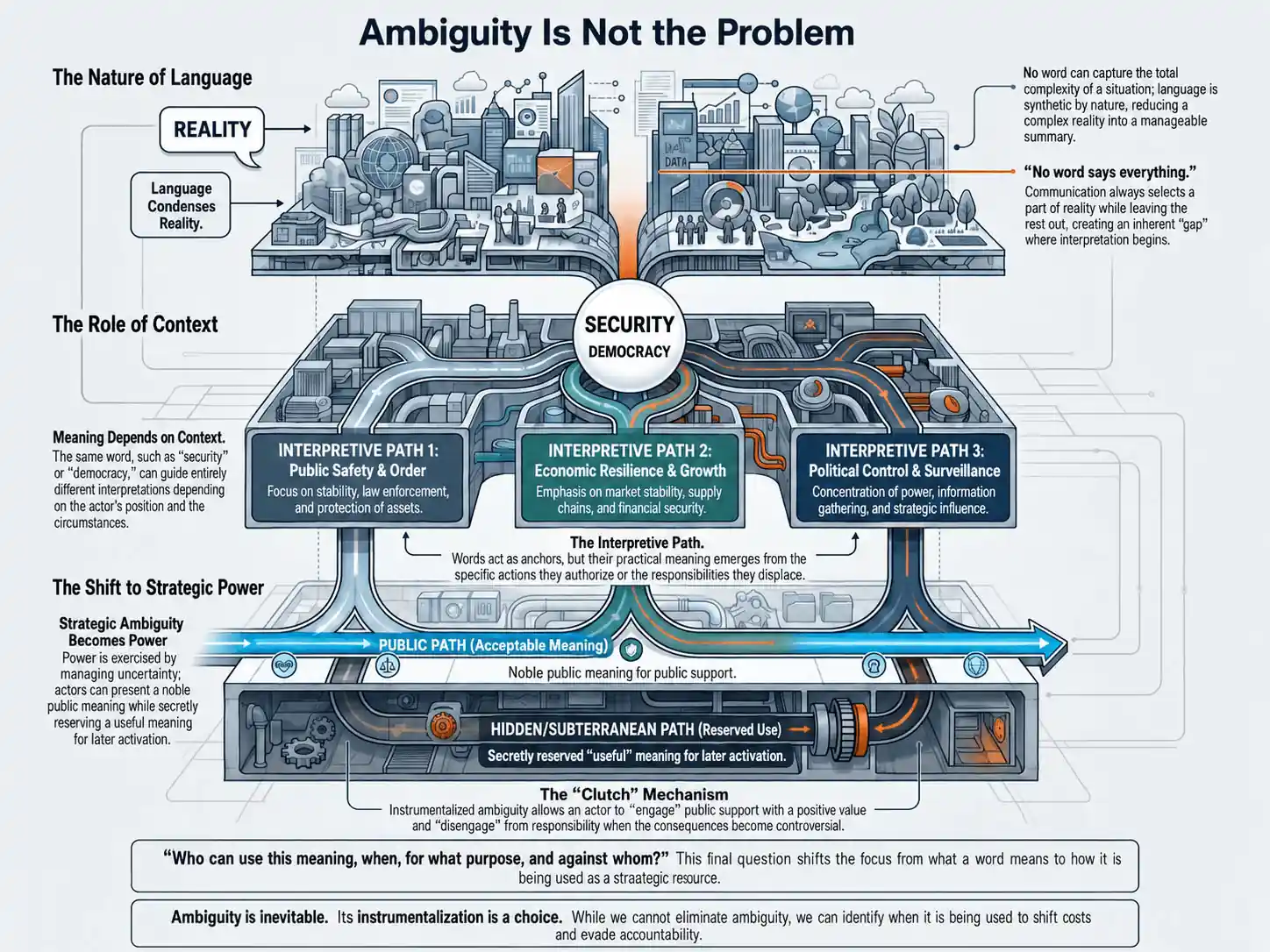
Humans carry a deep frustration with uncertainty. Instrumentalized ambiguity begins from this discomfort: we prefer a world of binary outcomes, “yes” or “no,” “legal” or “illegal”, “safe” or “dangerous.” In public discourse, we often demand absolute clarity, rigid procedures, clear responsibilities, and unambiguous categories. Any gray area is quickly treated as a systemic glitch, a legal failure, or a moral weakness in governance.
Why this matters: Ambiguity is not merely a communication problem. In public institutions, markets, law, and public safety, it can change who is able to act, who hesitates, who assumes risk, and who avoids responsibility. When sophisticated actors learn to preserve multiple interpretations and activate the most useful one later, uncertainty itself becomes a source of power.
Recognizing instrumentalized ambiguity therefore matters because it helps decision-makers distinguish necessary discretion from strategically exploited uncertainty, trace how risk and responsibility are redistributed, and reduce the chance that legitimate institutional flexibility becomes an advantage for actors with greater information, resources, or freedom of action.
That reaction is understandable but incomplete. Ambiguity does not begin with poorly written laws, evasive authorities, or disorganized institutions. It begins earlier, in language itself. No word says everything. Every sentence reduces reality, selects part of it, and leaves something out. Terms such as “security,” “rights,” “sovereignty,” “risk,” “order,” and “public interest” do not enter the world with a single, final meaning. Their meaning depends on context, institutional position, power relations, timing, and practical consequences.
Several scholars have already noticed parts of this problem. Organizational communication has discussed strategic ambiguity. Institutional theory has examined the distance between formal structures and real practices. Political science has shown that power also operates by keeping certain decisions from happening. These contributions matter because they show that ambiguity, decoupling, and managed inaction are not accidental curiosities. They are recurring features of institutional life.
The point here is not to pretend that these phenomena have never been studied. The contribution proposed in this article is more specific: to connect them into a practical vocabulary for public safety, organized crime, institutional risk, and decision-making under pressure.
The expression “instrumentalized ambiguity” names this broader practical configuration. It does not refer only to high-level strategy or deliberate political messaging. It refers to the operational use of ambiguity across different levels of action: strategic, tactical, legal, bureaucratic, communicational, economic, and criminal. Ambiguity becomes instrumentalized when an actor uses linguistic, institutional, procedural, or political openness to expand room for action, reduce exposure, produce fear, induce inaction, shift responsibility, or preserve unstated purposes.
In public safety, this is not an abstract theoretical concern. A criminal group may attach itself to the language of social rights to create narrative barriers against legitimate intervention. A public authority may invoke “sovereignty” both to resist external abuse and to avoid necessary cooperation against transnational networks. A company or bank may not politically endorse a given narrative but still block transactions, contracts, or relationships because it has internalized reputational, legal, or financial risk. In these cases, power does not need to issue a direct order. It changes the cost of action.
This is the silent paradox inside our most important institutions. Society demands total transparency and complete certainty, but complex systems do not operate that way. They depend on interpretation, context, discretion, incomplete information, and decisions under pressure. Ambiguity is therefore not always a defect. It can allow adaptation, proportionality, and contextual justice. But in the hands of sophisticated actors, from organized crime to economic intermediaries, political operators, and bureaucratic gatekeepers, ambiguity can become a powerful instrument for shaping decisions, delaying responsibility, producing fear, and reorganizing the field of action.
Ambiguity is not always a bug in the system. Sometimes, it becomes one of its most sophisticated features. The decisive question, therefore, is not how to eliminate all ambiguity. That would be impossible and dangerous. The real task is to recognize when ambiguity is being transformed into power.
When Words Leave Room for Power
Once we accept that no word says everything, the next question becomes practical: what happens inside the space that language leaves open?
In public life, that space is never empty. Institutions fill it with interpretation. Courts fill it with doctrine. Police officers fill it with situated judgment. Markets fill it with risk calculations. Political actors fill it with narratives. Criminal actors may fill it with opportunity.
This is why words matter so much in politics, law, markets, diplomacy, and public safety. They do not only describe problems. They organize what can be done about them.
The tension of our time lies in the gap between what language can say and what reality requires us to interpret. Ambiguity arises in this gap. In ordinary life, it creates misunderstandings. In institutional life, it creates discretion. In adversarial environments, it creates shadows where power can move.
This is the first argument: ambiguity does not begin in the legal system. It begins in language itself. Law, politics, finance, public safety, and diplomacy merely formalize struggles over meaning that already exist in communication.
The question, then, is not whether ambiguity exists. It always will. The question is who can manage it, preserve it, activate it, and benefit from it.
Not Every Gray Zone Is the Same
To navigate this terrain, we need to distinguish between three forms of ambiguity. Not all gray areas are the same.
Common ambiguity is the ordinary noise of human interaction. It appears when context is incomplete, when people use the same word differently, or when a sentence leaves room for more than one interpretation. There may be confusion, but not necessarily strategy.
Functional ambiguity is necessary for institutions. Laws use open concepts because no legislature can foresee every future case. Judges interpret because applying a rule is not the same as repeating its words. Police officers, managers, prosecutors, and regulators need some room for judgment because reality does not arrive in perfect administrative categories.
Without functional ambiguity, institutions become brittle. A completely rigid rule can produce injustice when the concrete case differs from the abstract situation imagined by the rule. Some ambiguity is the breathing room of justice.
The third form is different. It appears when an actor cultivates, preserves, activates, or exploits uncertainty as a resource. This may occur through a national security doctrine, a legal category, a police procedure, a compliance decision, a bureaucratic delay, a public statement, or a criminal narrative. In these cases, ambiguity is no longer only a condition of language or a necessary space for judgment. It becomes operational.
This does not require a grand strategy every time. A street-level actor may use ambiguous authority to pressure a resident. A bureaucratic office may keep responsibility unclear to avoid exposure. A company may overcomply because the risk category is undefined. A criminal network may use the language of community protection to obstruct scrutiny. The scale changes. The process remains similar.
This is not a call for absolute clarity, which would be both impossible and unjust. Functional ambiguity remains the breathing room of justice. The target is not uncertainty itself, but the asymmetry that allows some actors to exploit it while others are crushed by it.
Consider the milícias of Rio de Janeiro. They are not merely gangs. They are hybrid governance arrangements operating in the seams between legal and illegal authority. Many members are current or former state agents who understand the internal logic of policing, territorial control, administrative delay, political protection, and local fear.
They do not always need to break the law openly. Often, they stretch meanings, blur roles, and operate where oversight is weak and responsibility is diffuse. For them, ambiguity is not an obstacle. It is their native habitat.
Why More Rules Can Mean Less Control
There is a powerful illusion in public life: the belief that more rules, more procedures, and more precision automatically produce more control. This is the clarity trap.
Of course, clarity matters. Institutions need defined responsibilities, traceable decisions, explicit limits, and reviewable procedures. But the fantasy of total clarity can become dangerous when it ignores how complex systems react.
Hyper-specific rules often create predictable surfaces. When the state creates an exhaustive manual for every procedure, it may also provide adversaries with a map. Sophisticated actors study these rigid boundaries. They look for the seams: jurisdictional gaps, procedural delays, overlapping mandates, weak points of coordination, and areas where one agency’s authority ends before another’s begins.
A criminal procedure example makes this clearer. Public rules of evidence, deadlines, warrants, custody chains, and admissibility standards are essential to the rule of law. They protect citizens against arbitrary power. But in organized crime cases, sophisticated actors may learn how these rules operate in practice. They study recurring mistakes in evidence collection, predictable delays, weak documentation, jurisdictional gaps, and procedural vulnerabilities. The rule is not openly violated. It is read as a map.
This does not mean that safeguards should be weakened. That would be the wrong lesson. The problem is different: when institutions repeat the same procedural fragilities, adversaries learn where legality becomes operationally exploitable. The issue is not legal protection itself, but the predictable way institutions fail to sustain it with rigor, memory, and coordination.
In public safety, this often produces the error of transposition. Decision-makers take a model that appears clear in one context and apply it to another without reading the local regime of operation. A practice that works in a smaller, high-trust environment may fail in a fragmented metropolis. A procedure that stabilizes one territory may generate displacement in another. A rule that produces accountability in one institutional setting may produce paralysis in another.
When we impose rigid clarity onto complex and adaptive environments, we do not always create order. Sometimes, we create new schemes for sophisticated actors to exploit.
The state may believe it is reducing uncertainty. The adversary may experience the same decision as useful information.
This is one of the central paradoxes of governance under complexity: the same measure that increases institutional control in one dimension may increase exploitable predictability in another.
How Noble Words Carry Hidden Uses
One of the most sophisticated ways to exercise power through ambiguity is the strategy of coupling and decoupling.
Coupling happens when an actor attaches a project to a noble or widely accepted value: human rights, community protection, transparency, sovereignty, stability, innovation, legality, or public safety. This creates support. Different groups may agree with the same formulation for different reasons. One sees protection. Another sees control. Another sees opportunity. Another sees risk reduction.
Ambiguity allows them to move together, even when they are not supporting the same thing.
Two mechanical images help clarify this movement if we use them carefully.
The tire connects the vehicle to the ground. It transmits movement, absorbs irregularities, and allows direction. Ambiguity can do something similar in social systems. It connects language, decision, risk, interest, and institutional behavior. It allows movement across different audiences without requiring everyone to agree on the same meaning.
The clutch adds a second image. It allows engagement and disengagement. Ambiguity can also work this way. When the policy or category is useful, the actor engages it with a noble purpose. When the practical effect becomes controversial, the actor disengages from the result and retreats to the abstract value.
The negative consequence then becomes a misunderstanding, an implementation error, an excess by someone else, or an unintended outcome.
Whoever suffered the consequence is left with the facts. Who formulated the idea keeps the words.
The capacity to exploit ambiguity is not a trait of genius. It is often a function of position. Those with legal teams, time, money, and institutional cover can sustain multiple interpretations. Those who decide on the spot, with incomplete information and high exposure, usually cannot.
We see this in cases where criminal actors allegedly use the language of housing rights, community representation, or social vulnerability as a shield. By coupling themselves to legitimate grievances and vulnerable populations, they create a narrative barrier. State intervention can then be framed only as abuse, repression, or disregard for rights, even when the concrete situation involves coercion, territorial control, or illicit governance.
The value invoked may be legitimate. Housing rights matter. Community protection matters. Social vulnerability matters. The problem begins when a legitimate language is coupled to an undeclared operational use and later decoupled from its consequences.
This is the strength of instrumentalized ambiguity: it connects the declared purpose to the possible purpose while preserving an escape route.
When Fear Makes Others Cooperate
Modern power does not always need to issue direct commands. Often, it manages uncertainty so that others adjust their behavior on their own.
This is one of the most efficient forms of power: reorganizing the environment of risk so that people and institutions “choose” the conduct that the powerful actor wanted to induce.
The goal is not always action. Often, the goal is inaction.
A suspicion kept open, an accusatory category, a reputational risk, a possible sanction, or an ambiguous warning may not need to produce a formal conviction to succeed. It only needs to paralyze a public procurement process, suspend an investigation, prevent a policy from moving forward, block a competitor, delay a cooperation agreement, or make a public authority avoid signing a decision.
Ambiguity becomes a resource of immobilization.
This also explains defensive behavior in markets and institutions. A public manager or a bank executive does not need to receive an explicit order to delay a decision, block a transaction, or terminate a relationship. If the cost of action becomes unclear and potentially ruinous, avoidance may look like prudence.
A bank does not need to endorse a political accusation to act on it. If a client, territory, organization, or transaction becomes surrounded by reputational, legal, or sanctions-related uncertainty, the bank may block, delay, report, or terminate the relationship. The decision may be presented as compliance, prudence, or risk management. In practice, the institution has internalized the ambiguity and converted it into self-protective behavior.
This is why fear can be instrumentalized without a direct command. Once the object of risk is internalized, actors downstream begin to cooperate with the risk environment itself. They may not agree with the source of pressure. They may even distrust it. But they still adjust, because the cost of not adjusting becomes unclear and potentially ruinous.
This is defensive collaboration: not adhesion, not ideological alignment, and not explicit coercion. It is the behavioral effect of a threat that no one needed to state aloud.
Banks, funds, insurers, auditors, payment platforms, public agencies, and private companies may all react in this way. They may not agree politically with the narrative that created the risk. They do not need to. The risk itself becomes enough.
They block, restrict, report, suspend, avoid, delay, or overcomply.
This is especially relevant in environments involving sanctions, organized crime, terrorism designations, corruption risks, reputational exposure, compliance systems, and international cooperation. The actor who defines the risk does not need to control every institution downstream. The risk travels. Others internalize it. Decisions change.
Power, here, is not a hammer. It is atmospheric pressure. It makes certain choices too costly to sustain.
How to Read Ambiguity Before It Reads You
To protect institutions, we must stop asking only what a policy, category, or statement means. We must also ask how it functions.
Imagine a public authority announces a new risk category in the name of “security,” “sovereignty,” or “public interest.” The stated purpose sounds legitimate. It may even be necessary. But a defensive reading does not stop at the noble language. It follows the consequences.
First, ask what value is being used as a shield. Is the word “security” being used to protect citizens or also to expand discretion without clear review? Is “sovereignty” being used to resist external abuse or also to avoid necessary cooperation? Is “transparency” being used to improve accountability or to expose selected actors while protecting others?
Second, ask who benefits from the uncertainty right now. Someone may gain time, reduce exposure, suspend scrutiny, delay a decision, protect assets, block a competitor, or preserve multiple interpretations for later use. Ambiguity used as power usually produces an immediate winner, even when the public justification remains abstract.
Third, ask who will carry the burden when the context changes. Ambiguity is never cost-free. If the meaning shifts later, someone will pay for the uncertainty: a police officer at the operational edge, a public manager who must sign under risk, a bank that overreacts, a community trapped between criminal control and institutional hesitation, or a country exposed to external classifications it cannot fully control.
Fourth, look for the escape route in the wording. Can the actor return to the noble meaning after the practical effect becomes controversial? Can responsibility be displaced to implementation, misunderstanding, excess, local interpretation, or unintended consequences? If the same formulation authorizes action but protects the author from the result, the ambiguity deserves attention.
Fifth, ask whether the ambiguity increases or reduces accountability. Functional ambiguity requires explanation, records, and review. Ambiguity used as cover hides the trail. It allows movement without responsibility, pressure without command, and consequences without an identifiable author.
And finally, ask what matters most: against whom?
Every instrumentalized ambiguity has a target. Someone gains room to move. Someone else carries the consequences. These questions do not eliminate uncertainty. They reduce vulnerability. The goal is not to create a world without ambiguity. That would be impossible and dangerous. The goal is to prevent ambiguity from working consistently in favor of those with more power, more information, and lower exposure.
Governing Inside the Fog
The quest for total clarity is a mirage. In a complex and adaptive world, we will never eliminate gray zones. To try to erase them completely would create rigidity, injustice, and new predictable surfaces for sophisticated actors to exploit.
The strategic task of modern governance is more demanding. Institutions must accept that ambiguity will always exist, while demanding traceability for how ambiguities are interpreted, activated, and used.
Functional ambiguity needs justification. Strategic discretion needs records. Public categories need review. Risk classifications need accountability. Institutional decisions need memory. Otherwise, ambiguity stops being breathing room and becomes cover.
The next time you encounter a policy, legal category, public statement, or institutional framework that seems unclear, do not stop at the puzzle of meaning.
Ask the harder questions.
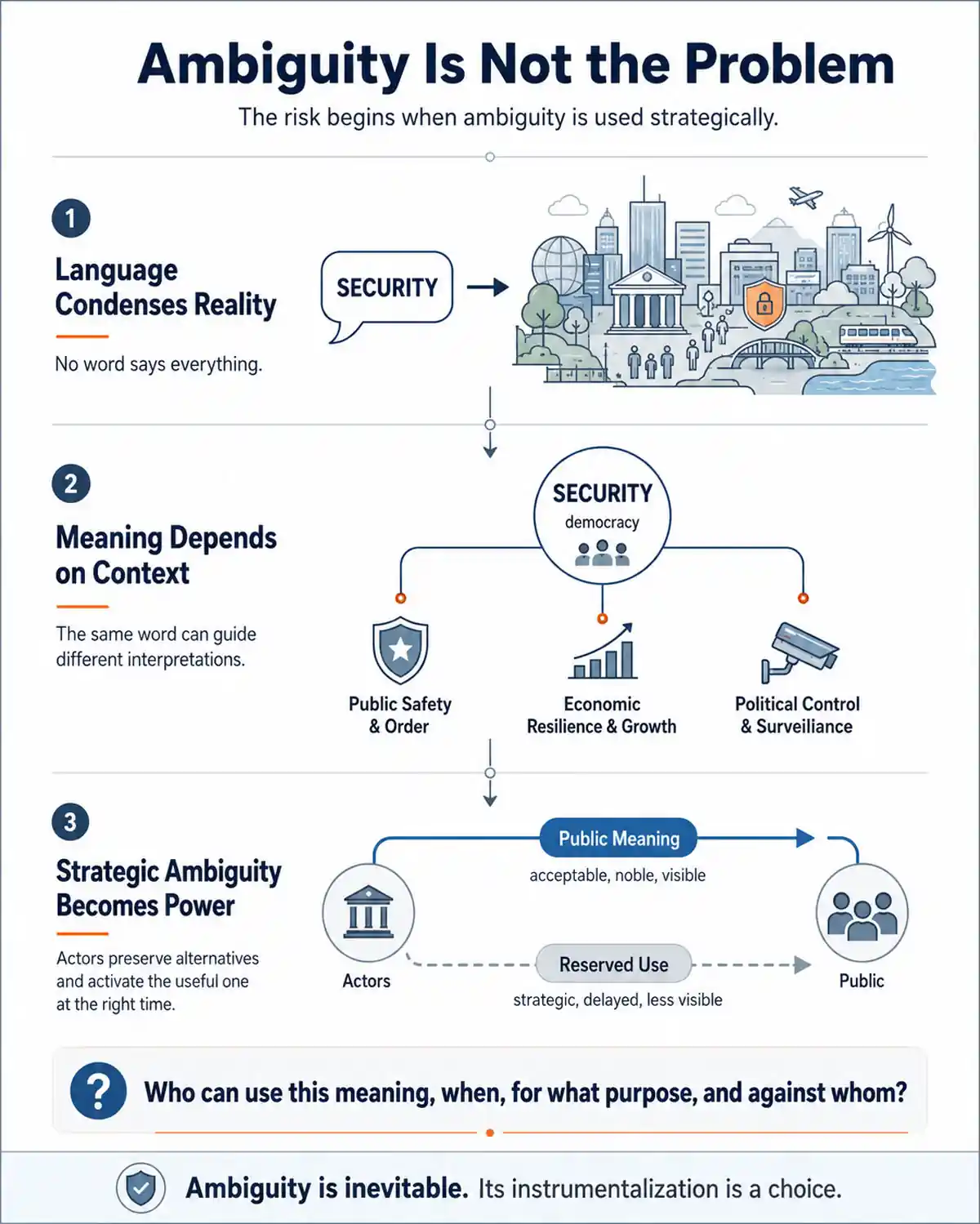
Who can use this ambiguity? When? For what purpose? And against whom?
This final question brings politics back into view. Ambiguity is never only an intellectual puzzle. It distributes power, risk, responsibility, and harm. It gives some actors room to move and leaves others carrying the cost.
Total clarity is impossible. Defensive reading is not.
In a world where words organize risks, block decisions, authorize interventions, and protect diffuse responsibility, learning to read ambiguity is a form of intellectual and institutional self-defense.
The infographic below summarizes the core movement of the argument: language condenses reality, context changes meaning, and strategic ambiguity becomes power when actors preserve alternative uses for later activation.
Related academic conversations: Eric Eisenberg on strategic ambiguity; John W. Meyer and Brian Rowan on institutional decoupling; Peter Bachrach and Morton Baratz on nondecision and the second face of power.