

Analytical friction is the deliberate pause that helps public safety leaders think before acting in systems that learn. It does not mean paralysis, hesitation, or bureaucratic delay. It means creating enough structured reflection to avoid predictable errors. In the fight against adaptive organized crime, decisions often occur under pressure, fear, political urgency, and incomplete information. The demand for immediate action is real. But when institutions move too quickly from data to operation, they may miss how the criminal system will respond, adapt, and learn.
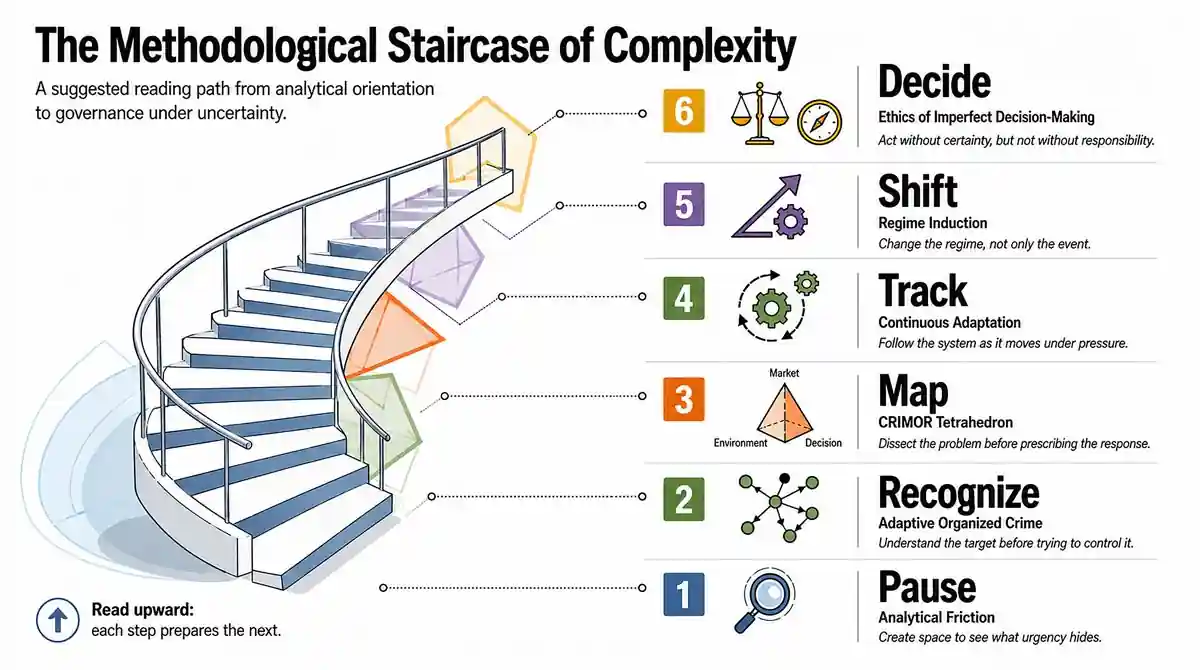
This first article opens a series inspired by the Methodological Staircase of Complexity. The series does not simply list concepts from Countering Adaptive Organized Crime. It follows a reading path. Each step prepares the next: pause, recognize, map, track, shift, and decide. The goal is to move from urgency to judgment, from isolated reaction to systemic understanding, and from repeated enforcement to more adaptive public safety.
The path begins with a simple idea: before trying to control a system, we need to create enough room to see it. Organized crime learns from repeated state action. For that reason, public institutions need more than courage, resources, and legal authority. They need a disciplined way to ask better questions before action teaches the adversary.
Why the Series Begins with a Pause
The first original move of this series is methodological. It does not begin by asking which criminal group should be targeted, which law should be strengthened, or which operation should be repeated. It begins with a pause. That choice matters because many public safety failures do not arise from inaction. They arise from action taken too quickly inside a poorly understood system.
In Countering Adaptive Organized Crime, analytical friction is treated as a practical safeguard against urgency becoming blindness. The point is not to delay action indefinitely. The point is to create a short, disciplined interruption between pressure and response. That interruption allows decision-makers to ask whether the problem is being read as a system or merely as a visible event.
This is why the staircase starts with Pause before Recognize, Map, Track, Shift, and Decide. If the first step is skipped, the rest of the path becomes fragile. A leader may try to map the wrong problem, track the wrong indicators, shift the wrong regime, or decide from a control narrative rather than from systemic judgment.
This pause also protects institutions from becoming predictable. Without analytical friction, urgent action can become repeated action; repeated action can become routine; and routine can become exploitable predictability. What appears to the state as responsiveness may appear to the adversary as a pattern to study, anticipate, and exploit.
Most importantly, the pause prevents decision-makers from ignoring the most difficult dimension of the system: human motivations and decision-making. Criminal systems persist not only because they have markets, networks, weapons, or territory. They persist because people decide, tolerate, fear, comply, cooperate, consume, recruit, resist, or remain silent. If this dimension is skipped, the state may attack the visible structure while leaving the human conditions of regeneration intact.
A Staircase for Reading Adaptive Crime
The staircase begins with Pause, through analytical friction. This first step creates space to see what urgency hides. Public safety decisions often begin with pressure: a violent event, a territory in crisis, a media demand, or a political expectation. Analytical friction slows the automatic movement from data to action just enough to test assumptions.
The second step is Recognize: adaptive organized crime. Before trying to control the target, we need to understand that it is not passive. Criminal systems observe, react, and reorganize. They learn from operations, legal reforms, patrol routines, and institutional gaps.
The third step is Map: the CRIMOR Tetrahedron. Organized crime must be read through interconnected dimensions: illicit markets, adaptive criminal networks, enabling social and institutional environments, and human motivations and decisions.
The fourth step is Track: continuous adaptation. Once the system is mapped, decision-makers must follow how it moves under pressure. Did the intervention disrupt the system, or did it merely produce displacement, concealment, or functional substitution?
The fifth step is Shift: regime induction. The goal is not only to produce events, arrests, or seizures. The goal is to change the pattern that allows the system to regenerate.
The sixth step is Decide: the ethics of imperfect decision-making. Public safety leaders must act without certainty, but not without responsibility.
Thinking Before Acting
Analytical friction is the first step because it protects decision-makers from the illusion that urgency automatically clarifies reality. Sometimes urgency reveals the problem. Sometimes it narrows attention so much that institutions attack only what is visible.
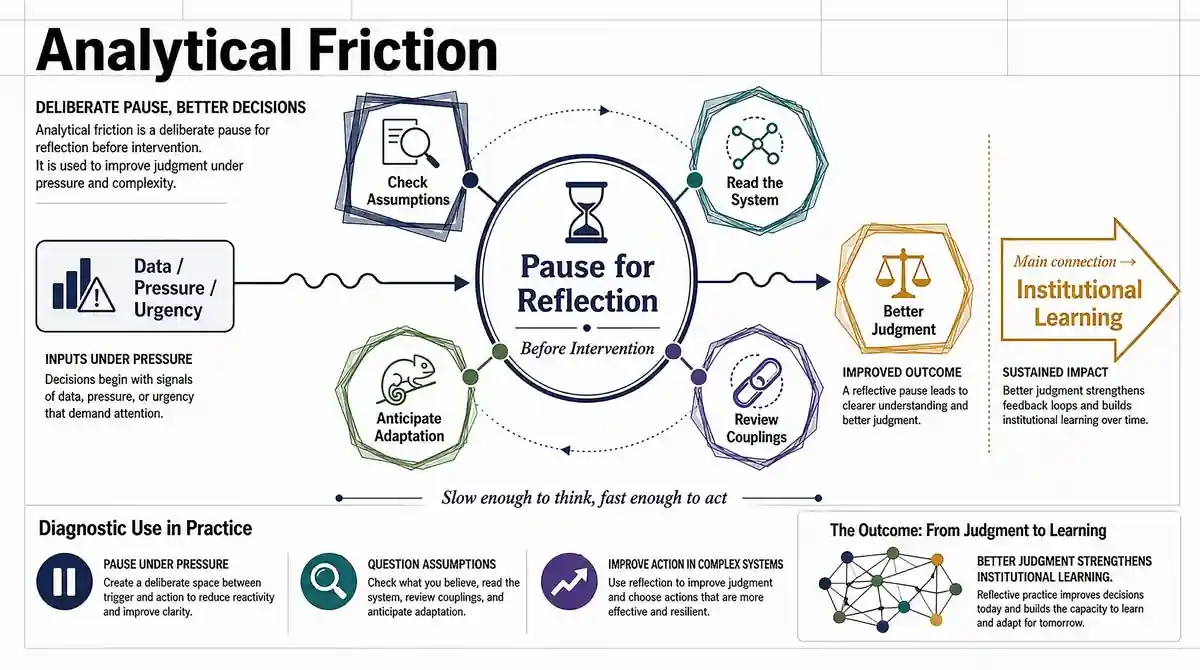
Before acting, decision-makers should ask, “What are we assuming?” Which dimension of the system are we targeting? Is this an illicit market problem, a network problem, an enabling environment problem, or a human decision problem? Which coupling sustains the criminal function? What may be displaced? What might the adversary learn from our action? Which indicators will show adaptation rather than only activity?
These questions do not eliminate uncertainty. They improve judgment under uncertainty. They also force institutions to look beyond the most visible target and examine the couplings that allow a criminal system to recover after pressure.
This is very different from a control narrative. A control narrative promises that the state can dominate the problem through force, command, or technical precision. Analytical friction recognizes that organized crime adapts. It does not abandon action. It makes action more responsible.
This series will now follow the staircase. The next article will examine adaptive organized crime: why criminal systems learn from the state, and why public safety needs to understand the target before trying to control it.