

Criminal learning helps explain why violence persists even when the state expands resources, laws, technologies, and high-impact operations. The problem is not only a lack of action. It also lies in the difference between how organized crime adapts and how the state interprets its own results. This is where The Crime That Learns offers a useful lens: when public responses become repetitive, criminal networks observe, test, absorb impacts, and reorganize their operations.
In the previous article, we discussed the need for adaptive public security. The next step is to understand how the criminal system actually works. If organized crime does not operate as a sequence of isolated events, but as an interaction among markets, networks, environments, and human decisions, then public intervention must consider how that system learns.
When we speak of The Crime That Learns, we do not mean that criminal organizations learn like a person, a school, or a formal institution. The idea is different. Learning occurs in a distributed way: a route changes, a point of sale moves, an intermediate leader assumes a new role, communication adapts, or an institutional opportunity is exploited. Often, there is no sophisticated central plan. There is practical, rapid adjustment oriented toward survival.
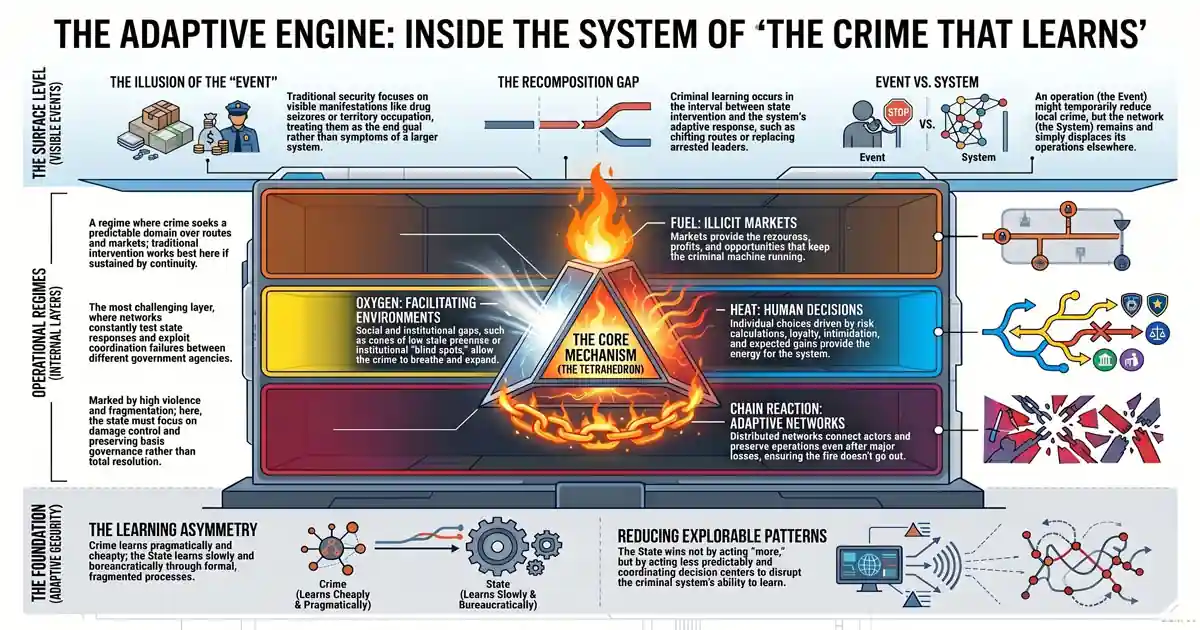
The Crime That Learns and the Mistake of Confusing Events with Systems
One of the main limitations of traditional public security is that it treats visible manifestations of crime as if they were the system itself. Drug seizures, arrests of leaders, territorial occupations, and major operations can produce immediate effects. However, when these actions do not consider the recomposition capacity of criminal networks, their results tend to remain temporary.
The event attracts attention. The system remains.
An operation may reduce drug circulation in one area, but shift the market elsewhere. The arrest of a leader may weaken a faction in the short term, but also open space for internal disputes, fragmentation, or functional replacement. Repression of one route may stimulate logistical diversification. For this reason, the decisive question is not only “what was interrupted?” but “what kind of reorganization may this intervention provoke?”
This question changes the focus of public action. Instead of measuring only immediate impact, decision-makers begin to observe indirect effects, displacement, substitution, and new patterns of coordination. Criminal learning appears precisely in this interval between state intervention and the adaptive response of the system.
Criminal Learning, the Tetrahedron, and Recomposition Capacity
To understand this process, the Tetrahedron of Criminal Organizations offers a useful analytical framework. It organizes the phenomenon into four interdependent dimensions: illicit markets, adaptive criminal networks, the facilitating social and institutional environment, and human decisions.
Illicit markets provide resources, profits, and opportunities. Criminal networks distribute functions, connect actors, and preserve operations even after losses. The social and institutional environment creates gaps, tolerances, fear, silence, and areas of weak state presence. Human decisions sustain adherence, cooperation, loyalty, intimidation, risk calculation, and expectations of gain.
These dimensions do not operate in isolation. A profitable market attracts networks. Networks exploit vulnerable environments. Vulnerable environments alter individual decisions. Individual decisions feed markets and strengthen networks. This circuit allows crime to survive punctual interventions.
The metaphor of fire helps visualize the problem. For fire to continue, flame is not enough. It requires fuel, oxygen, heat, and a chain reaction. In organized crime, illicit markets function as fuel; facilitating environments function as oxygen; human decisions function as heat; and adaptive networks sustain the chain reaction. Attacking only one dimension may reduce the intensity of the problem for some time, but it rarely eliminates its capacity for recomposition.
The Crime That Learns and Operational Regimes
Criminal learning also helps explain why not every territory requires the same response. In some contexts, crime seeks local stabilization, with relatively predictable control over routes, points of sale, markets, and relationships. In these cases, traditional interventions may produce better results when supported by qualified information and institutional continuity.
In other contexts, continuous adaptation predominates. Networks change routes, redistribute functions, test public responses, and exploit coordination failures. Here, intervention tends to produce temporary effectiveness. The state must alternate strategies, revise indicators, reduce predictable patterns, and anticipate displacement.
There are also situations of episodic rupture, marked by violent disputes, territorial instability, fragmentation of leadership, and rising lethality. In these scenarios, the priority may not be to solve the entire criminal dynamic immediately, but to contain harm, reduce deaths, prevent escalation, and preserve minimum conditions for governance.
These operational regimes are not fixed labels. They are forms of functioning that may change over time. Recognizing them helps avoid the mistake of applying the same response to every case. A strategy suited to local stabilization may fail under continuous adaptation. A response designed for continuous adaptation may be insufficient in a situation of episodic rupture.
From State Repetition to Institutional Learning
The central issue, therefore, is not whether crime learns. It does. The more relevant question is whether the state can learn with enough legitimacy, speed, and coordination to reduce the adaptive advantage of criminal networks.
This is the key asymmetry. Crime learns in a pragmatic, distributed, and low-cost manner. The state learns in a slower, more formalized, bureaucratic, and fragmented way. These limits are part of democracy and should not simply be eliminated. The challenge is to create an institutional architecture that learns better without abandoning legality, fundamental rights, accountability, and public control.
For this reason, The Crime That Learns should not be read as a fatalistic message. Crime is not invincible. It adapts because it finds patterns, failures, markets, and opportunities. When the state understands these patterns, reduces its exploitable predictability, and coordinates its decision centers more effectively, it begins to dispute not only territory or isolated events, but the very learning capacity of the criminal system.
More intelligent intervention begins when we stop asking only “how can we act more?” and begin asking “how can we act in a less predictable, more coordinated way, compatible with the real operational regime?”. This shift does not promise a magic solution. But it allows for more consistent public decision-making, capable of confronting not only the crime that appears, but The Crime That Learns.
Regards
Sergio Senna