

Legislative architecture for complex challenges
Legislative architecture explains why governing complex systems requires managing risk, distributing responsibility, and abandoning illusions of total control.

Legislative architecture explains why governing complex systems requires managing risk, distributing responsibility, and abandoning illusions of total control.

Linear blindness kills. Beyond simple causality, we engineer resilient laws for adaptive threats. Master systemic rigor with our research.

Stop legislating into the void. Use Legislative Architecture to engineer resilient systems and anticipate unintended institutional risks.

Social complexity reveals why interventions shift problems instead of solving them. Understand adaptive governance in complex systems.

Beyond the text of the law: Discover the role of the Perceptual Base of Legislative Science in applied behavior analysis…

Linear tactics fail against organized crime. Master systemic governance and asymmetry exploitation with the (S) Lab analytical framework.
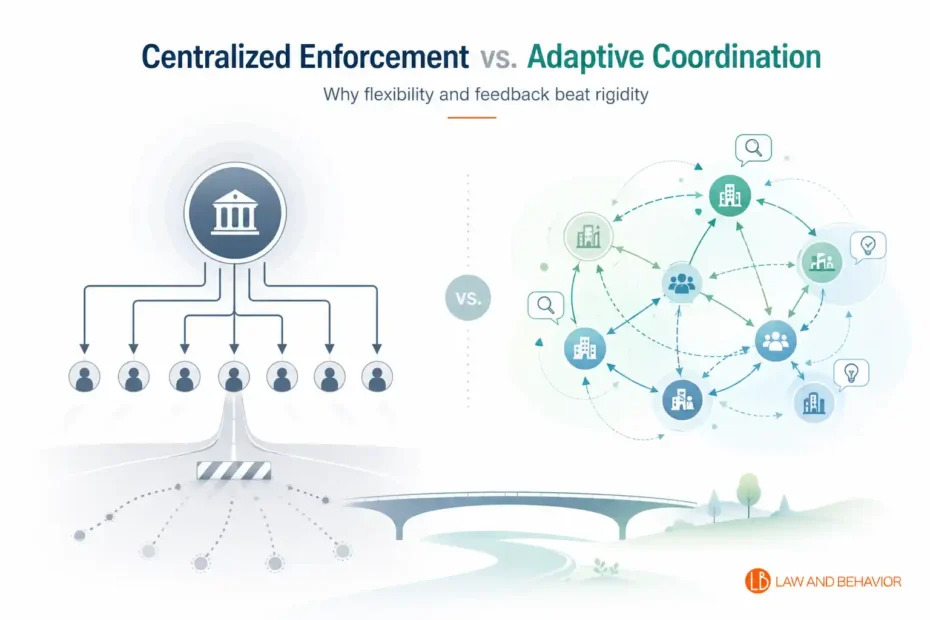
Centralized enforcement works only when command supports coordination, feedback, local intelligence and institutional learning.

Legislative Architecture: Replacing static codes with adaptive systems to build resilient, effective governance.

Beyond Pinocchio’s nose: The dangers of using unscientific methods in public safety and the importance of ethical behavioral analysis.

Violence isn’t just physical. Learn to identify the 5 dimensions of violence—from symbolic to decisional—that impact our daily lives.

False positives and decisional risks: the limits of FAST technology and why the State cannot automate the reading of human…