

As a public safety leader, you likely know the hollow “whack-a-mole” sensation that follows a high-profile operation. You authorize the surge, the arrests hit the evening news, and for a few days, the “hot spot” on your digital map turns a peaceful blue. Then, the resources shift, and the market reopens. The violence returns, often with younger, more aggressive faces.
You’ve done everything “right” according to the traditional playbook, yet the results evaporate. In Brazil, street-level officers have a name for this frustration: Enxugar Gelo—literally, “wiping ice.” You are working yourself to the bone, using the best mops available, but you are merely containment-focused, mopping up a puddle while the block of ice continues to melt and regenerate.
The reason for this failure is fundamental: we treat organized crime as a static target, a puzzle to be solved. In reality, it is a Complex Adaptive System. It isn’t a building you can knock down; it is a learning organism that observes your intervention, anticipates your routines, and reorganizes to exploit the very “defensible” decisions you make to satisfy the public.
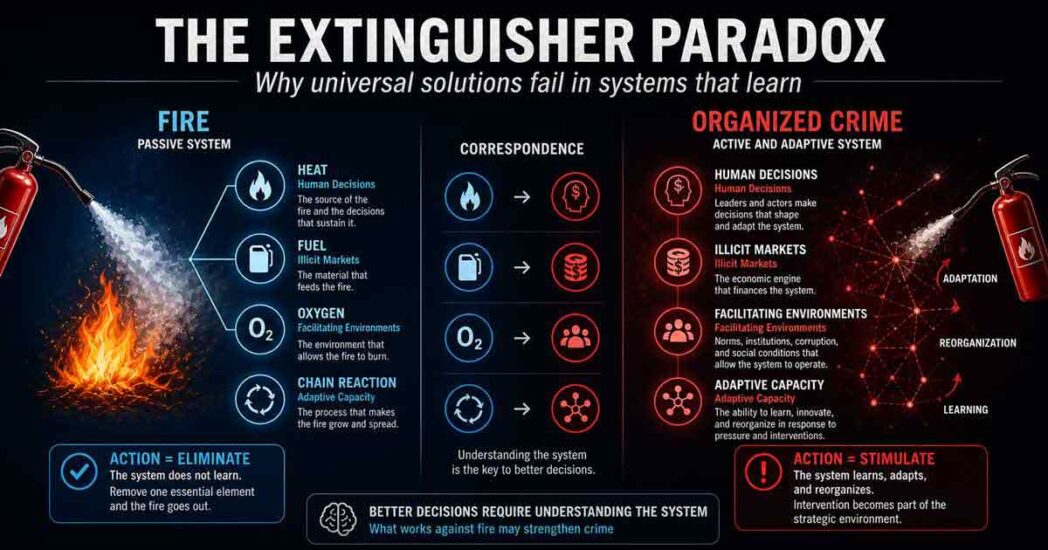
Takeaway 1: The “Extinguisher Paradox” (Fire Doesn’t Learn, But the Cartel Does)
In traditional emergency management, we rely on linear logic. Take a fire, for instance. A fire requires heat, fuel, and oxygen. If a firefighter removes any one of those elements, the system collapses. Fire is a “passive system.” It doesn’t move to a different neighborhood because it saw the fire truck coming, nor does it bribe the fire marshal to look the other way.
Organized crime follows a different set of rules. When we apply that same linear “extinguisher” logic—arresting a kingpin to stop the network—we often trigger what is known as the Extinguisher Paradox.
“Against fire, action that removes one essential element produces elimination… Against organized crime, the same linear logic may produce stimulation. Intervention becomes part of the adversary’s strategic environment. Pressure teaches, displaces, and sometimes strengthens the system.”
When you “extinguish” a node in a criminal network, you are not simply removing a part. You are also providing the remaining actors with free intelligence. You teach them which routes have become legible to the state, which members are compromised, and which behaviors triggered detection. In many cases, state pressure acts as a selective evolutionary force: it removes the sloppy, noisy, and exposed criminals while leaving behind a quieter, more resilient, and more sophisticated adversary. This is why an adaptive crime strategy must treat every intervention not only as enforcement but also as information that the criminal system can use to learn.
Takeaway 2: Mapping the CRIMOR Tetrahedron — The System in Motion
To stop “wiping ice,” we must move beyond viewing organized crime through a single lens like “drug sales” or “gang violence.” The CRIMOR Tetrahedron maps the four dimensions that sustain these systems:
- Illicit Markets and Resources: The economic engine—drugs, weapons, and territory.
- Adaptive Criminal Networks: The flexible coordination that allows for the replacement of actors and routes.
- Facilitating Social Environments: The institutional gaps, corruption, and community silence that make the crime viable.
- Human Choices and Motivations: The individual decisions made by offenders, victims, and bystanders.
The base of this tetrahedron—Human Choices—is what I call “institutionally orphaned.” Police think it’s a social service problem; schools think it’s a family problem; families are too terrified to act. Because no one “owns” the perceptions of the youth on the corner or the fear of the shopkeeper paying extortion, this dimension remains the anchor that allows the system to regenerate.
These dimensions are not isolated; they are interdependent. If you seize five tons of cocaine in the market dimension, the adaptive network may simply activate a redundant route. If you have not addressed the facilitating environment, such as the corrupt port official, or the human-choice dimension, such as the economic desperation of drivers, the tetrahedron remains stable. The system does not break; it just shifts its weight. That is why an adaptive crime strategy must look at the tetrahedron as a moving configuration, not as a checklist of separate problems.

Takeaway 3: The Danger of Being “Defensible” (How Legality Breeds Predictability) under Adaptive Crime Strategy
Public safety leaders operate under a “Recurring Decision Chain.” Because you are accountable to the media and the courts, you are pressured to make defensible decisions. These are legally safe, administratively justifiable, and easy to explain to a reporter (e.g., “We increased patrols by 20%”).
The grit of the reality is this: that which is most easy to justify is most easy for a criminal to predict. If your raids always happen at 6:00 AM on Thursdays because that’s when your warrants are processed and your personnel are on shift, you have created Exploitable Predictability.
This creates a Learning Asymmetry:
- The State repeats what is “standard” and “defensible.”
- The Adversary learns and adjusts to what has become predictable.
Your institutional regularity is operational gold for the adversary. They don’t need to outgun you; they just need to listen for the predictable clatter of boots on the pavement and hide the product until you go back to the precinct to file the paperwork.
Takeaway 4: The Technocratic Illusion (Why Heat Maps Are Strategy’s Ghost)
Modern policing is obsessed with “data-driven” results, but we must distinguish between Restricted Complexity (data and algorithms) and General Complexity (open, ambiguous systems).
Relying solely on heat maps leads to the Technocratic Illusion. A heat map is essentially a “ghost of the past”—it tells you where crime was. In an adaptive system, a heat map is a signal that tells the criminal exactly where not to be tomorrow.
If you see a drop in reported crime on your dashboard, is it because you deterred the criminals, or because they’ve successfully intimidated the community into silence? Strategy requires interpreting the system’s “General Complexity”—community fear, the speed of leadership replacement, and the “why”—not just counting the dots on a screen.
Takeaway 5: Trading Body Counts for “Adaptation Sensors”
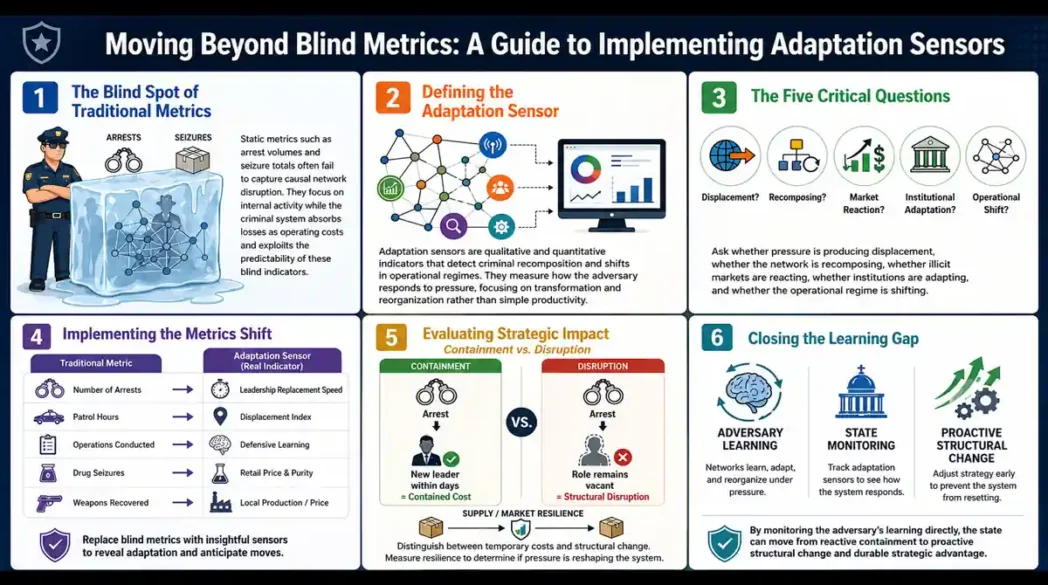
Traditional metrics like arrest totals are often poor indicators of systemic disruption. To understand if you are actually winning, you must shift to Adaptation Sensors.
| Traditional Metric | Adaptation Sensor (Systemic View) |
| Number of Arrests | Leadership Replacement Speed: If a new leader is active in under 48 hours, you haven’t “disrupted” anything; you’ve just subsidized the organization’s HR department by forcing a promotion. |
| Drug Seizures | Retail Price Stability: If prices don’t spike after a “record seizure,” your operation didn’t touch the actual supply; the network absorbed the loss as a cost of doing business. |
| Patrol Hours | Displacement Index: Did the crime stop, or did it just move two blocks over to a jurisdiction that is less “hot”? |
| Weapons Recovered | Black Market Price Variation: Does the cost of an illegal firearm increase after a crackdown? If not, the supply chain is still open. |
Takeaway 6: “Analytical Friction” as a Leadership Tool
In a crisis, the pressure to “do something” is overwhelming. However, in complex systems, rapid reactivity usually leads to predictable errors. You need Analytical Friction—a deliberate, structured pause to improve the quality of judgment.
Imagine a Monday morning briefing where a major operation is proposed. Before the green light, the team must move through this four-step loop:
- Check Assumptions: Are we acting on where the crime was last week, or where it’s moving?
- Read the System: Is this network in a state of “continuous adaptation”?
- Anticipate Adaptation: How will they change their communication or lookouts the moment we roll the first cruiser?
- Review Couplings: Are we hitting a “brittle” link, or just stretching an “elastic” one?
The Briefing Room Scenario: Instead of asking, “How many targets do we have?”, the leader asks: “If we take out these three lieutenants today, who replaces them by Wednesday, and what will they have learned from our tactical entry?” This is the discipline behind an adaptive crime strategy. Analytical friction moves the institution from being merely reactive to becoming regime-sensitive. It makes leaders slow enough to think, but still fast enough to act with precision.
Takeaway 7: Managing “Adaptive Elasticity” vs. Brittle Couplings
Criminal systems possess Adaptive Elasticity—the capacity to bend and reorganize without losing core functions. They achieve this through Functional Substitution.
There is a vital distinction here: Adaptive Elasticity is the system’s capacity to survive; Functional Substitution is the mechanism. If you arrest the network’s primary money-launderer, the system doesn’t stop moving cash. It substitutes that function—perhaps moving the ledger to an encrypted cloud or using five smaller “smurfers” instead of one “accountant.”
To break a system, you must find Critical Couplings—the rare points where the system is brittle. These might be a specific, non-fungible corruption link in a port or a unique logistics provider that cannot be easily replaced. If you hit elastic couplings, you are just “wiping ice.” If you hit critical couplings, you induce a Regime Shift.
Conclusion: From Containment to Regime Induction against Adaptive Crime Strategy
The shift from “wiping ice” to systemic strategy requires moving beyond containment. While containment—the temporary suppression of violence—is often necessary to prevent the public from “drowning,” it is a palliative measure, not a cure.
Real success is found in Regime Induction: changing the underlying patterns of how the illicit market, the network, and the community interact. This requires a commitment to three things:
- Conceptual Clarity: Using a shared vocabulary to describe how systems learn.
- Systemic Fidelity: Refusing to simplify the problem just to make it “politically communicable.”
- Decision Relevance: Ensuring every analysis helps you make a better choice under uncertainty.
We must stop being the most predictable actors in the system. The challenge remains: How can public institutions act more intelligently within criminal systems that learn, adapt, and reorganize under pressure?
The answer begins by admitting that the ice is melting. Adaptive crime strategy starts when we stop just wiping the surface and begin reading the temperature of the room.
This post is also available in pt_BR.