

The 93 percent myth is one of the most persistent distortions in nonverbal communication. It usually appears as the claim that words matter only 7%, while tone of voice and body language carry almost everything else. That is not what the original studies showed.
Let’s address the best-known and most widespread myth about body language and non-verbal communication.
What is the 93 percent myth in nonverbal communication?
♦ FACTS
- It’s one of the first rules you learn;
- It is an argument used to value non-verbal content;
- Experts never tire of repeating it.
When I started to become interested in the topic, this was one of the first rules I learned.
I have seen this statement in many books and heard it from many “experts”. These people claimed that “scientific studies ” proved this percentage. But do you know the origin of the 7-38-55 rule?
When I started to become interested in the topic, this was one of the first rules I learned.
I have seen this statement in many books and heard it from many “experts”. These people claimed that “scientific studies” proved this percentage. But do you know the origin of the 7-38-55 rule?
Click to see the reasons for my concern about this
However, I have always been bothered by this story about 93% non-verbal communication for two reasons:
1. It seemed to me that if the meaning of words represented only 7% of what was wanted to be communicated, a good observation of non-verbal behavior would be enough to get a very close idea of communication.
If this ratio of 93% non-verbal to 7% verbal is proven – verbalization could even (in a more extreme scenario) be placed in the background, which does not happen in real life…
2. I also observed that communication changed a lot according to the context in which it occurred (including non-verbal communication). In welcoming environments, for example, words were very important and understood with care.
On the other hand, in hostile environments, words were chosen carefully, and the number of gestures people made also decreased if they started to be careful with what they said or increased if they entered a “persuasive mode”.
This concern of mine led me to search for the origin of the much talked about 7-38-55 rule of sovereignty of the 93% nonverbal communication, to which I will dedicate this article.
♦ IMPORTANT!
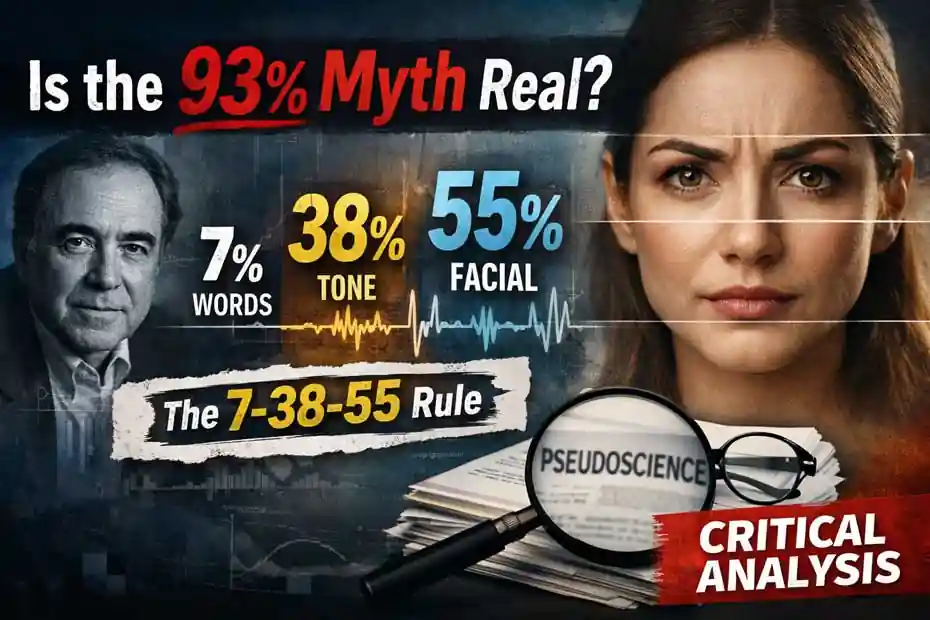
What does this rule say?
Supposedly,
- 7% of communication would be attributed to the verbal component (its meaning),
- 38% to the vocal component (in this specific case, the tone of the voice ) and
- 55% to the facial component (facial expression).
Hence, adding 38+55 results in the magical body language proposed by some that non-verbal communication is responsible for 93% of all communication.
In this article, we will show the origin of this myth and reflect on the fragility of this conclusion.
How did the 7-38-55 rule become the 93 percent myth?
The 7-38-55 rule is based on two studies carried out by Albert Mehrabian (pictured above) in 1967:
♦ TIP – These are Mehrabian’s studies :
- Decoding of Inconsistent Communications and
- Inference of Attitudes from Nonverbal Communication in Two Channels
Let’s look at the second (more robust) study, which aimed to compare the relative importance of word meaning, tone of voice, and facial expression, the results of which contain Mehrabian’s conclusion about the prevalence of facial expression for interpreting the message.
What was Mehrabian’s methodology in this study on the non-verbal 93% of communication?
Below, I present a summary of the methodology of how the conclusion was reached that the meaning of words matters in only 7% of communication:
♦ FACT
The voices of three women were recorded saying the word “maybe” with an intonation that meant:
- That the person might like;
- That the person does not show appreciation or aversion (neutrality);
- That the person might not like.
The words were recorded twice, by the three women, making a total of 18 enunciations of the word “perhaps”, with the intonations described above.
These recordings were presented to 17 listeners (all also women) who had to judge, upon hearing each word, whether the communication was positive, neutral, or negative, on a scale presented in the study.
Photographs of three models were also taken with facial expressions that could mean the following:
- Who liked something;
- That is neutral in relation to something;
- That he didn’t like something.
Photos and recordings were combined
The voices and photographs were paired in a certain way (which we are not interested in at the moment) described in the original study, so that the evaluators could see a photo with a positive facial expression and hear a negative, or neutral “maybe”, etc.
♦ FACT
After doing the mathematics of the result, the 7-38-55 rule was arrived at for the verbal, vocal and facial components, respectively (conclusion expressly written on page 252 of the Journal of Consulting Psychology , 1967, vol. 31, n3).
I imagine that, at the time, Mehrabian had no idea how much confusion this study would create. So, even after his various attempts to explain the limitations, the myth was already created.
Why does the 93 percent myth distort communication analysis?
When this study was published without its major limitations being made explicit, it paved the way for one of the best-known myths about nonverbal communication.
This myth was established without any plausible explanation about its origin and repeated to thousands of people who do not have, and possibly will never have, access to the original studies to verify the veracity or exaggeration of these statements.
♦ Take a test!
If you want to know if someone is truly an expert in nonverbal communication, ask how the 7-38-55 rule came about and who was responsible for it!
By the way, check out my tips for being a real body language expert.
It only takes a little common sense to see that, at the very least, this rule is greatly exaggerated. Furthermore, there are several limitations to the applicability of these studies in real life. These limitations are largely ignored, especially if the rule is applied to a context other than that in which it was constructed.
Let’s look at some other reasons to question this type of “ magic body language ” in nonverbal communication:
- The study used female voice recordings from a single opportunity. Would this be a natural context?
- The studies refer to the positive versus negative perception of the message. And the other possibilities? What about the other degrees of attitude? And what about doubt (which is not neutrality), for example?
- The voices were only female. Will the same happen if the voices are male? What if the evaluators were male? Would the result be different? The study does not address this!
- How would other types of non-verbal communication , for example, body posture, position relative to other objects such as tables, obstacles, etc., influence communication? This was not addressed in the study!
There are other aspects to poithat can be raised, but the ones I point out above are more than enough to call into question the all-powerful rule 7-38-55.
In another article, I will bring information from other studies from which we can reach different conclusions. For this reason, we must evaluate the limitations and possibilities of any scientific study, as it is only safe to use knowledge within these limits. We must be cautious about hasty (or ill-intentioned) generalizations.
The most incredible thing is the following. A feat in itself…..
In my opinion, this number of subjects is not enough for such generalization. That’s not enough! In fact, it’s absurd!
♦ TIP
There is no doubt that non-verbal communication is important! However, don’t be fooled by the “siren song”…
♦ TEST
The next time someone tells you this, ask if the person knows where it came from. If she doesn’t know, be careful with the type of knowledge she is teaching you! Discover our courses on body language.
Like it or not, there is unanimity in the scientific community about the myth of the 7-38-55 rule. See this other article on the topic: Let’s Dump the 55-38-7 Rule
See our article about Eye Detect on Reality Amor: truth or consequence , announced by Netflix.
You can find our other articles on NLP here: Neurolinguistic Programming